

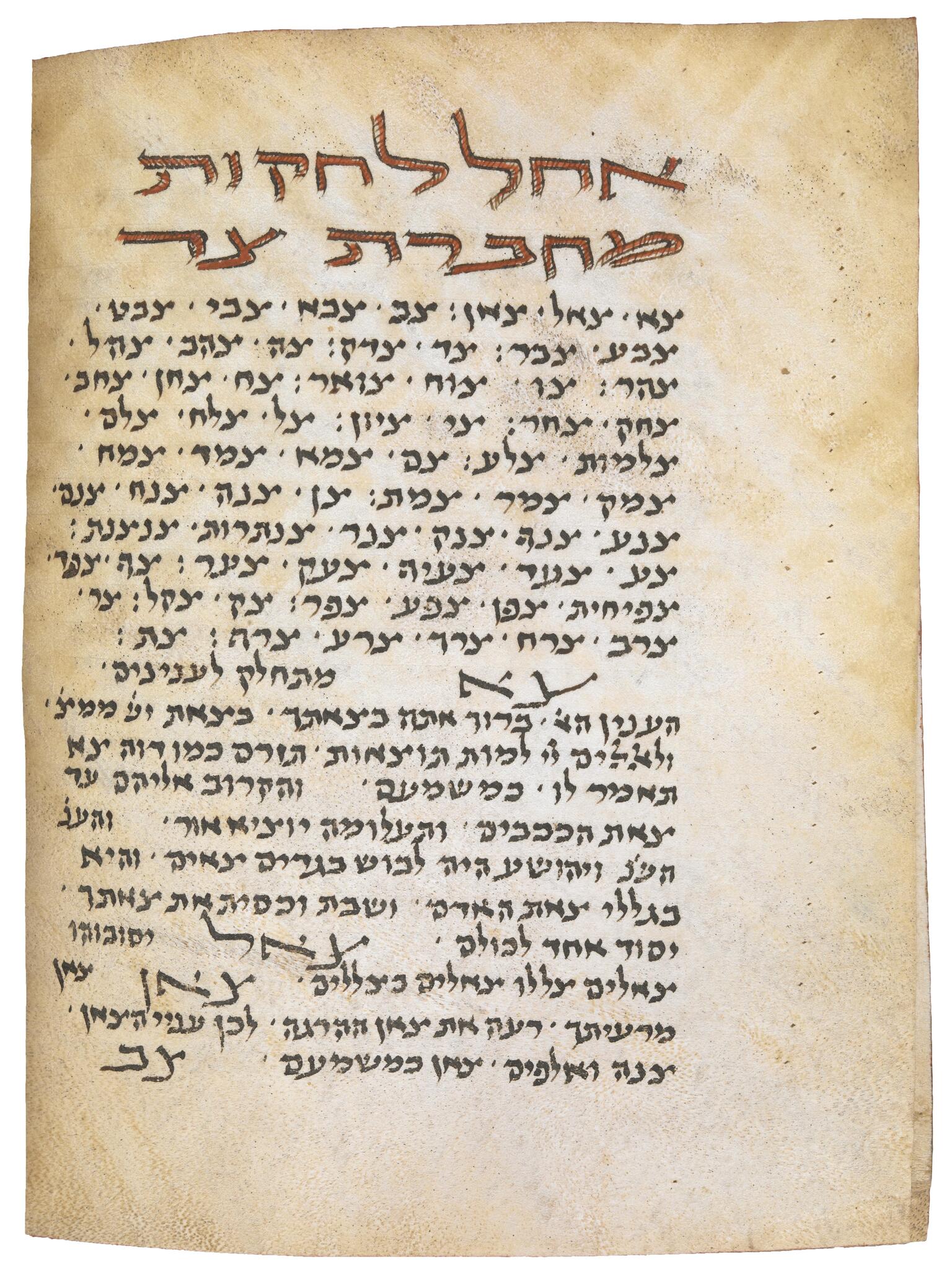
Notebook (Maḥberet)
Image
Please login or register for free access to Posen Library
Already have an account?
You may also like

Book of the Seventy Isolated Biblical Words
And I saw that there are some among the Hebrews who reject whatever is transmitted from the prophets by way of the unwritten precepts and laws, and similarly those who reject whatever they have heard…


Notebook (Maḥberet)
Menaḥem Ibn Sarūq was the main Andalusi proponent of the theory, later abandoned, that Hebrew roots could have one, two, or three root consonants. He thought that a root consonant must by definition…
Against Menaḥem Ibn Sarūq’s Maḥberet: Introduction
Many warm greetings to you, R. Menaḥem ben Jacob, from me, Dunash ben Labraṭ, your brother and beloved, who prays to God for your welfare. Righteousness itself should love you. Your face should light…
Book of Responses
To begin, he [Se‘adya] interprets and [she] sent her handmaiden [amatah] [to fetch it] (Exodus 2:5) as meaning that she [the daughter of Pharaoh] extended [sent forth] her [own] arm [amatah]. This is…
Responsum: On Grammar
And now, please listen to my response to you regarding when the master makes a sheva na‘ vowel [mobile sheva] into a sheva naḥ [resting sheva] and vice versa, and when he composes poetry in the Jewish…
Book on Verbs That Contain Weak and Lengthening Letters
“Praise be to God: to Him praise is due. He was without beginning and shall be without end, Creator and Ruler of the world. He decrees a thing, and it is established unto Him. He made man by His power…