

O father of the son
About This Entry
Abraham Ibn Ezra wrote this Hebrew poem while mourning the loss of his son, Isaac Ibn Ezra. After departing al-Andalus (Muslim Spain) with Judah ha-Levi in 1140, Isaac ended up in Baghdad, where he was rumored to have converted to Islam. Ibn Ezra’s sadness as a grieving father is palpable in these lines.
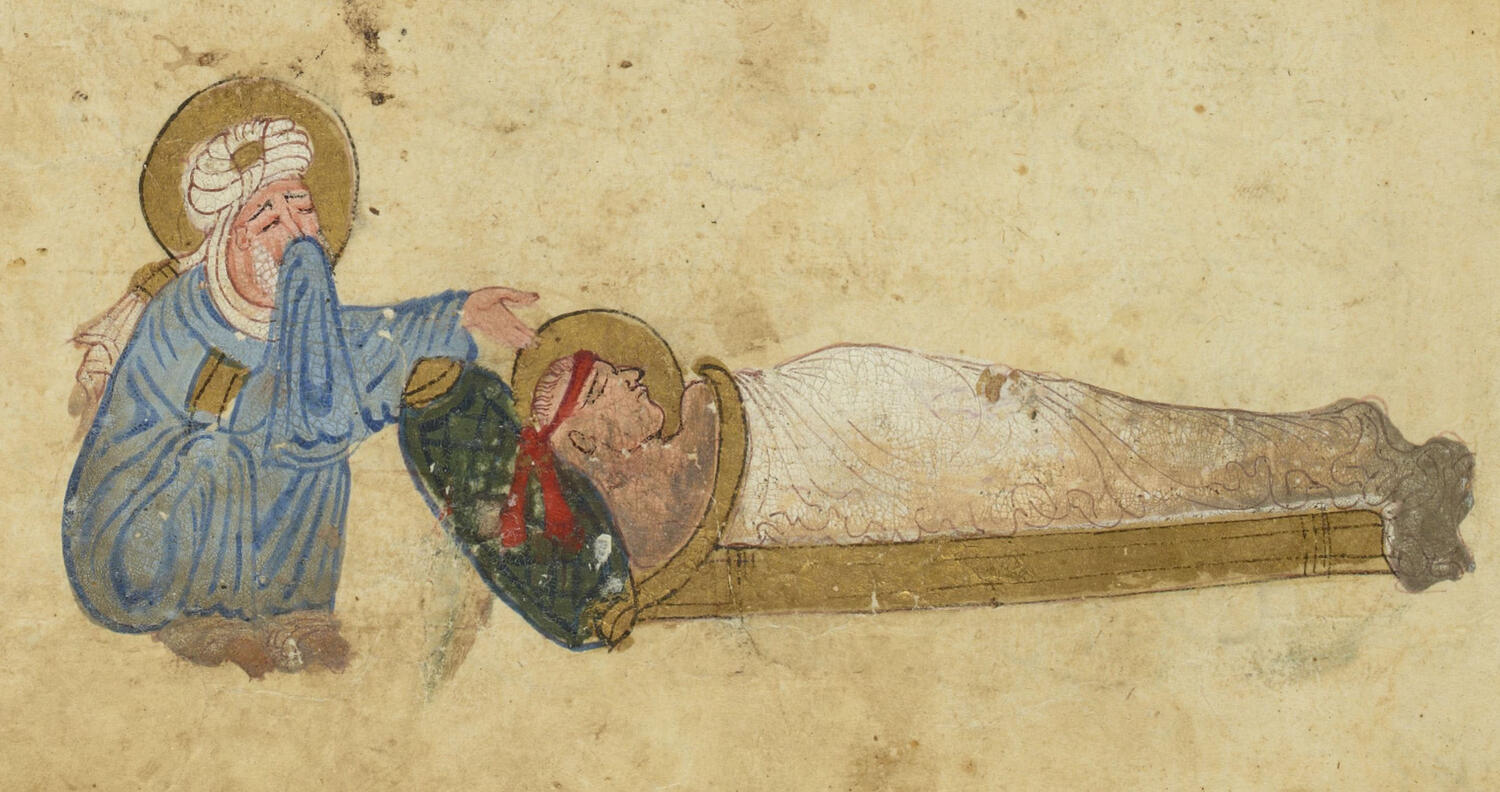

We’re sorry. The Posen Library’s licensing agreements prevent this image from being printed or downloaded.
O father of the son, come here to mourn,
for God has distanced from you
your son, your only-begotten,
whom you love—Isaac (Genesis 22:2).
I am the man who has seen disaster,
and his joy has gone into exile.
Ah! I have been scourged, gone is the fruit of my loins,
something I had never considered.
I thought that in my old age
he would give me release and rescue,
but my begetting and toil have been in vain.
For how can my heart rejoice?
He has expired, he has died—Isaac [see Genesis 35:29].
I cry, yes, cry, at every moment,
and I take up wailing and woe,
these past three years,
when I recall his death in a foreign land,
and his wanderings from place to place.
My soul churned for him,
until I brought him to my home,
crying by night and by day,
So many travails befell me—
this is the story of Isaac (Genesis 25:19).
My friends, let me be!
If you offer me consolation, you disturb me.
Do not mention the one on whom I had compassion,
do not speak his name to me.
Time has extinguished the remaining ember that I had.
And what if it breaks me?
It has made me desolate, eternally desolate,
and taken my eye’s beloved.
My flesh and heart pined, when Isaac finished (Genesis 27:30).
O God,1 whose hand holds everything,
You who act as You wish toward all Your creations,
speak to calm the heart of the aching father,
who has revered Your name since his youth.
Blow a spirit of consolation upon him
and let him pass between its pieces.
He taught his beloved son
to walk in the way of his parents, to fear You,
when he was still a boy—
[the path] that you demonstrated to your servant, Isaac. (Genesis 24:24).
Translated by Gabriel Wasserman.
Notes
[Ma‘on, literally “lair, dwelling,” referring to God’s dwelling in heaven, and here, by metonymy, to God.—Trans.]
Credits
Bibliothèque nationale de France, Department of Manuscripts, Arabe 3929, fol. 78r, detail.
Published in: The Posen Library of Jewish Culture and Civilization, vol. 3: Encountering Christianity and Islam.
You may also like

Take up wailing
Take up wailing over every mountain, and I’ll take it up over the wilderness pastures.And I’ll make a bitter lament, like jackals wailing over every passageway.I’ll speak with constricted breath, and…
Alas, evil has befallen Sefarad
Alas, evil has befallen Sefarad from heaven.My eye, my eye pours down tears of water. (Lamentations 1:16)My eye cries like an ostrich for the city of Lucena.The Jewish diaspora lived there all on its…
The Holy Shekel
O wise one, lay it to heart at all times, yea, every day, whether week-day or feast-day, sabbath or new moon, and you will find in “The Holy Shekel” every good quality, more precious than…
The doves in the trees are moaning
The doves in the trees are moaning, as I am.
What makes your speech bitter? Is it due to my anguish?
If crying from the pain of spirit and heart can help,
then, O ye jackals and ostriches, come…
Beautiful women and girls
Beautiful women and girls, hiding
in your homes, gorgeous
like the heavenly luminaries, and white like snow—
go out and see the wonders of the sea!
From your homes, roar like a lion
to see the…
How orderly, precious, and desired are these words!
How orderly, precious, and desired are these words!
I will give praise to the God of praises,
Who wears a brazier of firebrands like a cloak.
My praise is to God, my Crag and my Rock;
my song…
You may also like
Take up wailing
Take up wailing over every mountain, and I’ll take it up over the wilderness pastures.And I’ll make a bitter lament, like jackals wailing over every passageway.I’ll speak with constricted breath, and…
Alas, evil has befallen Sefarad
Alas, evil has befallen Sefarad from heaven.My eye, my eye pours down tears of water. (Lamentations 1:16)My eye cries like an ostrich for the city of Lucena.The Jewish diaspora lived there all on its…
The Holy Shekel
O wise one, lay it to heart at all times, yea, every day, whether week-day or feast-day, sabbath or new moon, and you will find in “The Holy Shekel” every good quality, more precious than…
The doves in the trees are moaning
The doves in the trees are moaning, as I am.
What makes your speech bitter? Is it due to my anguish?
If crying from the pain of spirit and heart can help,
then, O ye jackals and ostriches, come…
Beautiful women and girls
Beautiful women and girls, hiding
in your homes, gorgeous
like the heavenly luminaries, and white like snow—
go out and see the wonders of the sea!
From your homes, roar like a lion
to see the…
How orderly, precious, and desired are these words!
How orderly, precious, and desired are these words!
I will give praise to the God of praises,
Who wears a brazier of firebrands like a cloak.
My praise is to God, my Crag and my Rock;
my song…