

Reform Synagogue, Plauen
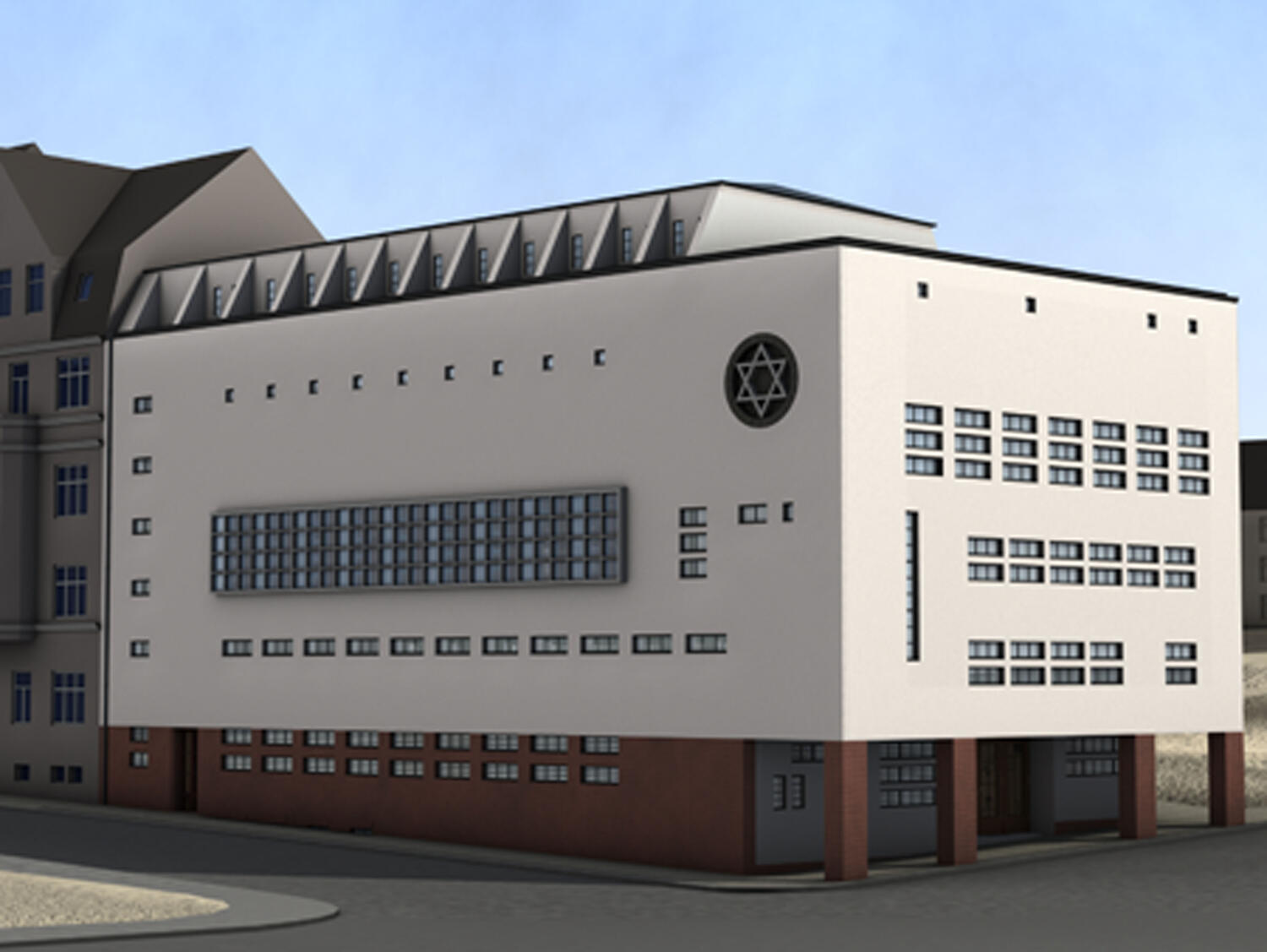

This modern synagogue in Plauen (in the Saxony region) was one of the few synagogues built in Germany in the economically turbulent years of the Weimar Republic. Jews and non-Jews contributed funds for its construction and shared space. Built in the style of the Neue Sachlichkeit (New Objectivity), a movement in German art that rejected expressionism for a less subjective approach. In architecture, this trend was known as Neues Bauen (New Building) and featured a plain, practical approach to design and construction. The Plauen synagogue was a largely unadorned white box sitting atop a red, brick base, combining communal and sacred space in one structure. It was destroyed on Kristallnacht (November 10, 1938).
We’re sorry. The Posen Library’s licensing agreements prevent this image from being printed or downloaded.
Credits
Virtual reconstruction. Courtesy Technische Universität Darmstadt, Digital Design Unit.
Published in: The Posen Library of Jewish Culture and Civilization, vol. 8.
You may also like

Religion Is an Obstacle to the Five-Year Plan
This poster, designed by an unknown artist, presents in a clear, graphic manner the goal of the Soviet campaign to eradicate religious life. The texts in Yiddish emphasize the need to bring an end to…

Come to Palestine
Raban was known as a designer, painter, and book illustrator but also designed at least two posters, including this one for the Society for the Promotion of Travel in the Holy Land. The poster’s…

Family Reunion
Painting in an expressionist style, Tofel was involved in the Jewish Art Center in New York (1925–1927) that held exhibitions on Yiddish culture. He was also active in a group of American Yiddish…

Diskin Orphanage, Jerusalem
Bassan is particularly well known for his photographs of the Old Yishuv, the community of Jews established well before the arrival of Zionist pioneers. He was the first Jewish photographer born in…

Carpet Depicting Rachel’s Tomb
This carpet was one of the many decorative objects with biblical themes produced at the Bezalel School of Arts and Crafts. This design features the legendary burial site of the biblical matriarch…

Teacher and Students in a Heder, Lublin
This photograph of a heder, a traditional Jewish boys’ elementary school, has become an iconic photograph of pre-World War II Jewish life in Eastern Europe. The heder was often a one-room classroom…
You may also like
Religion Is an Obstacle to the Five-Year Plan
This poster, designed by an unknown artist, presents in a clear, graphic manner the goal of the Soviet campaign to eradicate religious life. The texts in Yiddish emphasize the need to bring an end to…
Come to Palestine
Raban was known as a designer, painter, and book illustrator but also designed at least two posters, including this one for the Society for the Promotion of Travel in the Holy Land. The poster’s…
Family Reunion
Painting in an expressionist style, Tofel was involved in the Jewish Art Center in New York (1925–1927) that held exhibitions on Yiddish culture. He was also active in a group of American Yiddish…
Diskin Orphanage, Jerusalem
Bassan is particularly well known for his photographs of the Old Yishuv, the community of Jews established well before the arrival of Zionist pioneers. He was the first Jewish photographer born in…
Carpet Depicting Rachel’s Tomb
This carpet was one of the many decorative objects with biblical themes produced at the Bezalel School of Arts and Crafts. This design features the legendary burial site of the biblical matriarch…
Teacher and Students in a Heder, Lublin
This photograph of a heder, a traditional Jewish boys’ elementary school, has become an iconic photograph of pre-World War II Jewish life in Eastern Europe. The heder was often a one-room classroom…