

Responsum: On the Permissibility of Music
About This Entry
The scholar Nehemiah bar Obadiah of Gabès, Tunisia, maintained an ongoing correspondence with Hayya Ga’on and asked him many practical questions, including this one concerning the propriety of listening to music. Nehemiah was afraid that his community’s custom of listening to celebratory instrumental music might violate a seemingly broad talmudic prohibition. Based on lived tradition, Hayya permits music at weddings and occasions of religious significance, pointing to an Arabic genre that was popular among Jews in medieval Iberia, and widespread throughout the Islamic world. Hayya closes this Hebrew responsum with a relatively restrictive position on women’s performance in mixed-gender settings and also discourages women’s performances in all-female settings, concerned that it will lead to “other problematic activities.”
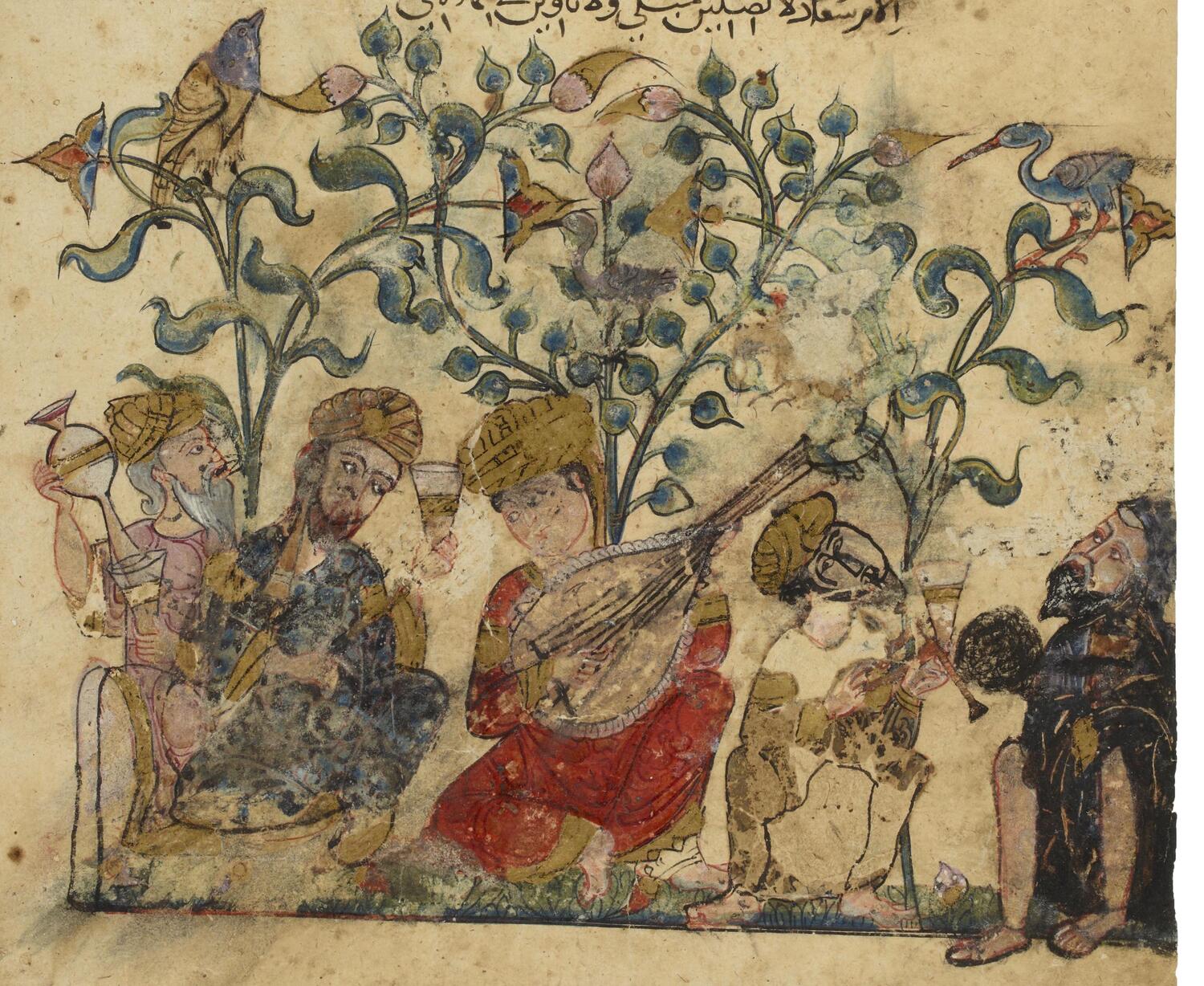

Question: Regarding the question that they sent to Mar Ukva: From where do we derive that song is forbidden? He wrote in response to them: Rejoice not, O Israel, to exultation, like the peoples (Hosea 9:1). And let him send them a response from here: They drink not wine with a song; strong drink is bitter to them who drink it (Isaiah 24:9; b. Gittin 7a). According to that verse, I would say that this matter applies only to instrumental music, but that vocal song is permitted. Thus he informs us.
Our master, teach us: Is this the ruling of law or is it not? For if that is the law, then the following is difficult, for it is taught: Anyone who benefits from the feast of a groom but does not cause him to rejoice violates the five “voices” [see b. Berakhot 6b]. Or, perhaps, there is a distinction between the house of a groom and others.
And the tradition in our community is that in the house of the groom and the bride women play timbrels and dance, and non-Jews are brought to bring joy to the assembled with musical instruments—with harp and lute and flute. Is this permitted or is it forbidden? Is there a difference between having these instruments present or not?
Answer: What I have seen is that the accepted tradition among the entire Jewish people is that in ordinary taverns, and certainly in the house of a groom and bride, celebrations include voiced expressions of joy, and that songs and hymns of praise before the Holy One are spoken. His miracles and righteousness with the Jewish people of old are recounted, together with hopes for the revealing of His rule and His good promises and the consoling news that the prophets disclosed to the Jewish people. All of this, together with many poems on similar themes are put to song. In the homes of grooms and brides, at joyous events and wedding canopies, blessings are composed wishing them success and good fortune and we have never found anyone from the Jewish community that refrains from any of this. The music discussed by Mar Ukva concerns not these types of songs; rather, he is referring to songs expressing love between people, praise of someone’s attractive physical appearance, honor given to a powerful warrior, and so forth—songs that are known among the Muslims as ash‘ār al-ghazal. It is not only prohibited to perform such songs with instruments, but they cannot even be sung without them. Regarding the main point on this topic, we have learned: From the time the Sanhedrin ceased, song was also nullified from the places of feasts, as it is stated: They drink not wine with a song; strong drink is bitter to them who drink it (Isaiah 24:9). On this the Gemara comments: And from where is it derived that this verse is written about the period when the Sanhedrin were nullified? R. Huna, son of R. Joshua, said: From that which the verse states: The elders have ceased from the gate, the young men from their music (Lamentations 5:14) [b. Sotah 48a]. When we say: R. Huna prohibited music; R. Ḥisda made light of it, this does not refer to Jewish music, but to the music of the non-Jews, as we find: R. Huna said: The song of those who pull ships and lead the herd is permitted; that of leather workers is forbidden. For the songs sung by those who pull ships and by those who herd animals are not Jewish songs, but R. Huna permitted them nevertheless, since he investigated them and found that they contained neither words of blasphemy nor unseemly language, while they offered support and assistance to the workers who pulled or herded. When he investigated the songs of the tanners, however, he found that they included inappropriate things, and he forbade them.
And regarding your question on the matter of women playing the timbrel and dancing: If it is in the presence of men, then there is nothing more base than that. This is true not only with musical instruments and dancing; even vocal singing is vulgar and forbidden, as R. Joseph said: If men sing and women respond, this is licentiousness. If women sing and men respond, it causes the evil inclination to burn as if one were setting fire to chips of kindling. What difference is there? To nullify one before the other, that is, if it is impossible to ban singing entirely, they should at least stop the most problematic form. And this is certainly true at a men’s party, for there it would be a definitive prohibition, and anyone who behaves defiantly in this matter will be placed under a ban, whether it is performed by women or by men. For R. Yoḥanan says: Anyone who drinks wine with the accompaniment of four types of instruments brings five types of retribution to the world, as it is stated: And the harp and the psaltery, the tabret and the pipe, and wine, are in their feasts (Isaiah 5:12). And next to it is written: Therefore, My people have gone into captivity, for want of knowledge (Isaiah 5:13), meaning that they bring exile to the world; And their honorable men are famished (Isaiah 5:13), as they bring famine to the world; And their multitude are parched with thirst (Isaiah 5:13), so that they cause the Torah, which is compared to water, to be forgotten by those who learn it. And mankind is bowed down, and man is humbled (Isaiah 5:15), so that they cause the enemy of the Holy One, namely, God Himself, to be brought down, as man in the phrase and man is humbled means nothing other than the Holy One, as it is stated: The Lord is a man of war (Exodus 15:3). The verse continues: And the eyes of the lofty are humbled (Isaiah 5:15), so that they cause the enemies of the Jewish people, namely, the Jewish people themselves, to be brought down. And what is written afterward? Therefore, the netherworld has enlarged her desire, and opened her mouth without measure, and down goes their glory and their tumult and their uproar, and he who rejoices among them (Isaiah 5:14).
And even if the women are alone without any men, it is still unseemly—certainly if among them are women who stand up and sing—and it is proper for them to refrain from this, since it serves as an act of defiance that has the potential to lead to many other problematic activities. This is even more of a problem if there are harps, lyres, and other stringed instruments as well as pipes and flutes. There are those who make light of this when timbrels and dancing are sounded to celebrate a bride’s anointing, if it is not at the banquet, and it would be better to guard against this.
Credits
Bibliothèque nationale de France, Department of Manuscripts, Arabe 6094, fol. 75v, detail.
Published in: The Posen Library of Jewish Culture and Civilization, vol. 3: Encountering Christianity and Islam.
You may also like

Responsum: On a Formerly Enslaved Woman and Her Son
Responsum: On Levirate Marriage

Report on Hayya Ga’on’s Rosh Hashanah Practice
[The Book of] Forbidden and Permitted
Query: On Robbers
Responsum: On a Kohen Who Apostatized
You may also like
Responsum: On a Formerly Enslaved Woman and Her Son
Responsum: On Levirate Marriage