

The Scroll of Egypt (A Medieval Story of Rescue)
About This Entry
Samuel wrote this Hebrew historical account, called The Scroll of Egypt (Megilat Mitsrayim), to commemorate his endangerment and rescue in 1012/13. On December 31, 1012, Samuel attended the funeral for Putiel, a cantor from Fustāt (Old Cairo), and he and twenty-two other Jews were forcibly imprisoned and scheduled to be executed. They were granted their freedom by the caliph al-Ḥākim (d. 1021), even though the caliph’s treatment of dhimmīs (“protected” non-Muslims) was otherwise very harsh. Later, in 1013, apparently suffering from some mental illness, al-Ḥākim imposed draconian rules on non-Muslims and even allowed some forced conversions. This text was apparently intended for public recitation, perhaps annually. The page pictured here comes from an undated manuscript of the text found in the Cairo Geniza. It has vocalization and cantillation marks (in colored ink) which suggest that the scroll was meant to be chanted publicly, perhaps as part of an annual commemoration.
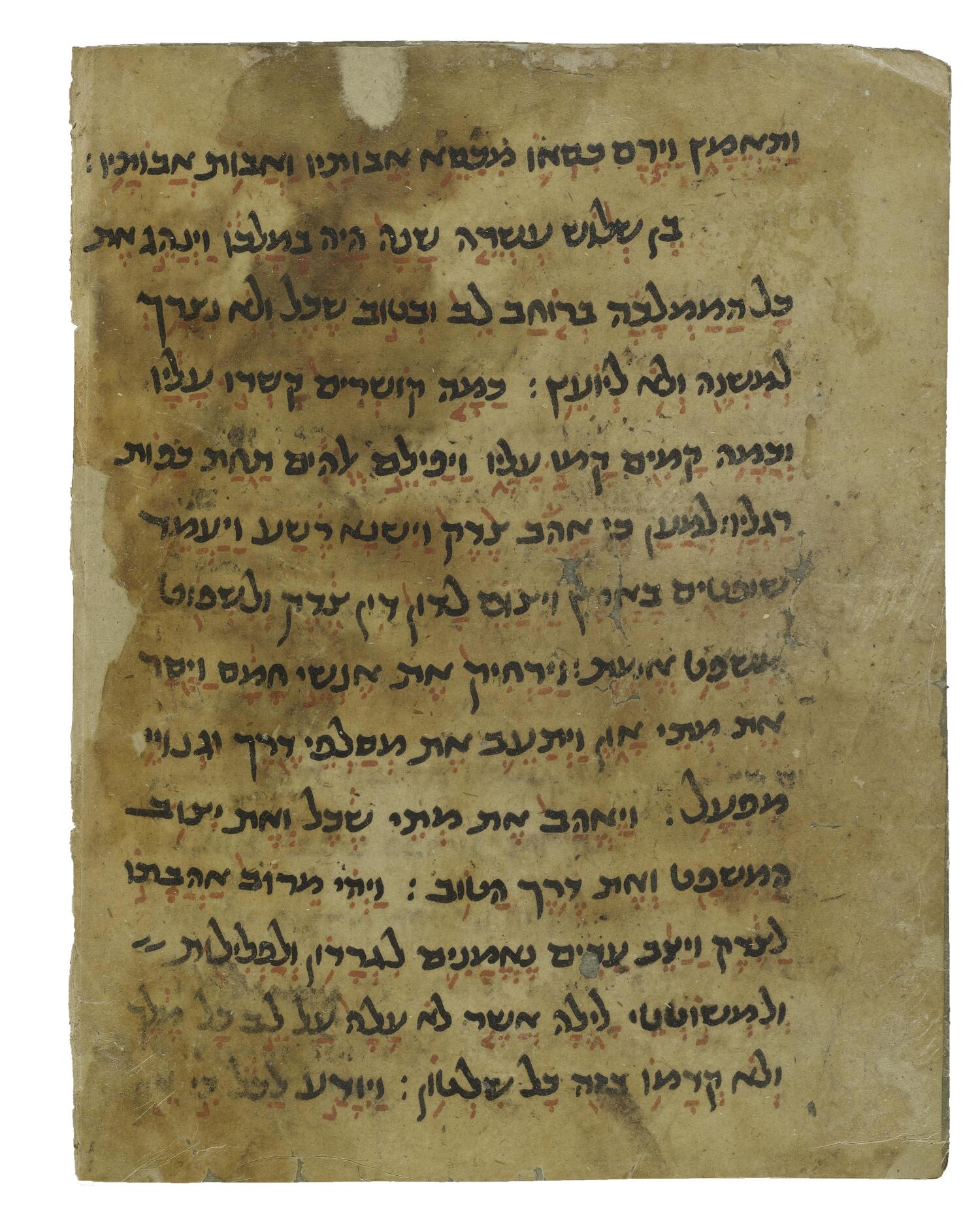

This occurred on the 3rd of Shevat in the year 4772 from the creation of the world, which is the year 1323 from the cessation of prophecy, or 943 from the destruction of the holy sanctuary [1013]. A man from among the precentors of the community—his name was Puti’el—had died, and the people of Israel gathered to render him the final kindness. They carried his bier and passed through one of the streets on the way out to the cemetery. The rabble of Egypt bore a grudge against them and pelted them with stones, cursing them and raising a fury against them. They enacted unjust laws and published oppressive writs against them. They slandered them and gave them the eye. They scorned, mocked, vilified, and attacked them, seeking to destroy them, shouting at each other and mustering their forces. The governor sent his collectors and tax wardens, and the judge his bailiffs and messengers; they broke out among the people while they were returning from the funeral, surrounded them, pursued them, trampling them and abusing them on the highways. The people were terrified; they ran in all directions, some fleeing, some hiding, some bribing the officers, some stripping off their garments, some cast into the pit, and some being bound hand and foot. They collected twenty-three men from the people, putting them under guard in two prisons, where they suffered overnight, hungry and thirsty; they confiscated some of their clothes against the taxes levied. Among them was an elderly judge, humble and God-fearing. He was third in the company, and his name was Samuel son of Hoshana.
They arose early on a Monday, the 4th of Shevat; they brought them out with great commotion, with fear and trembling, at the third hour of the day. They drew them forward in a stampede through the alleys, surrounding them on all sides with mobs of thousands and ten thousands; the Egyptians rioted against them, so that the ground split from the sound. Others gathered against them: every tyrant and magnate, every ruffian and scoundrel. They damned them and cursed them, haranguing them, leading and drawing them to the slaughter site; they stripped them of their garments and force-marched them with rage and fury, that they might slay them all at a single stroke. But when they had led them about ten cubits, a voice was heard behind them, “Bring them back to the king’s palace,” so that some of the oppressors were leading them to the slaughter site, and others to the palace. The king commanded that they be led to the guardhouse that was within the royal palace. There they bound their feet in iron chains to within an inch of their lives.
All the Israelites who were in Egypt were in dire straits. They hid in their houses and storage places and could not come forth. They were hunted by their footsteps, and it was dire for them. The countrymen conspired to deprive them of life and possessions, and to destroy them off the face of the earth. They turned to the right and left, but there was no help or support. They mourned, sighed, and wailed. They fasted and wept, men, women, and children, even those pregnant and nursing. Their fear and terror grew; they could not devise any plan or response. The poor and mendicants among them fortified their souls, together with some of their women and children, and put their souls on the line. They got up early on Thursday and cast themselves down, kissing the dust before the king’s gate, heaping earth on their heads, shouting and crying out mightily to God. They bowed down and said, “Save us, O lord the king!”
And it came to pass, when their outcry was heard before our lord the king, and he knew their pain and the anguish of their spirits, that he had mercy on their impoverished state. Our God turned his heart toward them, for the king’s heart is in the Lord’s hands like springs of water; He directs it however it pleases Him. He was made aware of the falsity of the witnesses who passed unjust laws and wrote oppressive writs. They said that their numbers were close to two hundred, yet there was no one who knew testimony or examined depositions except four men whose depositions were doubtful and whose testimony was harmful. Their lies were revealed along with their cowardice, their wiles and slanders. The king—may he live long!—is a just king from the outset; he abominates wicked men and succors his throne with kindness. Thus, when the people cried out, along with their wives and their poor, our lord the king had compassion on them. He commanded that those in prison be released, and that the chains be removed from their legs and the collars from their necks, and that they be brought out from their imprisonment. The king likewise commanded to restore their garments, down to the very last thread and shoe-strap, and they did as he commanded.
The people went out and blessed the king. They surrounded the gates of his palace. They offered lavish blessings to grant him long life, to prosper his kingdom, to make his armies strong, to aid his troops, to open up the eastern and western stretches of the world before him, to put down those who hate him and destroy his enemies. They took counsel with their brethren who were shouting and weeping, and they all went to the provinces, to the streets of Egypt. Whereupon their brethren came out of hiding to greet them, and they were joined by every runaway and fugitive, everyone in hiding or secret, everyone in fear and trepidation. They all banded together, coming through the streets in a procession and blessing the king, until they arrived at the great synagogue. They took out three Torah scrolls and offered lavish thanksgiving to the living God and abundant blessings to our lord the king. They recited the Great Hallel of praise and celebrated the great salvation. They enacted setting aside three days in the calendar every year for fasting and renunciation, from the 3rd to the 5th of Shevat.
Leading individuals took on themselves to fast all three days, and the rest of the people just one day, the day the Jews were taken into custody. They made the announcement on the Sabbath and spread the word to gather all the Jews of Egypt, to establish it as a fast day in memory of these extraordinary events, to thank our God and offer lavish blessings to our lord the king. [ . . . ] May the name of the Lord our God be blessed and extolled from now to all time, to all generations and all epochs and eternity. We will tell and relate all His wonders and counsels concerning us, though they surpass expression. Hallelujah! Praise Him, exalt Him, for His kindness overwhelms us and the faithfulness of the Lord is forever. Hallelujah! We conclude this scroll with the aid of Him who is awesome in deeds; may His name be blessed forever. Blessed is the Lord forever. Amen and amen. The Lord shall reign forever. Amen and amen. Peace.
Credits
Published in: The Posen Library of Jewish Culture and Civilization, vol. 3: Encountering Christianity and Islam.
You may also like

The Story of Bustanay

Letter from Sicily
Account of an Earthquake
Key to the Locks of the Talmud
Kitāb miftāḥ maghālīq al-talmud
The Scroll of Aḥima‘ats: Aaron of Baghdad
Megilat Aḥima‘ats
The Scroll of Aḥima‘ats: Rabbi Silano
Megilat Aḥima‘ats
You may also like
The Story of Bustanay
Letter from Sicily
Account of an Earthquake
Key to the Locks of the Talmud
Kitāb miftāḥ maghālīq al-talmud
The Scroll of Aḥima‘ats: Aaron of Baghdad
Megilat Aḥima‘ats
The Scroll of Aḥima‘ats: Rabbi Silano
Megilat Aḥima‘ats