

The Scroll of Ovadiah
About This Entry
The partially surviving autobiographical account of Ovadiah ha-Ger’s life, known as The Scroll of Ovadiah (Megilat ‘Ovadyah), is written in the third person. Found in the Cairo Geniza, this text traces Ovadiah’s transformation and travels through various Middle Eastern cities before he finally reached Egypt. The text, however, cuts off with him in Tyre, Lebanon. Ovadiah recounts his youth as a Christian, meeting with Karaites, and encountering Crusaders. This excerpt covers his initial journey from Italy and his travels in Iraq and elsewhere.
It happened at that time regarding Archbishop Andraeas the high priest in the city of Bari, that the Lord put the love of the Torah of Moses into his heart. He forsook his land, [his] priesthood [and a]ll his glory and came to the city of Constantinople, [where] he circumcised the flesh of his foreskin. There [pa]ssed over him sufferings and hardships; he arose and fled for his life from before the uncircumcised [margin: seeking to slay him; but the Lord God of Israel saved him from their hands in purity. May the Lord guard proselytes, blessed be the Lord forever! Many went up after him and, ob(serving) his deeds,] they did as he had done—they also entered the covenant of the living God. [ . . . ]
Then came [Obadiah the Proselyte] unto the city of Adinah which is Baghdad, [capital of the Ishma]elites. [ . . . ] The servant installed Obadiah the Proselyte in the house wherein the Jews would pray, and they brought him provisions. It happened thereafter that Isaac, the head of the academy, directed that Obadiah the Proselyte be with the orphan youths, in order to teach him the Torah of Moses and the words of the prophets in the script of the Lord and the language of the Hebrews. Prior to this, the king of Adinah, whose name was al-Muqtadi, empowered his second-in-command, whose name was Abishuga [=Ibn Shuja], to take discriminatory action against the Hebrews dwelling in the city of Adinah. He sought many times to cause them to perish, but the God of Israel thwarted his intent, this time also hiding them from his wrath. [Abishuga] put gleaming signs upon them, on the head of each and every Jew: one on the head and the other on [the] throat, and about a silver-mithqal of lead hanging from the throat of each and every Jew, upon which was inscribed [the word] Dhimmi—for the Jews were taxed. He moreover had a girdle placed around the loins of each and every Jew. Abishuga further had placed upon the Jewish women two signs: the shoes belonging to each and every woman had to be one red and the other black, while upon the throat of each and every woman or upon her shoe was placed a small brass bell to make a noise. [ . . . ]
Now this was the law concerning the tax which the officials of the king of Adinah would collect from the Jews each and every year: from every single Jew amongst the wealthy ones and those who had the most power they would take four and a half drachmas; from the middle-class Jews, two and a half drachmas; and from the very poor Jews, one and a half drachmas. If a Jew died without having paid the tax, then whether there remained much or little of it to pay, the gentiles would not allow that he be buried until they had collected that part of the tax still owed by him. If the deceased person had left nothing, the gentiles would ask the Jews to redeem their deceased out of their money for the amount of tax owed. If they would not, the gentiles would seek to cremate him. [ . . . ]
In the mountains of Assyria, in the land of Hakkeriya, there arose a certain Jew named Solomon ben Ruji, the name of whose son was Menahem; and with them was a glib man named Ephraim b. R. Azariah the Jerusalemite, known as ben Fadlun. They wrote letters to all the Jews near and far in all the la[nds wh]ich were round about them, so that their renown and the contents of their letters reached a far distance. Unto all [the] places which are upon the face of the earth where the Jews are scatt[er]ed am[ong a]ll the nations which are beneath all the heavens did their renown reach. All of them said that the time had come when the Lord would gather his nation Israel from all the lands unto Jerusalem the holy city, and that Solomon b. [R]uji was the king Messiah. When all the Jews residing in the various lands heard the words of their letters, they rejoiced greatly. [ . . . ] [T]he Jews became ashamed before all the gentiles. For all the gentiles and the uncircumcised ones heard the rumors which came to the Jews; they would all laugh and mock at the Jews and would say “Behold the Jews want to fly, yet they have no wings with which to fly to their land.” They continued goading, calumniating and cursing the Jews, and the gentiles would say that everything which the Jews had was false and vain. [ . . . ] In th[ose] days w[ere the Franks near unto] Aleppo. The Ishmaelites were in dire strai[ts; Radwan] the king of Aleppo died, and his son would pa[y homage to Lulu] the eunuch of his father, who exercised the rule [in place of him.] One of the servants of Radwan slew the [eunuch Lulu,] and the city of Aleppo remained without a ki[ng, for the king] was survived by small children who did not have [the power] to withstand the Franks. So the me[n of Aleppo] sent and took a great man from the [To]garmites [= Turks] named Ghazi bin Urtuq to be ruler over them along with the sons of Radwan. For the city of Aleppo had remained in dire straits because of Sir Rogier king of Antokhia [=Antioch] and because of the Togarmites[ . . . . ] Jews [in abundance in A]leppo died, while those who remained alive were weak and impoverished. [Upon the] poor was a heavy yoke and great trouble. [They would seek from] the gentiles, the inhabitants of Aleppo, and from their brethren [bread, and would keep g]oing and returning to them. They [also] acted charitably in some small measure with Obadiah the Proselyte, [and O]badiah the Proselyte blessed them. Then Obadiah returned to the city of Kalneh [=Raqqa], and dwelled there [some] days.
So the Lord raised up a saviour for the inhabitants of Aleppo—Ghazi bin Urtuq of the chiefs of the Togarmites.
Notes
Words in brackets appear in the original translation.
Credits
Ovadiah the Proselyte, The Scroll of Ovadiah, trans. Royal B. MacDonald, from Norman Golb, “The Autograph Memoirs of Obadiah the Proselyte of Oppido Lucano, and the Epistle of Barukh b. Isaac of Aleppo,” prepared for the Convegno Internazionale di Studi, Giovanni-Obadiah da Oppido: proselito, viaggiatore, e muscista dell’età Normanna, Oppido Lucano (Basilicata), March 28–30, 2004, 1–2, 5–11. Available at https://isac.uchicago.edu/research/individual-scholarship/autograph-memoirs-obadiah-proselyte-oppido-lucano-and-epistle-barukh (accessed April 17, 2024). Used with permission of the Institute for the Study of Ancient Cultures, University of Chicago.
Published in: The Posen Library of Jewish Culture and Civilization, vol. 3: Encountering Christianity and Islam.
You may also like

Migration and Mobility in the Early Medieval Period
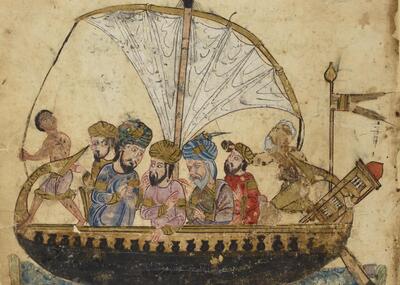
Medieval societies can sometimes be seen as static and isolated. Yet medieval people of all sorts moved from one place to another, for a variety of reasons: for economic opportunity and trade, driven by wars and forced displacement, and more. Western Europe and the Mediterranean, the Middle East, and even the Far East were connected by the migration of people, merchandise, and ideas.

Dialogue Against the Jews: His Conversion to Christianity
Dialogi contra Iudaeos

I uttered a vow to God
Report of Messianic Troubles from Baghdad

Account of a Raid on Aden
Mainz Anonymous
You may also like
Migration and Mobility in the Early Medieval Period
Medieval societies can sometimes be seen as static and isolated. Yet medieval people of all sorts moved from one place to another, for a variety of reasons: for economic opportunity and trade, driven by wars and forced displacement, and more. Western Europe and the Mediterranean, the Middle East, and even the Far East were connected by the migration of people, merchandise, and ideas.
Dialogue Against the Jews: His Conversion to Christianity
Dialogi contra Iudaeos
I uttered a vow to God
Report of Messianic Troubles from Baghdad