

I uttered a vow to God
About This Entry
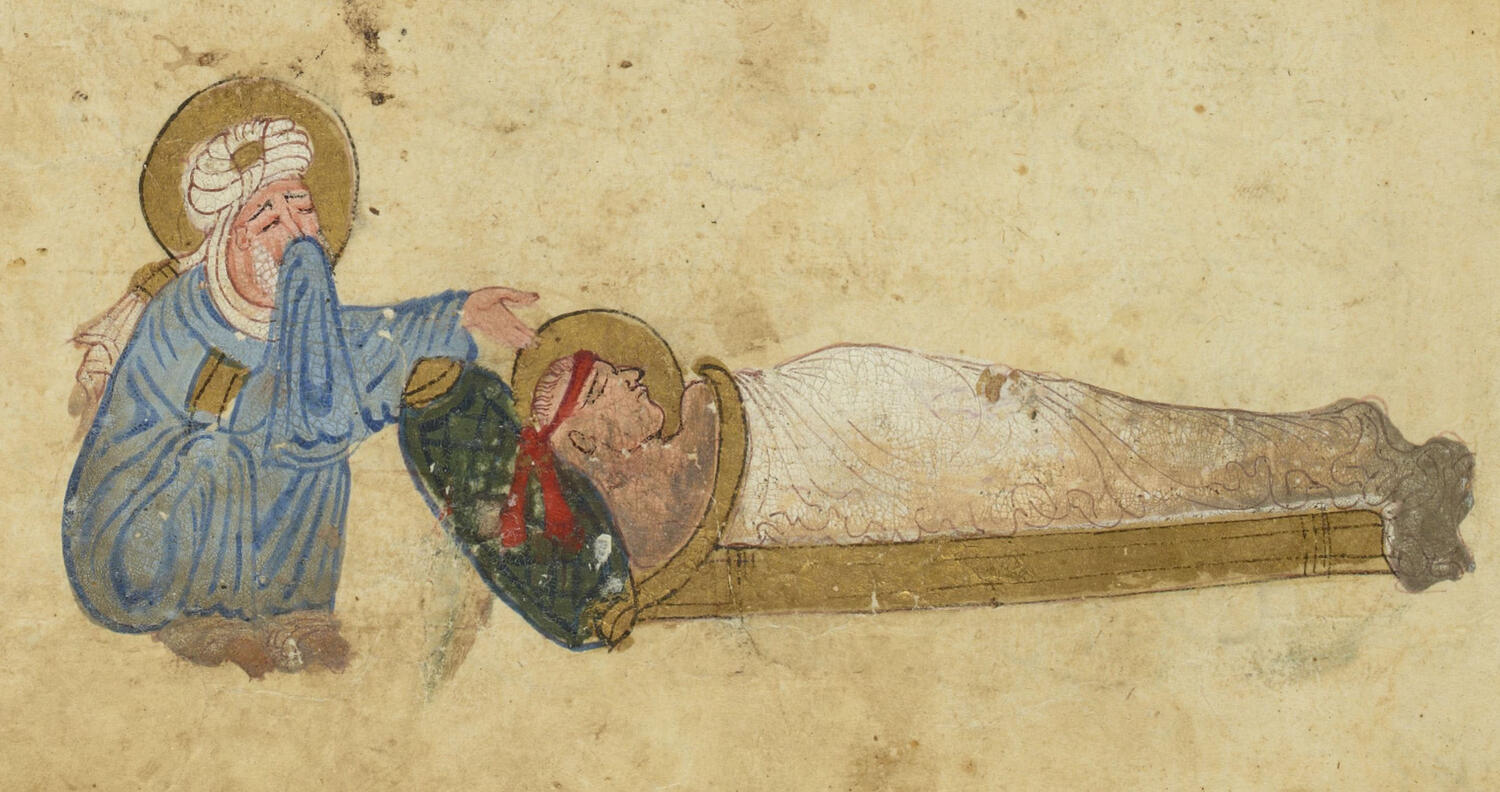
This Hebrew poem, which Nathan ben Yeḥiel of Rome placed at the end of his talmudic dictionary, the ‘Arukh, recounts the repeated tragedies that befell him and his family. It replaces a traditional colophon and, like some earlier poetic models from the Italian poet Shabbetai Donnolo, was written in a monorhyme without a quantitative meter. The acrostic in the first half of the poem spells out Nathan’s name. Nathan begins by alluding to a vow to write a Torah scroll, which he seems to have fulfilled by commissioning it from a scribe named Samuel, with its cover made by a woman named Rachel. Nathan then writes about the death of four of his five sons. Finally, he closes with his promise to build a mikveh (ritual bath).

Notes
[Various “crowns” have to be added on top of specific letters in the writing of Torah scrolls. See b. Menaḥot 29b.—Trans.]
[Generally, certain words can be written in more than one way, sometimes with letters that indicate vowels and sometimes without them. However, in a Torah scroll, they must be written in exactly the prescribed manner.—Trans.]
[This refers to the different spacing between sections in a Torah scroll.—Trans.]
[An “ordered line” refers to a tradition that a specific passage in a Torah scroll must end in the middle of a line, with the next section starting beneath the spot where the previous line ended.—Trans.]
[The biblical verses contain predictions for life, and allude to the names of his sons.—Trans.]
[See Psalms 49:10: “That he should live more, forever; that he should not see the pit.” Psalms 49:8 reads: “No man can by any means redeem his brother”; Benjamin was redeemed and spared by the efforts of his brother Judah.—Trans.]
[The rest of the verse reads: “For a child is born to us, a son is given to us; and the government is upon his shoulder; and his name is called Pele-joez-el-gibbor-Abi-ad-sar-shalom.” This verse is often interpreted as referring to the messiah and hints here at the name of his third son, Shabbetai, a name traditionally associated with the messiah.—Trans.]
[See b. Makkot 10a: “Although Moses our teacher knew that accidental murderers would not be admitted to the three cities of refuge in the east bank of the Jordan until the three cities in the land of Canaan were designated, he nevertheless said: ‘A mitzvah has come my way; I will fulfill it.’” On Moses’ designation of three cities of refuge on the eastern side of the Jordan, see Deuteronomy 4:41–43.—Trans.]
[See b. Eruvin 54b: What is the meaning of the verse: “You who ride on white donkeys, you who sit on rich cloths, and you who walk by the way, tell of it?” (Judges 5:10) “You who ride on white donkeys”; these are Torah scholars who go from one city to another and from one country to another to study Torah. They are called white (tseḥorot) because they render the Torah as clear as noon (tsahorayim).—Trans.]
Credits
Published in: The Posen Library of Jewish Culture and Civilization, vol. 3: Encountering Christianity and Islam.
You may also like

Dialogue Against the Jews: His Conversion to Christianity
Dialogi contra Iudaeos
Report of Messianic Troubles from Baghdad

Account of a Raid on Aden
Mainz Anonymous
The Kuzari: On the Karaites
Book of Scales
You may also like
Dialogue Against the Jews: His Conversion to Christianity
Dialogi contra Iudaeos
Report of Messianic Troubles from Baghdad