

Shulḥan ‘arukh (Set Table)
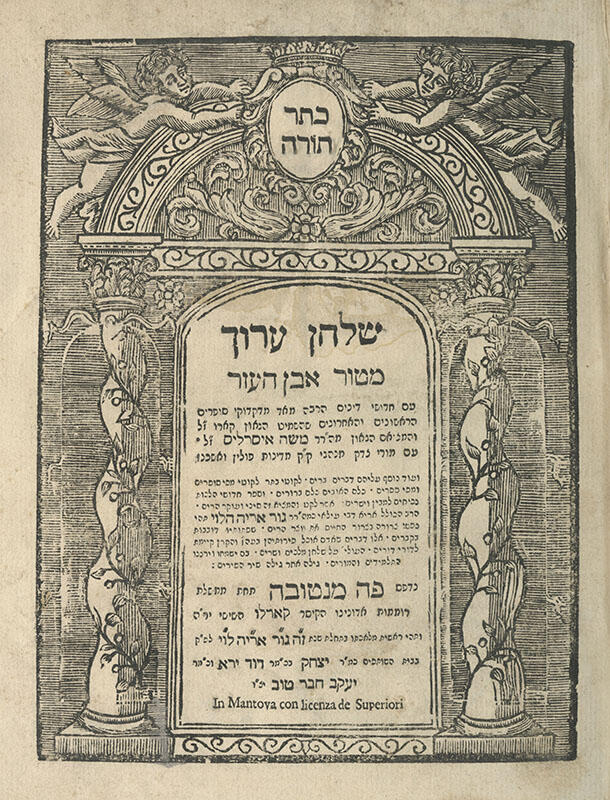

Joseph Karo’s Shulḥan ‘arukh (Set Table)—printed together with the additions of Moses Isserles’s Mapah (Tablecloth) and first published in 1565—was a codification of Jewish law that was easy to use as a basis for Jewish observance. It became accepted throughout the diaspora as the basis for traditional halakhic decision-making and is still considered an authoritative text today. This title page is from a version from Mantua that was published in many editions. One early edition included a title page with portraits of great rabbis. This did not meet with the approval of the rabbis of Mantua and that title page did not appear in subsequent editions of the work.
We’re sorry. The Posen Library’s licensing agreements prevent this image from being printed or downloaded.
Credits
Shulchan Aruch with Likutei Rabbi Gur Aryeh Ha-Levi.Mantova [1721–1723]. Printed by Yitzhak Ya're Ve-Ya'akov Haver Tov. Towson University Albert S. Cook Library Special Collections & University Archives.
Published in: The Posen Library of Jewish Culture and Civilization, vol. 5.
You may also like

Mapah (Tablecloth) to Shulḥan ‘arukh
Says Moses, son to my master, my father, R. Israel, seeing that the illustrious author [Joseph Karo] of the Bet Yosef [The House of Joseph] and its Shulḥan ‘arukh [Set Table], a sage greater…

Vikuaḥ mayim ḥayim (Dispute of “Living Waters”)
And just as a person finds pleasant only such food as he has prepared himself, in accordance with what he wishes to eat, and has no desire whatsoever to depend upon his neighbor’s table, so too, he…

Two Authorizations Given to Female Slaughterers
Stronger than the lions’ den [see Song of Songs 4:8; 2 Samuel 1:23], raise a banner over Mount Zion [see Isaiah 13:2], they are the mighty ones [see…
Emblem of the Jewish Butchers’ Guild
The merchants’ and artisans’ guilds introduced into Eastern Europe beginning in the thirteenth century by German immigrants resembled those in Western Europe in their exclusion of Jews. Jews therefore…
Responsum: On an Inheritance Dispute
Question: A rabbi died, leaving all his assets in the rabbinic court’s control until his heir came to take possession, and his closest heir, who ought rightfully to inherit, is in Portugal, living as…
Responsum: On Coffee
Question: I will inform you regarding my opinion on the fruit called al bun, and about kahve [coffee], which is the broth brewed from the husks of that fruit, and which is drunk by non-Jews, whether…
Engage with this Source

Related Guide
Early Modern Rabbis and Intellectuals on the Move
1500–1750
Carrying books and knowledge, itinerant rabbis and scholars traveled between communities, facilitating cultural exchange.

Related Guide
Early Modern Religious Practices
1500–1750
Early modern Jews both preserved tradition and innovated. Documents and legal texts reveal rich details about synagogue life, marriage, family relations, and death rituals.
You may also like
Mapah (Tablecloth) to Shulḥan ‘arukh
Says Moses, son to my master, my father, R. Israel, seeing that the illustrious author [Joseph Karo] of the Bet Yosef [The House of Joseph] and its Shulḥan ‘arukh [Set Table], a sage greater…
Vikuaḥ mayim ḥayim (Dispute of “Living Waters”)
And just as a person finds pleasant only such food as he has prepared himself, in accordance with what he wishes to eat, and has no desire whatsoever to depend upon his neighbor’s table, so too, he…
Two Authorizations Given to Female Slaughterers
Stronger than the lions’ den [see Song of Songs 4:8; 2 Samuel 1:23], raise a banner over Mount Zion [see Isaiah 13:2], they are the mighty ones [see…
Emblem of the Jewish Butchers’ Guild
The merchants’ and artisans’ guilds introduced into Eastern Europe beginning in the thirteenth century by German immigrants resembled those in Western Europe in their exclusion of Jews. Jews therefore…
Responsum: On an Inheritance Dispute
Question: A rabbi died, leaving all his assets in the rabbinic court’s control until his heir came to take possession, and his closest heir, who ought rightfully to inherit, is in Portugal, living as…
Responsum: On Coffee
Question: I will inform you regarding my opinion on the fruit called al bun, and about kahve [coffee], which is the broth brewed from the husks of that fruit, and which is drunk by non-Jews, whether…