

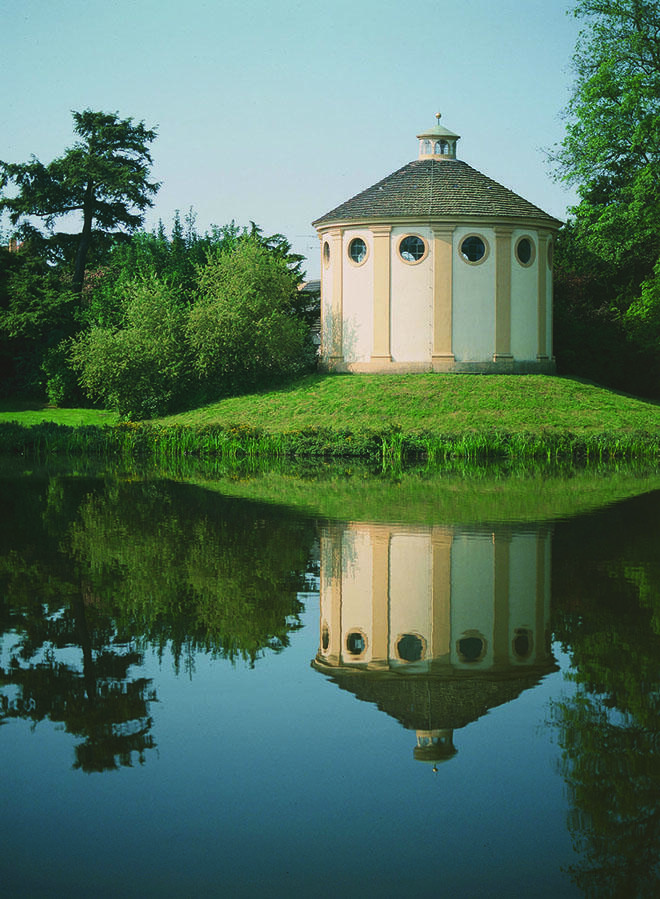
Synagogue in the Park at Wörlitz, Germany
Image
Please login or register for free access to Posen Library
Already have an account?
Engage with this Source


Related Guide
Synagogue Architecture
1750–1880
Synagogues built in Europe in the age of Emancipation had somewhat contradictory goals. On the one hand, they were to articulate a proud Jewishness, which by definition meant a distinctive style. On the other hand, they wanted to announce that they were deeply embedded in the European cityscape.
You may also like

Touro Synagogue: America’s Oldest Jewish House of Worship
Built in 1763, Newport’s Touro Synagogue reflects colonial Palladian design and stands as a symbol of early Jewish life and liberty in America.

Janów Sokólski Synagogue
Janów, Poland, was home to a unique wooden synagogue. The town was settled by Jews toward the end of the seventeenth century, and, by 1739, the Jewish population formed the majority of the town’s…
Óbuda Synagogue
The Óbuda Synagogue in Budapest is the oldest functioning synagogue in Hungary. The building was inaugurated in 1821. Its restrained, neoclassical aesthetic was consistent with popular architectural…

Interior of the Beth Elohim Synagogue Charleston, South Carolina (Solomon Nunes Carvalho)
This synagogue, built in the Georgian style and dedicated in 1794, was, at the time it was erected, the largest and most impressive synagogue in the United States.

Dohány Street Synagogue
The Dohány Street Synagogue in Budapest is the largest synagogue in Europe, and the second largest in the world, capable of accommodating three thousand people. The Moorish- and Byzantine-inspired…

Grand Synagogue of Lyon
The Grand Synagogue of Lyon was built shortly after the establishment of a regional consistory by Emperor Napoleon III and the appointment of a regional chief rabbi. In 1858, a new synagogue for the…