

Torah Binder (Munich)
About This Entry
German Jews created Torah binders for young men from the swaddling cloths used during the circumcision ceremony. The Torah binder, used to wrap the Torah scrolls, symbolically linked the circumcision ceremony with the initiation into active practice in the community for an adult male. Most binders were designed and sewn by women. The gendered role for creation and use of the binder demonstrates how life-cycle rituals cemented distinctive roles, with men playing leading roles in synagogue life and women playing the role of facilitator. The Hebrew text reads: “Made for Menachem, called Mendl, ben Judah Loeb Schnaidack, born under a good sign on Thursday, 3rd of Marheshvan 5575.”
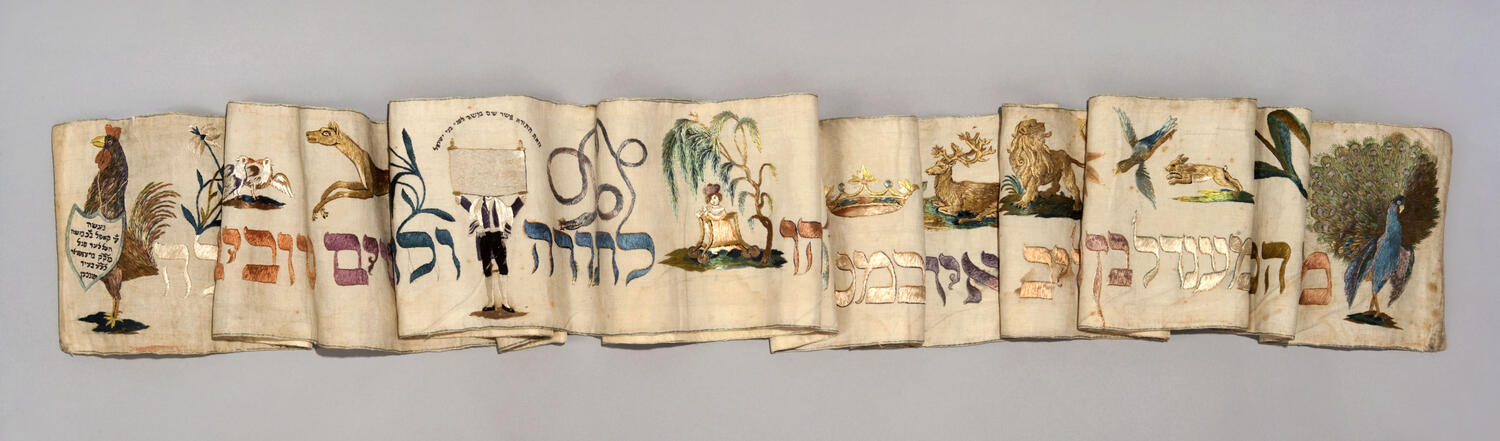

The cloth covering a baby boy at his circumcision was sometimes later made into a Torah binder (wimpel) and brought later to the synagogue in a celebratory manner. Koppel ben Moses Heller, of Bretzfeld, Germany, was commissioned by the Lilienthal family to create this Torah binder in Munich, which includes the inscription: “Made for Menachem, called Mendl, ben Judah Loeb Schnaidack [Schnaittach], born under a good sign on Thursday, 3rd of Marheshvan 5575 [October 17, 1814].” Menachem Mendel grew up to become Max Lilienthal (1814–1882), best known for establishing modern schools for Jews in Russia despite tremendous opposition from some traditional Jews. At the time, Lilienthal’s enlightenment agenda received backing from the Russian authorities. In 1845, he immigrated to the United States and served for many years as rabbi in a Reform congregation in Cincinnati, contributing considerably to the development of Reform Judaism in the United States. Silk embroidery on linen.
Credits
Accession no. 80.83, Gift of Mr. and Mrs. Theodore Lilienthal, Magnes. Collection of Jewish Art and Life, Bancroft Library, UC Berkeley, Berkeley, California.
Discussion Questions
In what ways do the images on this Torah binder reinforce gender roles?
What is the symbolic relationship between the circumcision ritual and the bar mitzvah (initiation ceremony for a 13-year-old boy)?
Can you think of ways that this ritual, or one like it, could be transformed to have relevance today?
Published in: The Posen Library of Jewish Culture and Civilization, vol. 6.
You may also like
Gender Roles
Engage with the gendered dimensions of Jewish life and discover lost voices of Jewish women.

Alms Container

Illustrated Daily Prayer Book

Grace Mendes Seixas Nathan (Mrs. Simon Nathan) and Her Son Seixas Nathan

Medal from Dedication of the Munich Synagogue in 1826

Torah Curtain
You may also like
Gender Roles
Engage with the gendered dimensions of Jewish life and discover lost voices of Jewish women.
Alms Container
Illustrated Daily Prayer Book
Grace Mendes Seixas Nathan (Mrs. Simon Nathan) and Her Son Seixas Nathan
Medal from Dedication of the Munich Synagogue in 1826