

Vigna Randanini Catacombs, Rome
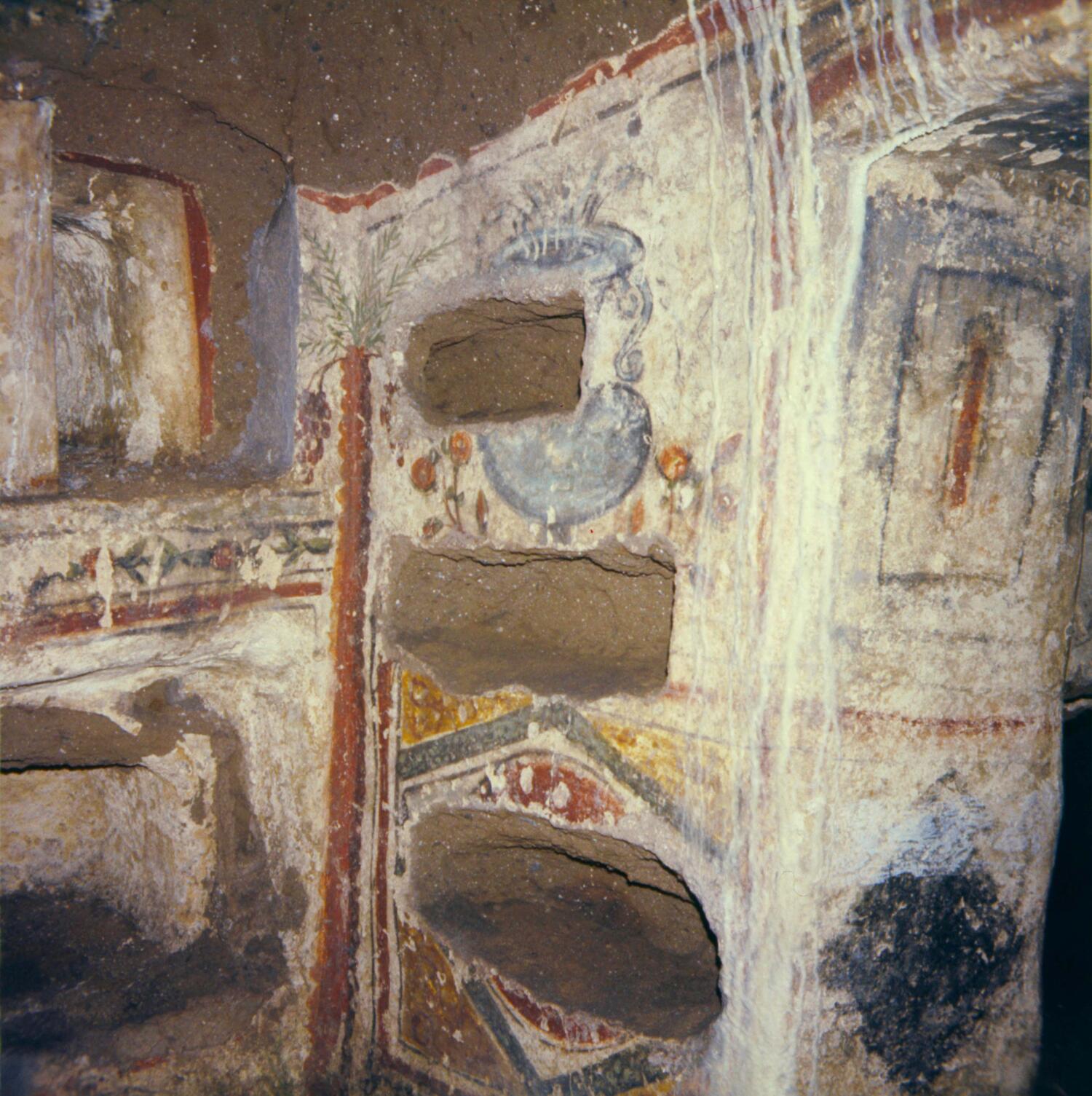

Much of the archaeological evidence pertaining to the Jewish diaspora comes from funerary contexts. Jewish tombs and hypogea have been identified in various places, particularly in the western Mediterranean. In this regard, the catacombs in Rome deserve special attention. They comprise an intricate underground network of corridors lined with loculi and arcosolia and have yielded more than six hundred inscriptions—mostly in Greek and Latin—that shed light on the social structure of the Jewish communities, their level of integration with the surrounding Roman milieu, and personal details such as names, ages at death, and occupations. The layout of the Vigna Randanini catacombs indicates that they developed by incorporating multiple existing underground areas; the complex ultimately contained more than a thousand tombs. The painted walls in this chamber from the Vigna Randanini catacomb feature a palm tree in the corner with other designs filling the space between the loculi: a water basin, garlands, and geometric patterns. The smaller loculi to the right of the palm tree were for child burials. Another hall has frescoes covering its walls and ceiling, the latter showing a winged Nike (Victory) who holds a palm frond in her left hand and crowns a young man with her right.
Credits
Courtesy Alexander Benenson.
Published in: The Posen Library of Jewish Culture and Civilization, vol. 2: Emerging Judaism.
You may also like

Villa Torlonia Catacombs, Rome

Shaft Graves, Qumran

Herod’s Mausoleum, Herodium

Burial Cave, Jericho

The Catacombs at Beth Shearim

Ossuaries with Decoration and Inscriptions
You may also like
Villa Torlonia Catacombs, Rome
Shaft Graves, Qumran
Herod’s Mausoleum, Herodium
Burial Cave, Jericho
The Catacombs at Beth Shearim