

The Western Wall
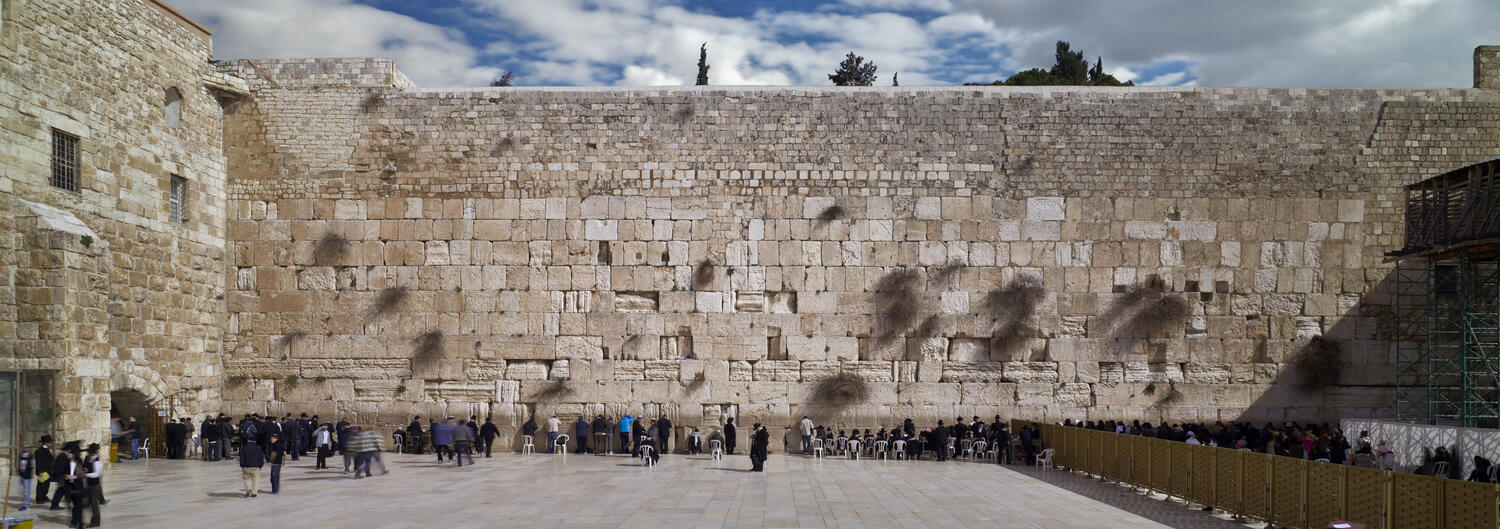

Today’s Western Wall is part of the retaining wall Herod began building around the Temple platform and was likely finished just before the end of the first century BCE. It remains one of the holiest sites for Jews and attracts millions of visitors each year. Many offer prayers at the site, some of which are written on small slips of paper and wedged into the crevices of the wall. The portion of the wall visible at the visitors’ site is just a fraction of the larger wall that surrounds the Temple Mount, a holy site known to Muslims as Haram al-Sharif.
We’re sorry. The Posen Library’s licensing agreements prevent this image from being printed or downloaded.
Credits
© GIGASHOTS / Shutterstock.
Published in: The Posen Library of Jewish Culture and Civilization, vol. 2: Emerging Judaism.
You may also like

The Decline and Death of Herod
The Jewish War 1.656–673
From that time on Herod’s disease spread to affect every part of his body with a range of symptoms. He had a fever (relatively mild), intolerable itching all…

Jerusalem under Herod
Herod expanded the Temple Mount into the large square platform that remains today. By adding giant underground vaults to the southeastern side of the mount, his engineers were able to compensate for…

Herod’s Temple Complex
One of Herod’s greatest projects was the expansion and renovation of the Jerusalem Temple.

Herod’s Caesarea
Originally a small Phoenician town called Strato’s Tower, the settlement that became Caesarea was part of the territory bequeathed to Herod the Great by Octavian (the future emperor…

Samaria-Sebaste
Like Caesarea Maritima, Samaria-Sebaste was a city rebuilt by Herod for a non-Jewish population. Herod transformed the preexisting settlement of Samaria, which was no longer Samaritan…

Fortress at Machaerus
Machaerus was one of the royal palatial fortresses built by the Hasmoneans and later lavishly renovated by Herod starting in 30 BCE. Located to the northeast of the Dead Sea, it…
Engage with this Source

Related Guide
The Jerusalem Temple
4th Century BCE–6th Century CE
Ancient descriptions of the Temple and its material culture indicate that the Jerusalem Temple was the central site of Jewish sacrificial worship.
You may also like
The Decline and Death of Herod
The Jewish War 1.656–673
From that time on Herod’s disease spread to affect every part of his body with a range of symptoms. He had a fever (relatively mild), intolerable itching all…
Jerusalem under Herod
Herod expanded the Temple Mount into the large square platform that remains today. By adding giant underground vaults to the southeastern side of the mount, his engineers were able to compensate for…
Herod’s Temple Complex
One of Herod’s greatest projects was the expansion and renovation of the Jerusalem Temple.
Herod’s Caesarea
Originally a small Phoenician town called Strato’s Tower, the settlement that became Caesarea was part of the territory bequeathed to Herod the Great by Octavian (the future emperor…
Samaria-Sebaste
Like Caesarea Maritima, Samaria-Sebaste was a city rebuilt by Herod for a non-Jewish population. Herod transformed the preexisting settlement of Samaria, which was no longer Samaritan…
Fortress at Machaerus
Machaerus was one of the royal palatial fortresses built by the Hasmoneans and later lavishly renovated by Herod starting in 30 BCE. Located to the northeast of the Dead Sea, it…