

What folly my homeland has committed
About This Entry
These moving lines are extracted from a longer Hebrew lament over the death of the poet’s mother. Interestingly, at a certain point, a reader of this text (perhaps the later copyist) made emendations between the lines, reworking this poem into a memorial for the wife of a certain Samuel. This text offers an idealized portrait of a son’s mourning for his mother, cast as a dialogue between the dead woman and the poet.
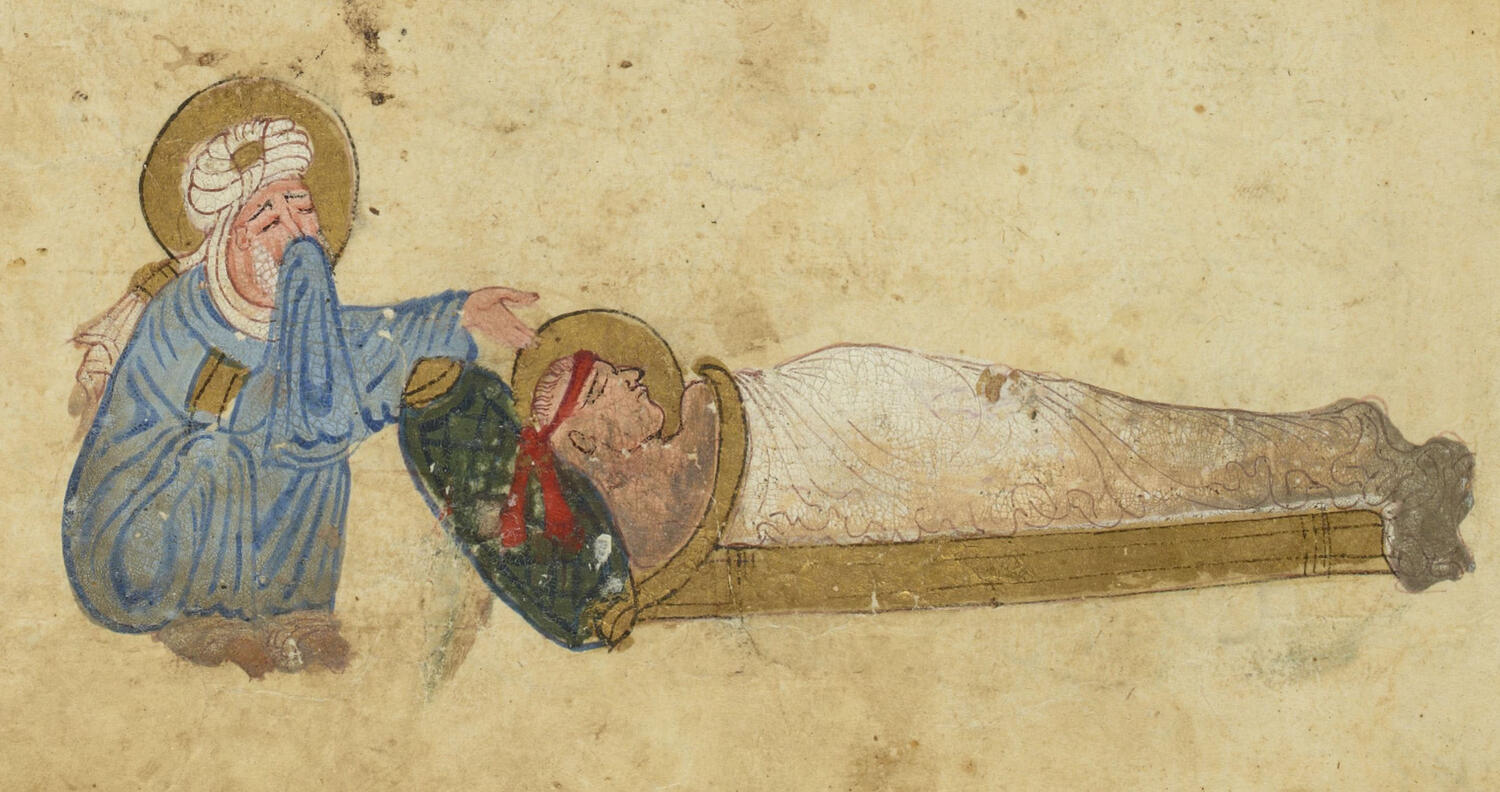

Lament on the death of his mother.
Notes
[Literally “the day of my reckoning, accounting,” i.e., the day when God took reckoning and ruled that it was her time to die.—Trans.]
[The poet is alluding to Psalms 137:5–7: “If I forget you, O Jerusalem, may my right hand forget [its abilities] . . . if I do not recall the mention of Jerusalem over my head joy (i.e., headmost, or chief joy).” For metrical reasons, our poet does not use the regular word for head, rosh (as in the biblical verse), but rather kodkod, “skull,” which makes the metaphor sound very strange.—Trans.]
[I.e., “the gift that I offered in life to you and to others.” The word minḥah also refers to a grain-offering in the Temple; obviously, the mother never made such an offering, since she lived long after the destruction of the Temple, but the line could mean that her long sleep should be as satisfying to her as a meal-offering was to God.—Trans.]
Credits
Published in: The Posen Library of Jewish Culture and Civilization, vol. 3: Encountering Christianity and Islam.
You may also like

So pressed by longing for the living God
Hurry to the lovers’ camp

My heart’s desire

The beautiful one who dwells within
This excerpt comes from a kinah (lament) for the 1096 massacres of Jews in the Rhineland and describes the murder of children at the hands of their mother.
If only my whole head could be water
This poem integrates accounts of the persecutions, forced conversions, and murders of the First Crusade into the tradition of laments for the Jerusalem Temple.

I'll sing a song of a battle array
This medieval Hebrew poem about a game of chess paints a detailed picture of the rules of the game.
You may also like
So pressed by longing for the living God
Hurry to the lovers’ camp
My heart’s desire
The beautiful one who dwells within
This excerpt comes from a kinah (lament) for the 1096 massacres of Jews in the Rhineland and describes the murder of children at the hands of their mother.
If only my whole head could be water
This poem integrates accounts of the persecutions, forced conversions, and murders of the First Crusade into the tradition of laments for the Jerusalem Temple.
I'll sing a song of a battle array
This medieval Hebrew poem about a game of chess paints a detailed picture of the rules of the game.