

Jewish Refugees in Shanghai Woodcut
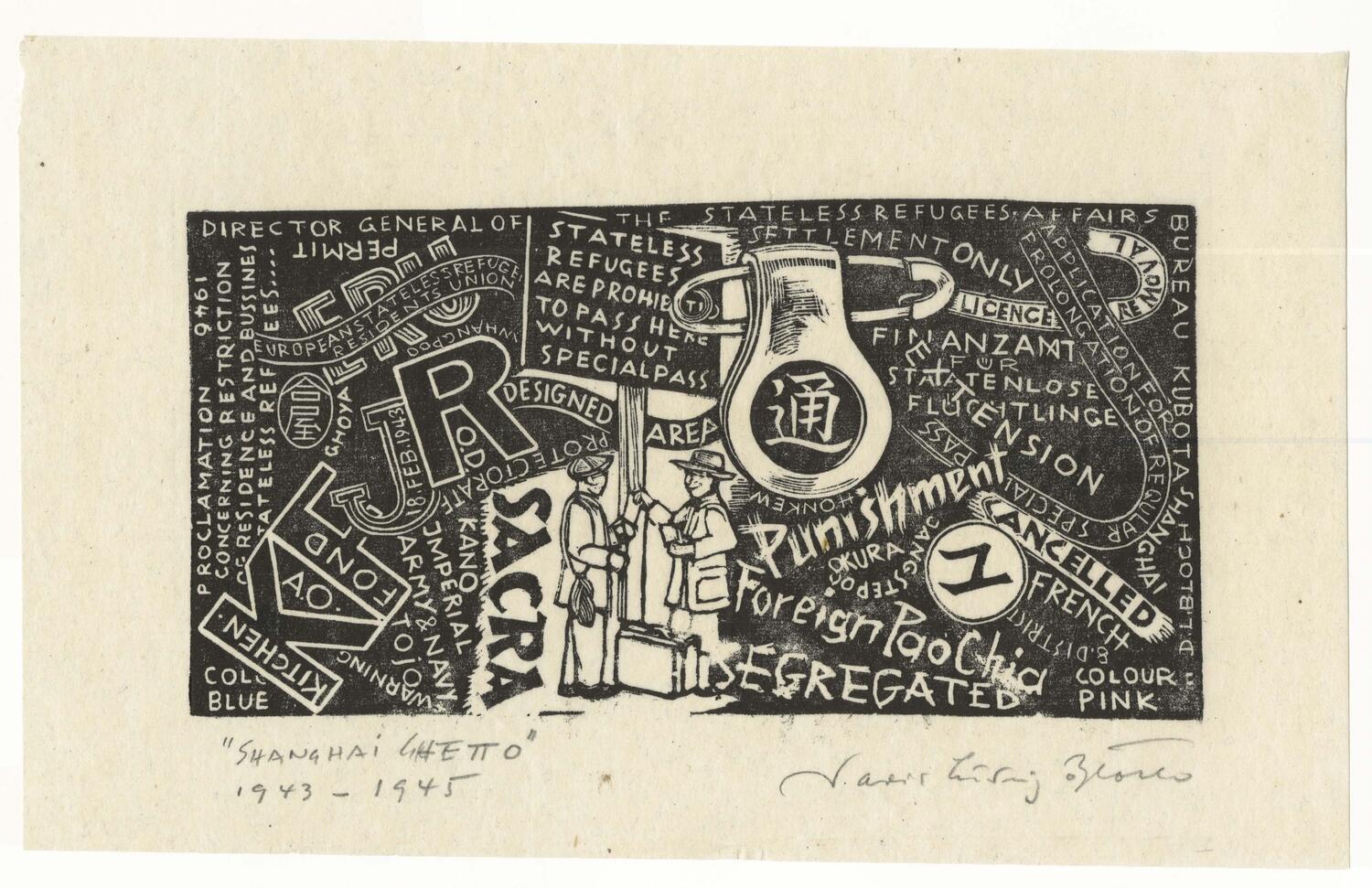

During World War II, as most nations barred Jewish refugees, Shanghai became a rare haven due to its divided international administration by British, American, French, and Japanese authorities. Between 1937 and 1941, about twenty thousand Jews found refuge there, including David Ludwig Bloch, a German lithographer and Dachau survivor. After Japan took full control of the Chinese city in 1943, authorities forced stateless Jews into the Hongkew ghetto, where harsh conditions, disease, and abuse claimed many lives. Bloch’s woodcut of presenting his pass to a guard captured the daily struggle for dignity and survival.
Credits
David Ludwig Bloch, “Shanghai Ghetto,” 1943–1945. Woodcut: ink on rice paper, 5.5 x 9.1 in. Courtesy of Leo Baeck Institute.
Discussion Questions
The large safety pin reads, “In town, Tojo’s Imperial Army and Navy rule.” What do the other inscriptions convey? How does the saturation of the woodcut with words express the refugees’ experience?
How does Bloch depict himself and the guard? What ideas about refugees’ experiences or identities does he communicate through these figures?
Bloch created this artwork while interned in the ghetto. What practical challenges might he have faced? What might creating art under such conditions have meant for him and for other internees?
You may also like

Class 3: Stateless Jews and the Politics of Papers, 1918–1948
Explore how 1918–1948 forced European Jewish refugees to navigate statelessness, closed borders, and the life-or-death politics of passports and papers.
You may also like
Class 3: Stateless Jews and the Politics of Papers, 1918–1948
Explore how 1918–1948 forced European Jewish refugees to navigate statelessness, closed borders, and the life-or-death politics of passports and papers.