

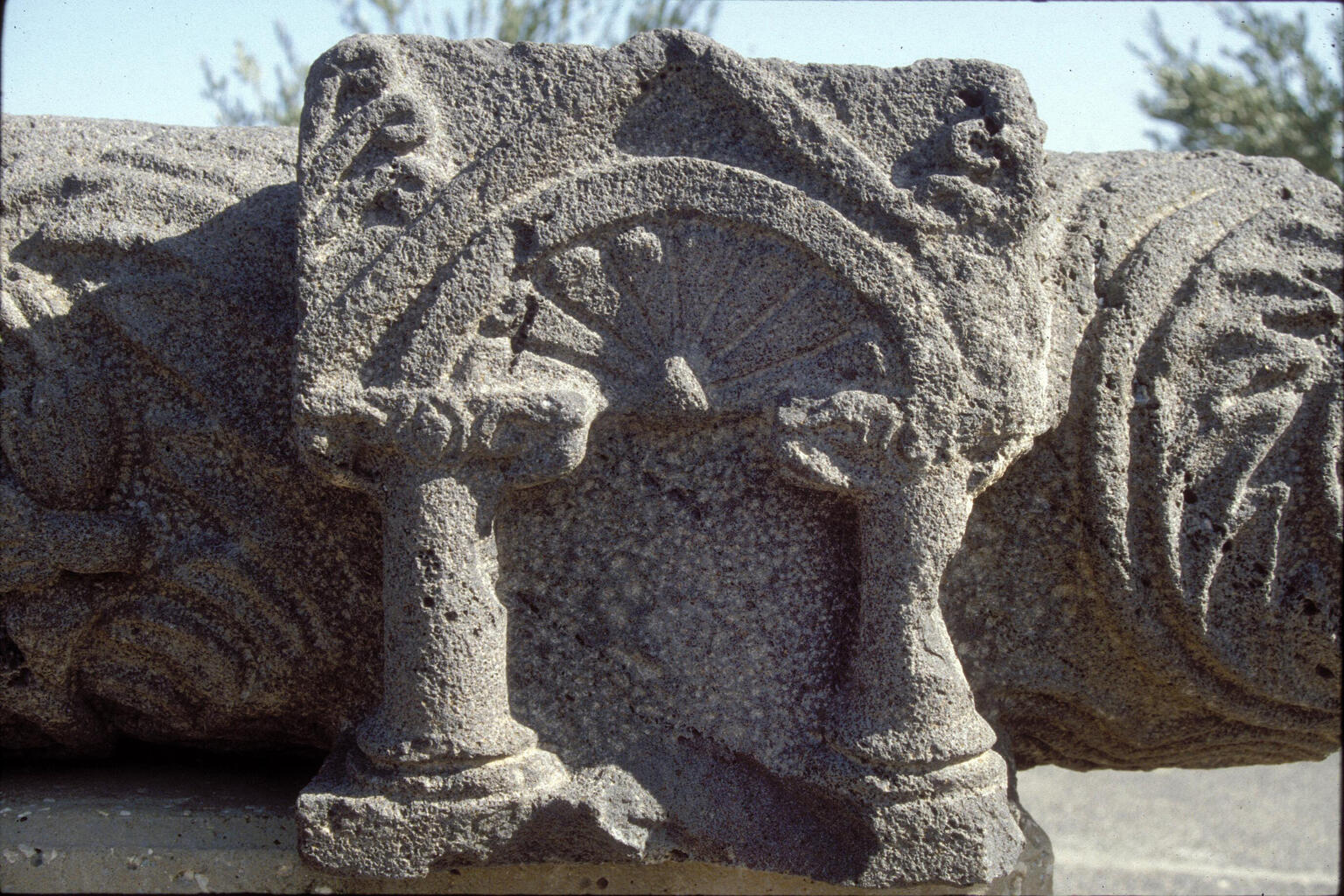
Black Basalt Shrine, Korazim
Image
Please login or register for free access to Posen Library
Already have an account?
Engage with this Source


Related Guide
Reading of Scripture and Prayer in the Early Synagogue
1st–6th Centuries
You may also like

The Palestinian Talmud on Translating the Scriptural Reading
y. Megillah 4:1, 74d
R. Samuel bar R. Isaac went to a synagogue. A man stood up to translate while leaning on a pillar. He [R. Samuel] said to him, “This is forbidden to you; just as it was given in trembling and fear, so…
The Babylonian Talmud on Translating the Scriptural Reading
b. Megillah 21b
It was taught: [This] is not the case with regard to [reading] the Torah, [which may be read only by a single person]. The sages taught: [When reading from] the Torah, one [person] reads and one may…
Using One’s Own Lulav
m. Sukkah 3:13
If the first day of the festival falls on the Sabbath, all the people bring their lulavim to the synagogue [on Friday, as it is prohibited to carry it there on the Sabbath]. The next day they arise…
The Synagogue as the Place for Prayer
b. Berakhot 4b, 6a–b
Actually, [the rabbis] hold in accordance with [the opinion of] Rabban Gamaliel, [and the fact] that they say until midnight is [in order]…
Teaching, Blessing, and Eating in the Synagogue
y. Berakhot 3:1, 6a
R. Abbahu was sitting teaching in the fortified synagogue in Caesarea; there was a coffin there. There came the time for lifting the hands, and they did not ask him. There came the time for eating…
The Importance of Communal Prayer
b. Berakhot 7b–8a
R. Isaac said to R. Naḥman: Why did the master not come to the synagogue to pray? [R. Naḥman] said to him: I was [weak and] unable [to come. R. Isaac] said to him: Let the master gather ten…