

Legend of the Sons of Jacob
About This Entry
The “Legend of the Sons of Jacob” (Aggadah bi-vene Ya‘akov) was originally part of a medieval Hebrew elaboration of the late-antique work known as The Testament of Naphtali. The medieval version, which survives in a few manuscripts, formed part of a group of Hebrew and Greek texts about the biblical figure of Naphtali, the earliest of which survives among the Dead Sea Scrolls. The medieval Hebrew version also overlaps with the Greater Midrash on Genesis (Bereshit rabbati) of Moses ha-Darshan of Narbonne, who drew on the Apocrypha and the group of texts known today as the Pseudepigrapha, which seem to have circulated in his Christian milieu. In this excerpt, Naphtali tells his father, Jacob, of a dream he has had.
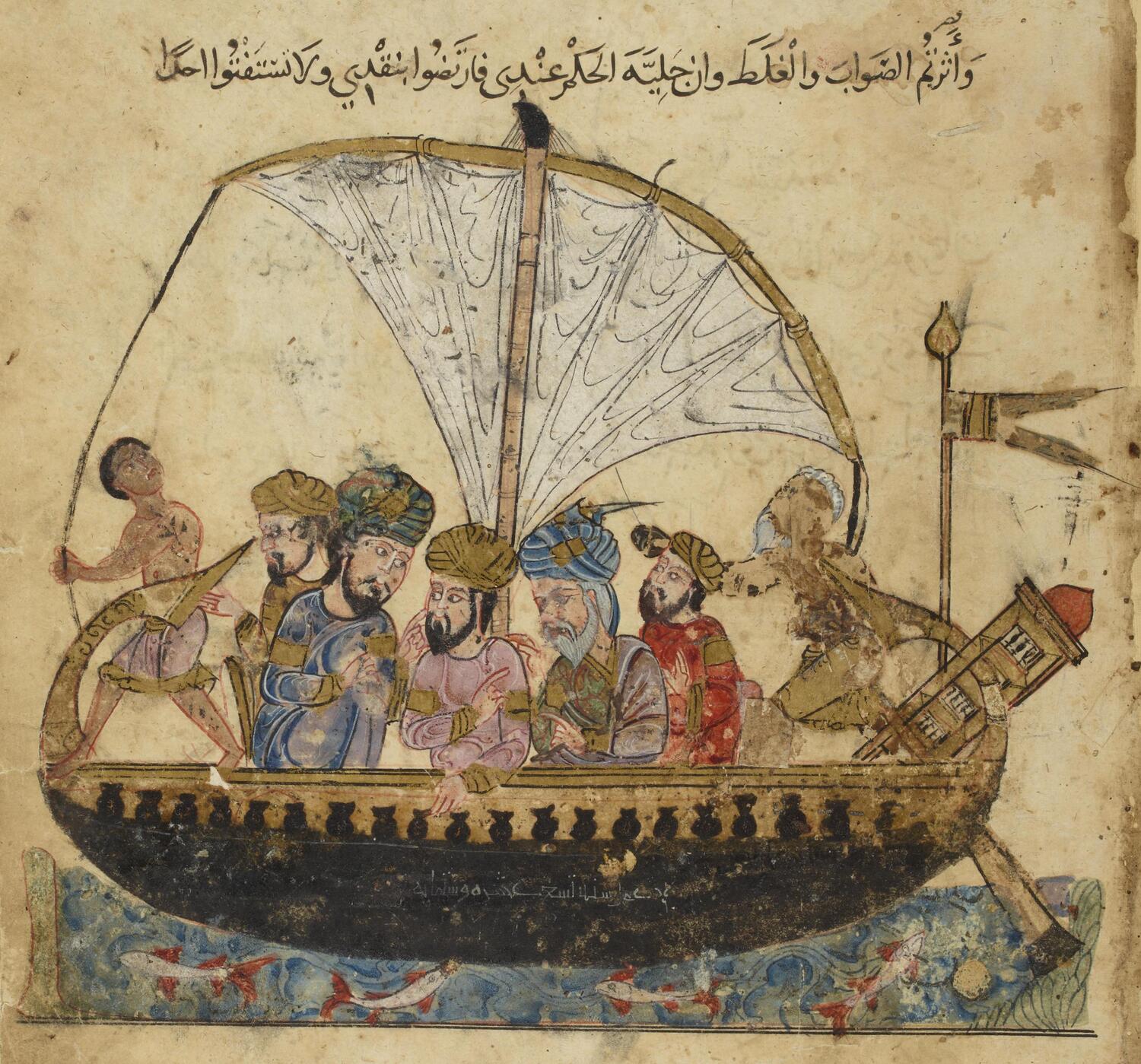

Furthermore, I saw in my dream that all of us—all twelve tribes—were standing with Jacob our father on the seashore. Behold! A large ship was sailing on the sea with nobody on it. Our father said to us, “Do you see anything?” We said to him, “We see that there appears to be a ship sailing on the sea without captain or crew.” Jacob removed his clothing and entered the water, and everyone followed him. Levi and Judah reached it before everyone else and jumped into the ship, and Jacob our father with them. In the ship were found all the valuables in the world, and all of us entered it.
Jacob said to them, “Look at the mast and see what is written on it, for every single ship in the world has its owner’s name written on it.” Levi and Judah looked and behold, written on the mast was: “This ship and all that it contains belong to Barakhel [i.e., Jacob, Isaac’s son, whom God blessed; see y. Sotah 5:3].” When Jacob heard this, he was very happy, and praised and thanked the Omnipresent. He said, “It is not enough that the Holy One blessed me on the land, but He has increased me on the sea!”
Our father turned to us and said, “My children, now everyone must strengthen themselves and take their part in directing the ship.” Immediately, Levi jumped onto the large mast, and Judah jumped on the second mast, and they sat on them. The other brothers took the oars, and Jacob grabbed hold of the helm to steer the boat.
Joseph alone was left without having taken hold of anything. Jacob said to him, “Take an oar.” But he did not want to listen to his father, and he did not take up anything. He said to him, “My son, come here and take the helm and steer the boat, and your brothers will row with the oars until we reach land. We will steer the boat slowly. Do not fear and do not be afraid of the waves or of the stormy wind.” When Jacob finished giving those instructions, he disappeared. Joseph took hold of the two helms—one on the right and one on the left—and the other brothers rowed with the oars, driving the ship forward in the water, while Levi and Judah sat in the masts to see that the ship was moving forward in a straight path.
Whenever Joseph and Judah were in agreement, the ship moved forward in the right path without encountering any obstacles. But after a time, a disagreement broke out between Joseph and Judah, and they did not direct the ship in the manner that their father had told them, so they caused the ship to list diagonally, and the waves dashed the ship against a rock, and it came close to breaking apart. Levi and Judah came down from the mast in an attempt to save themselves, as did all the other brothers, until they reached land.
Our father also came and found us beaten and confused. He said to them, “Perhaps you did not follow my instructions regarding how to pilot the ship?” They answered, “By your life! We did not stray from any of your commands! The only one who did was Joseph, who disobeyed your instructions and became angry with Levi and Judah because he was jealous of them. That is why the ship listed diagonally and sank.” Our father said to them, “Show me the place.” They said to him, “It is where the waves crash together.” Jacob looked and saw that the tops of the masts could be seen. Everyone gathered together with him, and he threw himself into the sea. He took the ship and repaired it, and he and his sons entered it. He rebuked Joseph, saying, “My son, do not continue to provoke your brothers, because they were almost destroyed because of you.” He responded, “I will not do so again.”
When I told my vision to my father, he clapped his hands together, sighed, and his eyes filled with tears. I was terribly embarrassed, but he said nothing to me. I grabbed my father’s hand to hug and kiss it, saying, “You servant of God! Why are you crying?” He said to me, “The repetition of your dream made my heart worry and stunned my body, for I loved my son, Joseph, more than all my [other] children. But because of the damage that he caused, you will be exiled and spread out among the nations. Your first and last visions carry the same message. For this reason, I command you that you should not join forces with Joseph under any circumstances. I will make sure that your lot and that of your brothers falls out in the best of the land so that you can eat and be satisfied from its goodness. Do not rebel because of its richness, nor defy the word of God who feeds you from the best of His land. Do not forget your God who was chosen by our forefather, Abraham.”
Credits
Published in: The Posen Library of Jewish Culture and Civilization, vol. 3: Encountering Christianity and Islam.
You may also like

The Alphabet of Ben Sira
The Midrash of Ben Sira

Tale of the Jerusalemite
Likely written in 9th-century Iraq, this Hebrew tale warns against broken oaths by telling the story of a man's marriage to a demon princess.

Additional Questions
The Tale of Ben Sira (Prose Version)
The Story of Daniel
Qiṣṣa-ye Dāniyāl, ll.1-4, 18-19, 23-25, 37-40, 42-52, 55-56.
You may also like
The Alphabet of Ben Sira
The Midrash of Ben Sira
Tale of the Jerusalemite
Likely written in 9th-century Iraq, this Hebrew tale warns against broken oaths by telling the story of a man's marriage to a demon princess.
Additional Questions
The Tale of Ben Sira (Prose Version)
The Story of Daniel
Qiṣṣa-ye Dāniyāl, ll.1-4, 18-19, 23-25, 37-40, 42-52, 55-56.