

Additional Questions
About This Entry
The so-called Additional Questions (She’elot nosafot), part of the early medieval corpus of Ben Sira literature, tells of a series of twenty-two satirical (and heretical) questions that Ben Sira supposedly posed to Nebuchadnezzar. Scholars debate whether the author of the Ben Sira narrative presented in The Tale of Ben Sira (Toledot Ben Sira) composed this text as well. These twenty-two questions correspond to the twenty-two letters of the Hebrew alphabet. The unknown author of this entertaining text was clearly well educated in biblical and rabbinic traditions and often plays on these texts in mocking and subversive tones.
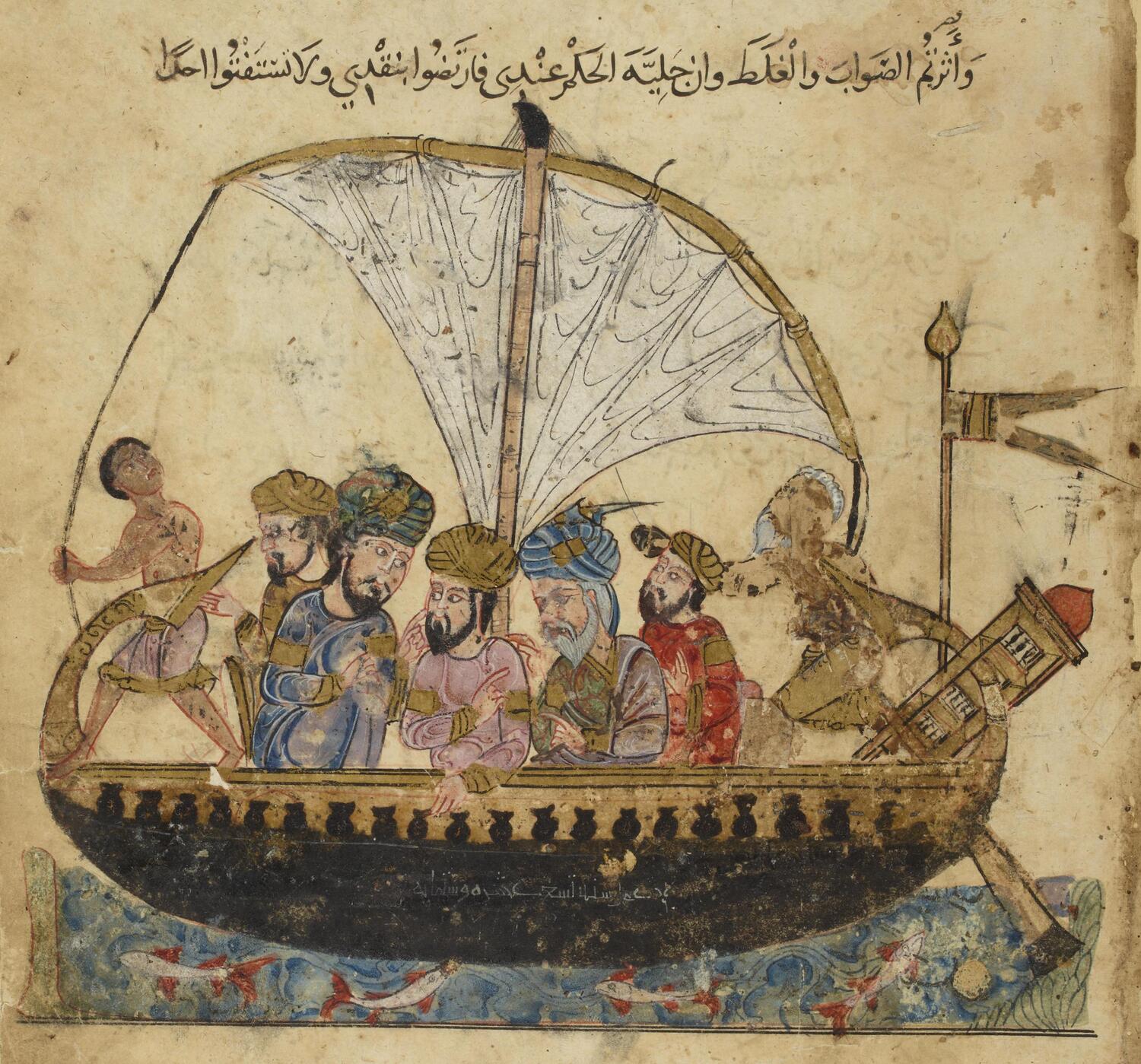

After all these [twenty-two] questions, Nebuchadnezzar asked, “Ask—how shall I pay you?”
Ben Sira replied, “My lord the king, I ask nothing of you except that you redeem the pledge that you made to me.”
The king replied, “I owe you nothing.”
Ben Sira replied, “But did you not promise me the weight of a unicorn [re’em] in gold?”
The king objected, “But where will you find weights or scales that can weigh a unicorn?”
Ben Sira said to him, “I will tell you how you should proceed. There is nothing in the world over which you do not have mastery. So first, procure a unicorn. Next, send [the order] through all your kingdom so they will construct a ship for you as long as the Sea of Reeds. After they construct the ship, place the unicorn in it, and place the ship in the sea. At that moment, the ship with the unicorn in it will sink. When it sinks, take a knife and make a mark on the ship at the water line, indicating how much it sank. Then, take the ship out of the sea and take the unicorn out of the ship. Place the gold that you pledged me in the ship and place the ship in the sea. Add gold to the ship, until the ship sinks to the place that was marked. When it sinks to the place indicated, then the gold will be equal to the weight of the unicorn. Give that gold to me. After that, do the same with pearls, and give me that weight in pearls.”
The king retorted, “And for the sake of the twenty-two things that you said to me, I should pay you the weight of two unicorns? Are your words for sale?”
Ben Sira replied, “Have you not heard that a sage is worth a thousand dinars, and a fool three pence? For the sage can make the three pence into a thousand zuzim, whereas the fool takes a thousand zuzim and turns it into three pence. I am the sage, and you are the fool. I came with the three pence that I paid for the journey, and with them I have acquired the thousand thousands of dinars that you are giving me. And you, for those thousand thousands of dinars, have not acquired even three pence. If you were wise, you would not despise my wisdom.” [ . . . ]
The next day, Ben Sira came. The king asked him, “If you cannot answer my questions, what should I do about you?”
Ben Sira replied, “Take back everything you have given me.”
The king replied, “You have spoken well.” And Ben Sira swore to the agreement. [ . . . ]
They [the wise men] furthermore asked, “Why is the rotation of the moon not like that of the sun?”
Ben Sira replied, “Originally, the sun and moon were equally bright, and their orbits were identical. The moon went to the Holy One and asked, ‘Master of the Universe! Why are we equally beautiful and equally bright?’ The Holy One replied, ‘Since you ask, I will take some of your light and give it to the sun.’ The moon objected, ‘Master of the Universe! Because I spoke correctly before You, should You go and take away my light?’” [ . . . ]
They asked him further, “Tell me, where is the midpoint of the heavens?”
Ben Sira replied: “At the heavenly Temple.”
They asked, “Is there a heavenly Temple?”
He replied, “Yes.”
They asked, “Tell me where it is.”
He replied, “It is aligned opposite the earthly Temple, as the verse says: A foundation [makhon] for Your habitation (Exodus 15:17). The rabbis commented, ‘Read not makhon [foundation] but rather mekhuvan [aligned], teaching that the two are aligned opposite each other.’”
The wicked king replied, “You say there is a heavenly Temple, but I don’t know if this is true or false. I trust you because you have cited a verse. But who knows if that heavenly Temple marks the midpoint of the heavens?”
Ben Sira replied, “If you don’t believe it, send forth your sons and servants and let them measure the heavens. If they find it is not the case, take back from me all the wealth that you have given me.”
He replied, “Who has gone up to heaven and come down? (Proverbs 30:4). And even if you find someone who can go up, who can measure the heavens?”
Ben Sira replied, “If so, what can I do? Trust me before you measure.”
Immediately, the king said to Ben Sira, “As you have answered all my other questions truthfully, so you speak truthfully in this matter as well.” He believed him and said, “So be it.” [ . . . ]
They asked furthermore, “Why is a woman’s voice more pleasant than a man’s?”
He replied, “Woman was created from bone, and man from earth. If you want to test the difference, take one pot filled with bones and another filled with earth. Roast each of them on the fire, and you will see which makes a more pleasing sound.” [ . . . ]
They asked furthermore, “What are the signs engraved on every person’s hand?”
Ben Sira replied to Nebuchadnezzar, “It is a ledger record of what that person has done. On the right hand are written all a person’s merits, and on the left hand all his liabilities, [as it is written: He inscribes on every man’s hand, that everyone may know his deeds (Job 37:7)].”
Nebuchadnezzar said to Ben Sira, “Bravo! Happy are your father and your mother!” He gave him a unicorn’s weight of pearls, and he went on his way.
Thereupon, the wicked Nebuchadnezzar ordered that all his other sages be slain. From that point on, he brought Hananiah, Mishael, and Azariah into his court.1 Ben Sira migrated to the land of Israel and dispensed all the wealth he had acquired for charitable purposes. He settled there and spent his time studying, writing, and editing many books.
Notes
[These three are mentioned in Daniel 1:7 as the three youths from the tribe of Judah who served in Nebuchadnezzar’s court.—Trans.]
Credits
Published in: The Posen Library of Jewish Culture and Civilization, vol. 3: Encountering Christianity and Islam.
You may also like

Tale of the Jerusalemite
Likely written in 9th-century Iraq, this Hebrew tale warns against broken oaths by telling the story of a man's marriage to a demon princess.

The Tale of Ben Sira (Prose Version)
The Story of Daniel
Qiṣṣa-ye Dāniyāl, ll.1-4, 18-19, 23-25, 37-40, 42-52, 55-56.

Tanḥuma: The Daughter of King Solomon
In this 10th-century Hebrew legend, a king tries to prevent his daughter from marrying a pauper, but she takes matters into her own hands and fulfills the divine will.
The Vision of Daniel
The Tale of Tseḥok ben Esther
You may also like
Tale of the Jerusalemite
Likely written in 9th-century Iraq, this Hebrew tale warns against broken oaths by telling the story of a man's marriage to a demon princess.
The Tale of Ben Sira (Prose Version)
The Story of Daniel
Qiṣṣa-ye Dāniyāl, ll.1-4, 18-19, 23-25, 37-40, 42-52, 55-56.
Tanḥuma: The Daughter of King Solomon
In this 10th-century Hebrew legend, a king tries to prevent his daughter from marrying a pauper, but she takes matters into her own hands and fulfills the divine will.