

Book of the Source of Life
About This Entry
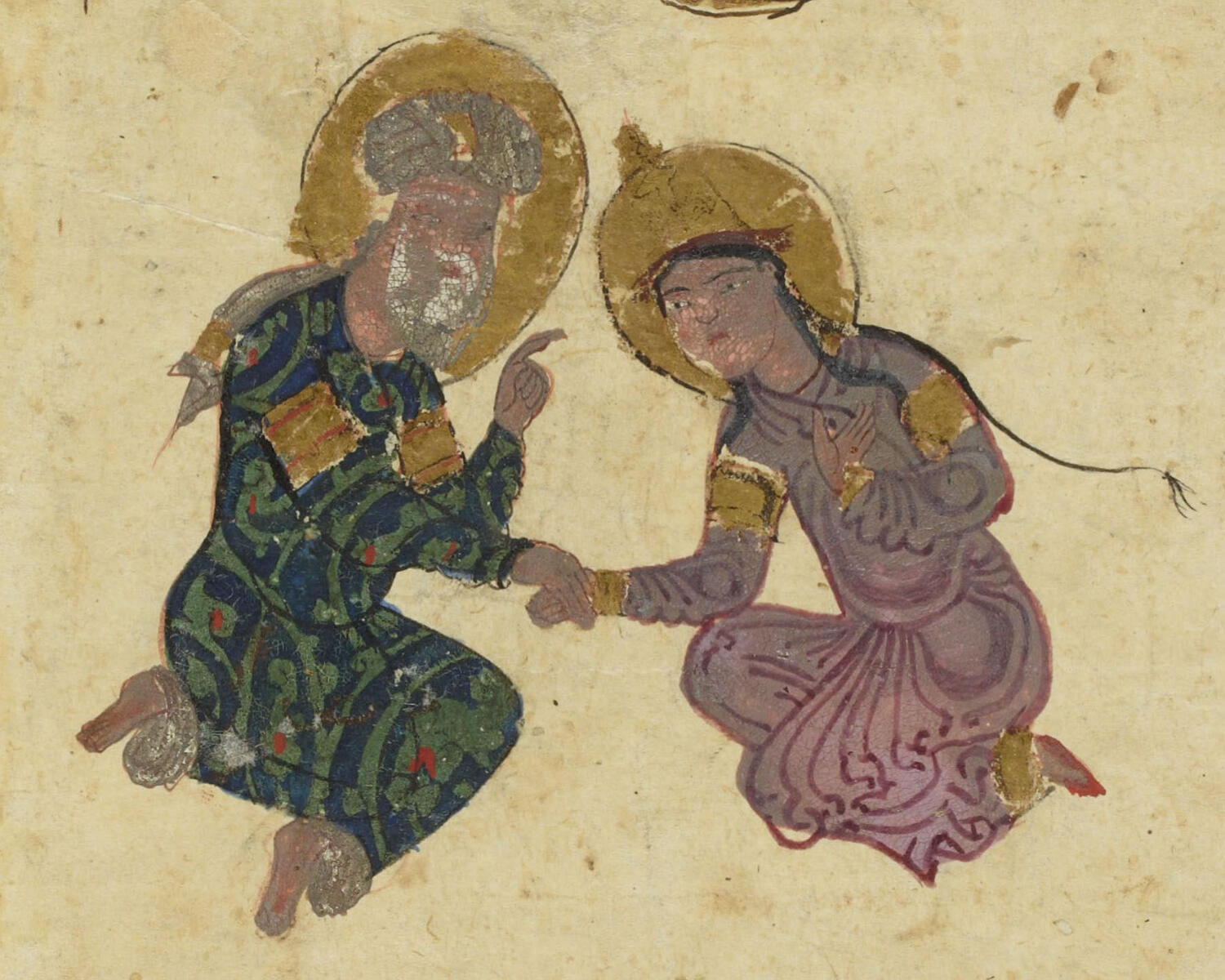
Ibn Gabirol composed the Book of the Source of Life (Kitāb yanbū‘ al-ḥayāt) as a dialogue between a student and a teacher about Neoplatonic philosophy. Only parts of the original Judeo-Arabic version survive, as well as a partial Hebrew translation by Shem Tov Ibn Falaquera under the title Mekor ḥayim, produced in the thirteenth century, and a full Latin translation by John of Seville and Dominicus Gundissalinus under the title Fons vitae, produced in 1150 in Toledo. In Latin translation, the Fons vitae was quite popular, especially among Franciscans; many Christians believed the author to be an Augustinian or a Muslim who misunderstood Aristotle. This excerpt begins with a parable for understanding the act of creation and then moves on to outline what one needs to study aside from matter and form, and for what ultimate purpose.

Treatise V, Section 43
You previously compared creation to the flow of water from its source, and the reflection of the form in a mirror. Does it resemble anything else?
Creation is likened to the word which a man pronounces. For when a man pronounces a word, its form and its meaning is impressed upon the ear and the intellect of the hearer. According to this simile it is said that the Creator (may He be praised and exalted) pronounced a word, and its meaning was impressed upon the essence of matter, and matter retains it, i.e., the created form is impressed in matter and marked in it.
Expound upon this simile and adapt it to the other one.
Sound is similar to universal matter in that sound is a universal matter that sustains all particular sounds, which include tones, movements [i.e., vowels], and stops; and the manifest form is like the form of the word that is heard and is divided into particular forms which subsist in singular particular materials. By particular forms I mean particular movements, and by particular materials, I mean tones. But the hidden form is the meaning which the word signifies.
What is creation compared to?
Speech. With the articulation of the word, when spoken, the matter which sustains the manifest form of the word, as well as its invisible form, i.e., its meaning, possesses being. Both forms exist together.
Do the parable and its interpretation agree in any way?
They agree in that each of them needs an agent for their being and their existence.
All the preceding has made evident to me that nothing besides matter and form exists in everything created. I now understand universal matter and universal form. I have discovered that movement is a force that flows from will, and that will is a divine force that permeates everything and extends over everything, as light in air and the soul in the body and the intellect in the soul. Now, then, teach me what I must presently investigate.
You shouldn’t think that the science of matter and form can suffice for everything that you need. Be patient and not overhasty. You must always consider the essence of each of them, i.e., universal matter and universal form, in abstraction from each other, and you must reflect upon the manner in which form emanates and infuses absolute matter, and the manner in which it proceeds to all substances according to their rank. Your intellect should distinguish most clearly matter from form, form from will, and will from movement. For if you do this, your soul will be purified, and your intellect will be enlightened and will penetrate to the world of intellect. You will intellectually cognize universal matter and form, and matter with all its forms will be to you as a book laid out before your eyes. You will gaze with your intellect at all its depictions, and you will apprehend with your intellect all its figures. Then you will have hope in your capacity to apprehend all that is above this.
What is above this?
The purpose for which everything exists as it does, i.e., the knowledge of the world of the Divinity, which is the maximum totality. Whatever is below this is insignificant in comparison.
What is the way to achieve this most worthy knowledge?
To achieve this knowledge there are two ways. The first is through the knowledge of the will in so far as it flows into all matter and form. The second is through the knowledge of the will in so far as it encompasses matter and form, which is the most exalted power, and which is not commingled with anything material or formal. However, you will only be able to ascend to the knowledge of the power that is not commingled with anything material or formal, by conjoining with the power in so far as it is commingled with matter and form, and by ascending by means of this power level after level, until you reach its principle and its root.
What is the select fruit of this study?
The escape from death and the conjunction with the source of life.
What helps to achieve this worthy hope?
First, to separate yourself from all sensible things, to become immersed with all your mind in the intelligibles, and to attach yourself, in your entirety, to the One who bestows the good. For when you do this, He will gaze upon you, and He will be generous with you, as befits him. Amen.
Credits
Solomon Ibn Gabirol, Book of the Source of Life, trans. Charles H. Manekin, from The Jewish Philosophy Reader, ed. Daniel H. Frank, Oliver Leaman, and Charles H. Manekin (London and New York: Routledge, 2000), 198–200. Used with permission of the translator. Photo: Bibliothèque nationale de France, Department of Manuscripts. Arabe 3929, fol. 22v, detail.
Published in: The Posen Library of Jewish Culture and Civilization, vol. 3: Encountering Christianity and Islam.
You may also like

Book of the Selection of Pearls
Kitāb mukhtār al‑jawāhir, 1-2, 81, 122-123, 129-131, 223, 228, 261, 370, 374, 551
Kingly Crown: The Wonders of Creation
Keter malkhut: X-XIV; XXIII-XXIV; XXIX-XXX

Preface to Ben Tehilim
Preface to Ben Mishle
Treatise on Optics
Treatise on the Nature of the Soul: Introduction
Kitāb ma‘ānī al-nafs, Introduction
You may also like
Book of the Selection of Pearls
Kitāb mukhtār al‑jawāhir, 1-2, 81, 122-123, 129-131, 223, 228, 261, 370, 374, 551
Kingly Crown: The Wonders of Creation
Keter malkhut: X-XIV; XXIII-XXIV; XXIX-XXX
Preface to Ben Tehilim
Preface to Ben Mishle
Treatise on Optics
Treatise on the Nature of the Soul: Introduction
Kitāb ma‘ānī al-nafs, Introduction