

Against Menaḥem Ibn Sarūq’s Maḥberet: Introduction
About This Entry
A member of the circle of Ḥasday Ibn Shaprūṭ, Dunash ben Labraṭ composed an impassioned critique of the Notebook (Maḥberet; a Hebrew dictionary) of Menaḥem Ibn Sarūq. The work is written as a poem with a lengthy commentary; the prose commentary sections explain in detail the objections to the Notebook. Dunash announced that Menaḥem had adopted problematic theological views and had erred in some of the fundamentals of Hebrew grammar. One claim consisted of the probably baseless accusation that Menaḥem had embraced certain aspects of Karaism. Dunash’s attack on Menaḥem spurred responses and counterresponses among their students. In these excerpts, Dunash attempts to show the purity of his intentions.
Many warm greetings to you, R. Menaḥem ben Jacob, from me, Dunash ben Labraṭ, your brother and beloved, who prays to God for your welfare. Righteousness itself should love you. Your face should light up with wisdom. May you be righteous, and may others become righteous through you. May you be placed in the assembly of those who lead others to righteousness, regarding whom it is written: And they who turn the many to righteousness [shall shine] as the stars for ever and ever (Daniel 12:3).
Know, my brother, that I have reproved you greatly only so you should love me greatly, as it is written: Do not reprove a scorner, lest he hate you; reprove a wise man, and he will love you (Proverbs 9:8), and it states about reproof such as mine: Better is open rebuke than hidden love (Proverbs 27:5). I formed my reproof into a song, to serve as a siren for your wrong. The rest I set in prose, in the form of a letter to you, so that it may be grasped by all the discriminating. And Lord knows that had I not seen the book, and had I not informed you of a few [mistakes] collected here, from the many that remain, evil and mockery would have arisen in the hearts of the simpler students (and indeed in many of those who are called discerning). Now in the Lord I trust, and I place my hope in Him that this book will reveal to you the rest of the errors that are written in your book. For regarding one as wise as you, it is written: Give to a wise man, and he will be yet wiser (Proverbs 9:9).
By law, each member of the holy people should reprove his fellow, as God commanded: You shall surely rebuke your neighbor (Leviticus 19:17). Thus, we should contend with one another, so that we can whiten our sins like the snow and wool; though [your sins] be red like crimson, they shall be as wool (Isaiah 1:18). It is known that the great sin of the early ones was their hatred of one who reproves, as it is written: They hate him who reproves in the gate, [and they abhor him who speaks uprightly] (Amos 5:10). The bottom line is that he who is brutish hates reproof (Proverbs 12:1).
The only man who can construct a work explaining language, with all its rules, regulations, and laws, is one who has amassed knowledge of its basic principles and structure. The foundation of his work must be fear of the Lord, his Maker, as it is written: The fear of the Lord is the beginning of wisdom (Psalm 111:10). For one who fears the Master will be careful to avoid error and willful mishap.
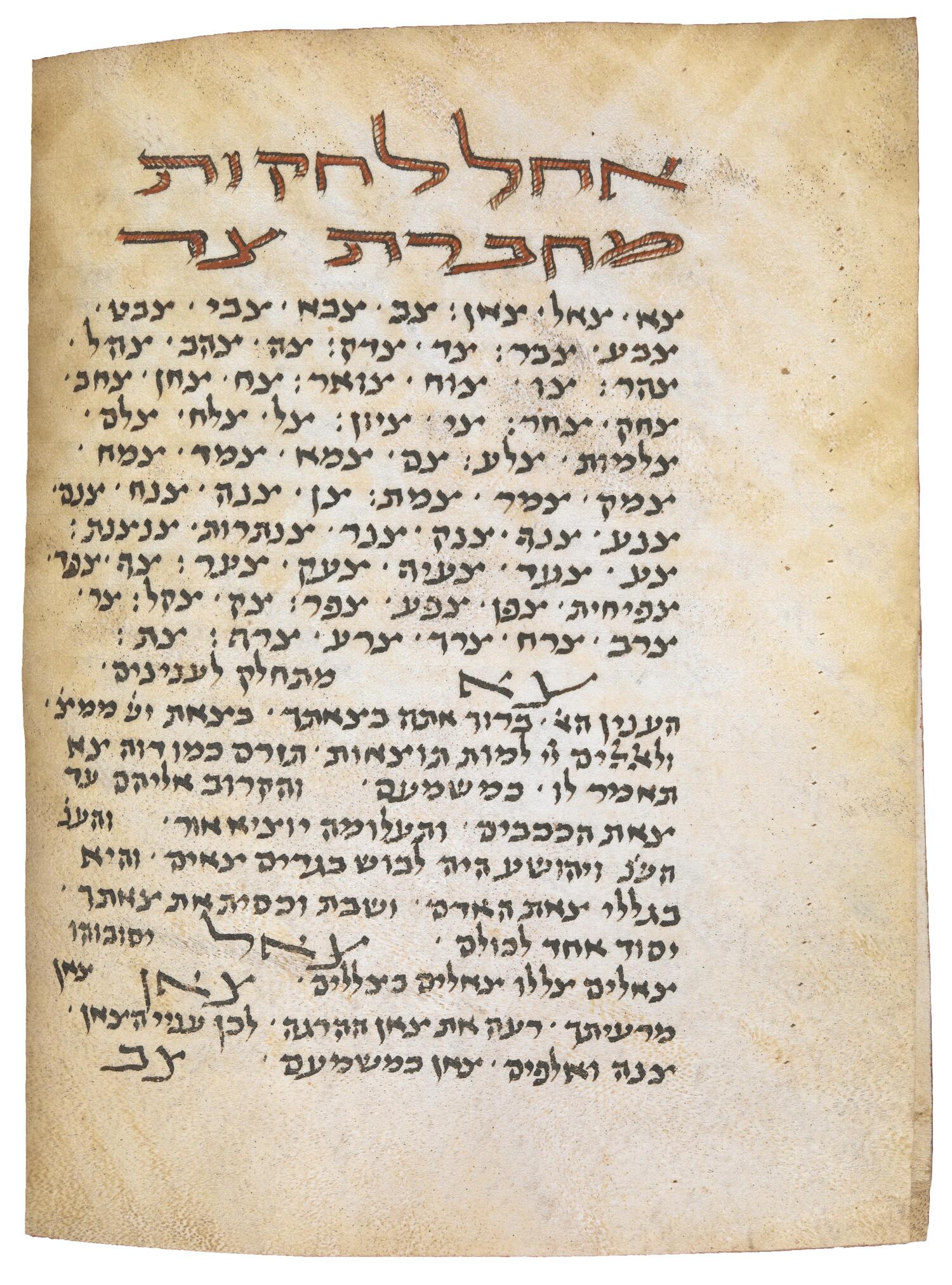

Published in: The Posen Library of Jewish Culture and Civilization, vol. 3: Encountering Christianity and Islam.
You may also like

An Early Manuscript Copy of the Notebook (Maḥberet)

Book of Responses
Sefer teshuvot
Responsum: On Grammar
Book on Verbs That Contain Weak and Lengthening Letters
Kitāb al-af‘āl dhawāt ḥurūf al-līn
Letter: On Arabic Meter
Book of the Collection of Words: Introduction
Kitāb jāmi‘ al-alfāẓ
You may also like
An Early Manuscript Copy of the Notebook (Maḥberet)
Book of Responses
Sefer teshuvot
Responsum: On Grammar
Book on Verbs That Contain Weak and Lengthening Letters
Kitāb al-af‘āl dhawāt ḥurūf al-līn
Letter: On Arabic Meter
Book of the Collection of Words: Introduction
Kitāb jāmi‘ al-alfāẓ