

Tafsīr (Arabic Translation): Introduction
About This Entry
This translation of the Torah, known in Arabic simply as the Tafsīr, is one of the most important works ever written in Judeo-Arabic. It replaced earlier Judeo- Arabic translations and became immensely popular as a way Arabic-speaking Jews (and non-Jews) could access the Hebrew Bible. Karaites and others would later produce their own translations, but these were never as popular. Se‘adya translated many other biblical books, but it is not clear how many. In this introduction, he presents his approach and the importance of his project. Se‘adya provides a fairly literal translation of the original Hebrew, but he inevitably engaged in interpretative decisions at every turn.
The Omniscient One resolved to instruct sentient beings through [His] Torah, and to guide them to His obedience, in three [different] ways, each more rigorous than the other. The first [way] is the feeblest, in which the subject is instructed: “Do this but not that,” without [the instructor] revealing the consequence of what he prescribes or prohibits, since it is clear to him that [the pupil] will perform his command and shun what is forbidden. The second [way] consists in revealing to the pupil, in conjunction with the command or prohibition, the consequence of that which he chooses to do, namely, “Do this, and you will be thus rewarded; do not do that, or you will be thus punished.” This is more rigorous than the first [way], because it portrays for [the subject] his gain, either of pleasure or suffering, depending on what he chooses to do. The third [way] is where, after informing the one who is commanded or prohibited about the good reward for compliance, [the teacher] demonstrates how, when people comply with this obedience, they are beautifully and happily rewarded; and after informing him of the severe punishment attendant on transgression, [the teacher] demonstrates how people who cast themselves to transgression are punished and suffer. This way is more rigorous than the two previous ones, for affliction and trial impress the one who hears and stand as visual testimony. [ . . . ]
Know, O one who examines this book, that despite the glory of its power, the nobility of its eminence, such that all the books of the prophets cannot be compared to it—despite its literary profundity, which explicates all mysteries and enigmas—let not the believers presume that God has for them no other argument besides this. Rather, it is incumbent upon them that they know He has two others. One of these [arguments] predates [the Torah]; this is the argument of reason, by which [men] know that all visible and otherwise sensible things are created, and that their Creator is timeless, devoid of beginning or end; that He is one and cannot be compared to [created things,] nor can these [things] be compared to Him; that He is omniscient, knowing what will be before it exists; that He is the Creator, who creates what He wills ex nihilo; that He is just, not imposing on his followers that which they cannot do; and all other such rational deductions that derive from the tenets of theology, such as rational precepts like truth and justice. But I shall refrain from elaborating on this matter in the present work, for I did not write it for such purpose. The other argument postdates [the Torah]; it is the knowledge of the legacy of the prophets, the guidance they provided in every human affair—how they formulated laws that human reason neither compels nor suggests, but to which man is amenable to comply. After the prophets established [these laws], they became authoritative, even though their measure and method [of execution] are not explicitly attested to in the Torah. [ . . . ]
Now, I have written this book at the behest of certain individuals who requested I present the plain meaning of the text of the Torah in a separate work, unadulterated by any feature of language that might change, alter, juxtapose, or impose metaphor, in which will sound neither echo of the contentions of the heretics, nor any polemical engagement with them, nor an explication of the different kinds of rational commandments, nor how to execute the laws not justified by reason—only an exposition of the [plain] meaning of the text of the Torah.
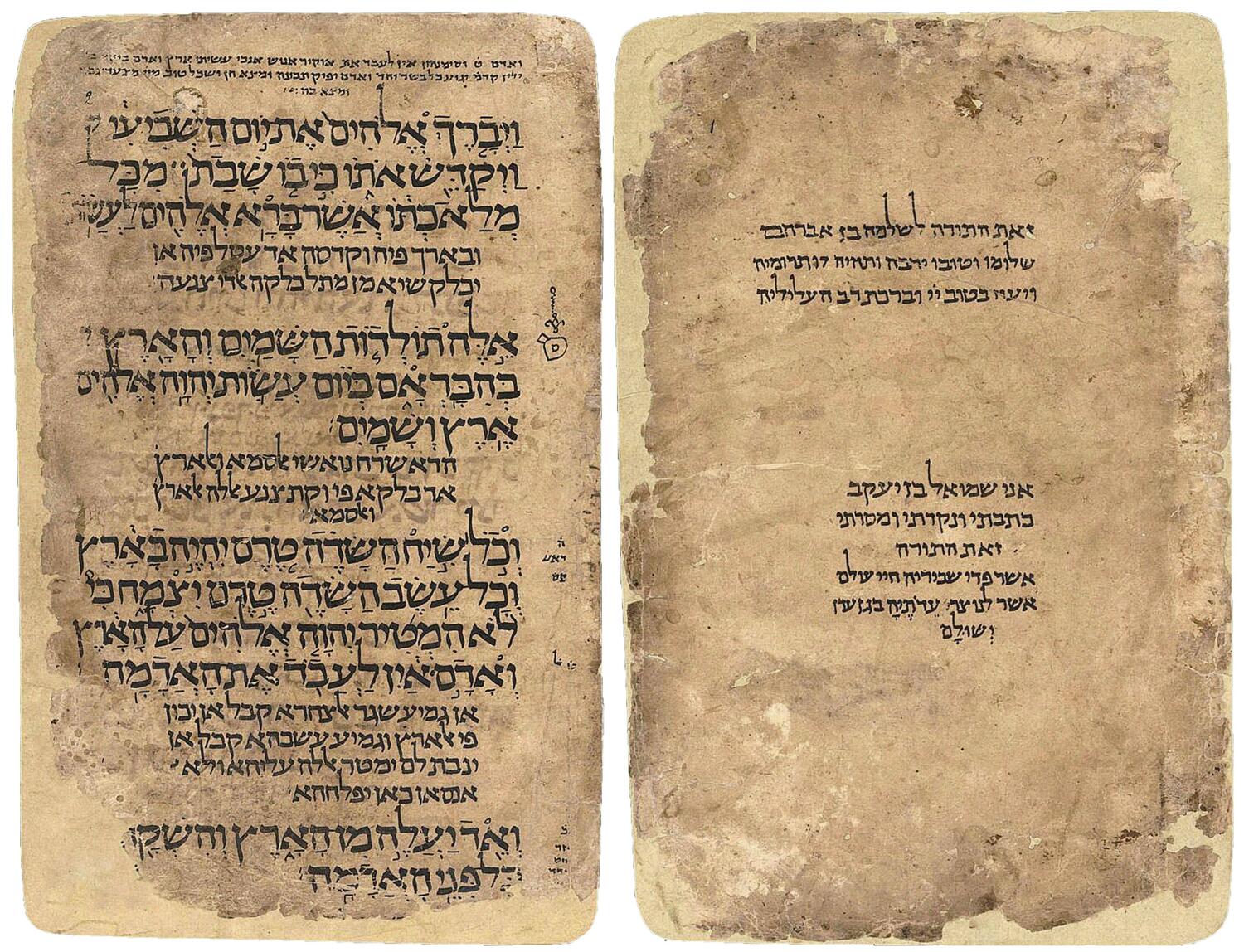

Published in: The Posen Library of Jewish Culture and Civilization, vol. 3: Encountering Christianity and Islam.
You may also like

Commentary: On the Song of Songs
Commentary on Song of Songs 1:15-17; 2:7; 4:10; 5:1.

An Early Manuscript Copy of Se’adya’s Tafsīr
Commentary: On Genesis
On Genesis 1:28
Book of Theodicy (Commentary on Job)
Commentary on Job, Introduction and Chapter 1 (selections)
Book of Conviviality in Exile (Commentary on Esther)

Commentary: On Psalms
On Psalms 69:1–3; 13
You may also like
Commentary: On the Song of Songs
Commentary on Song of Songs 1:15-17; 2:7; 4:10; 5:1.
An Early Manuscript Copy of Se’adya’s Tafsīr
Commentary: On Genesis
On Genesis 1:28
Book of Theodicy (Commentary on Job)
Commentary on Job, Introduction and Chapter 1 (selections)
Book of Conviviality in Exile (Commentary on Esther)
Commentary: On Psalms
On Psalms 69:1–3; 13