

Man with Torah
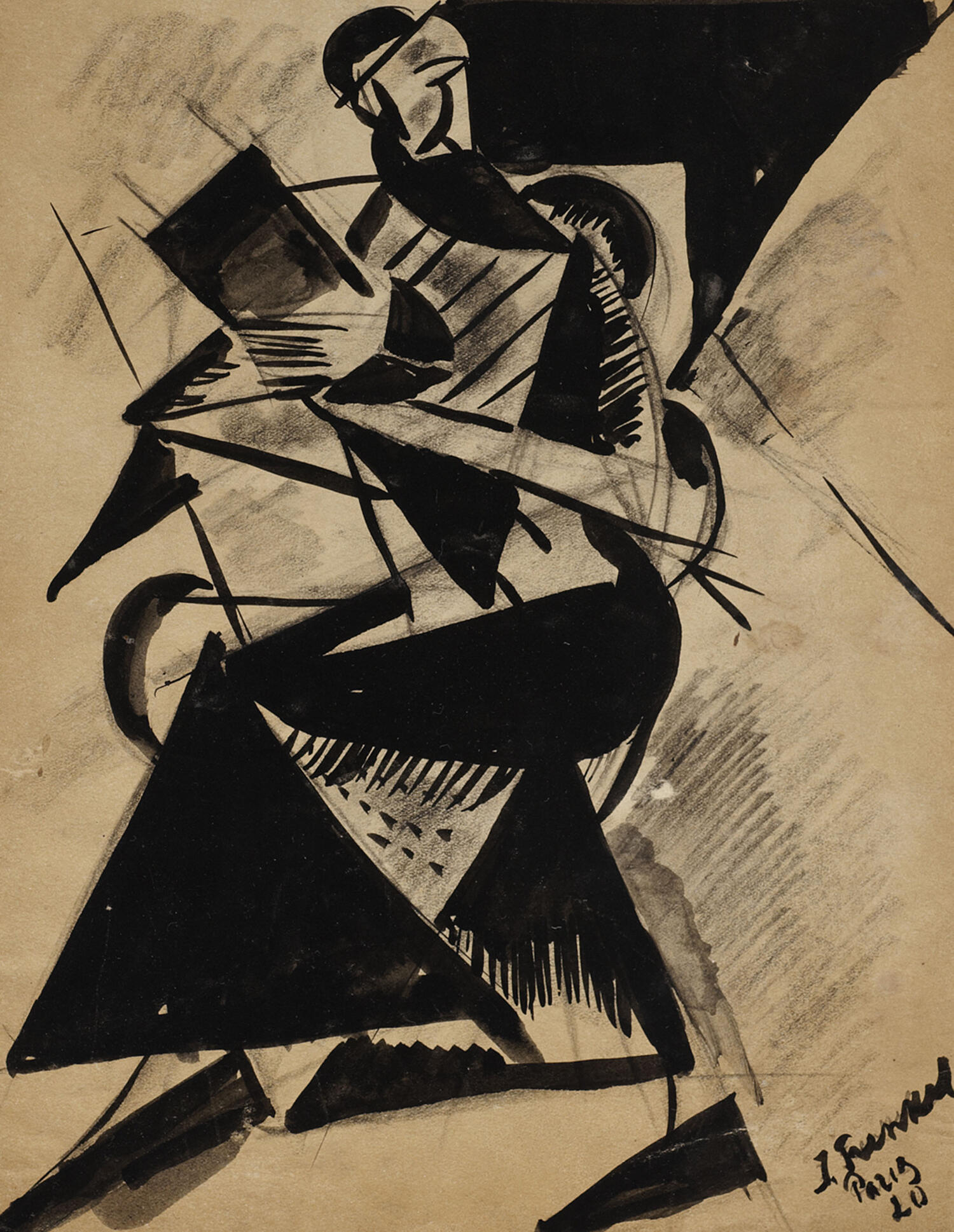

Frenkel, whose work was shaped by the School of Paris (École de Paris), played a key role in bringing modernism to Israeli art. Among his students were prominent members of what is known as the Land of Israel movement, a group of artists who, in the 1920s, broke away from the artistic conventions characteristic of the Bezalel School of Arts and Crafts. They and Frenkel drew on the ideas and practices of post-impressionism to create a new modern art of Jewish revival in Palestine, favoring light colors and naïve, flat painting. This cubist work, done in watercolor, pen, and ink on paper, dates from the period when Frenkel was living in Paris, before he returned to Palestine and established the Histadrut Art School in Tel Aviv.
We’re sorry. The Posen Library’s licensing agreements prevent this image from being printed or downloaded.
Credits
Ben Uri Gallery, The London Jewish Museum of Art.
© Estate of Yitshak Frenkel-Frenel.
Published in: The Posen Library of Jewish Culture and Civilization, vol. 8.
You may also like

Woodcut no. 1
Tkhiyes-hameysim (The Resurrection of the Dead) is a dramatic poem by Moyshe Broderzon inspired by medieval Christian “mystery” (or “miracle”) plays that presented bible stories and were performed in…

Self-Portrait
In the interwar period, Liebermann’s portraits were highly sought after by the wealthy. He also produced many self-portraits. This one, painted when he was in his seventies, portrays him as a self…

The Meeting: A Jewish Youth and Two Women in an Urban Alley
The Meeting, Schulz’s only surviving oil painting, obliquely explores a theme he returned to many times in his writing and art, namely, sadomasochism, this time in the context of an encounter between…

Cover, Di malke Shvo: dramatishe poeme
In 1920 and 1921, Broderzon, the guiding force of Yung-yidish (Young Yiddish), a literary and artistic group he co-founded in Łódź, published over half a dozen books of poetry and plays. Prolific and…

Jacob Kramer
The rough-hewn sculptures that Epstein created early in his career, like that of the painter Jacob Kramer (1892–1962), departed from the conventions of classical Greek sculpture in a radical way that…

Of the High Priest’s Tribe
An important Jewish genre painter, Kaufman drew inspiration for his romantic depictions of traditional Jewish life from trips to Moravia and Upper Hungary, Galicia and Bukovina and areas of Russian…
You may also like
Woodcut no. 1
Tkhiyes-hameysim (The Resurrection of the Dead) is a dramatic poem by Moyshe Broderzon inspired by medieval Christian “mystery” (or “miracle”) plays that presented bible stories and were performed in…
Self-Portrait
In the interwar period, Liebermann’s portraits were highly sought after by the wealthy. He also produced many self-portraits. This one, painted when he was in his seventies, portrays him as a self…
The Meeting: A Jewish Youth and Two Women in an Urban Alley
The Meeting, Schulz’s only surviving oil painting, obliquely explores a theme he returned to many times in his writing and art, namely, sadomasochism, this time in the context of an encounter between…
Cover, Di malke Shvo: dramatishe poeme
In 1920 and 1921, Broderzon, the guiding force of Yung-yidish (Young Yiddish), a literary and artistic group he co-founded in Łódź, published over half a dozen books of poetry and plays. Prolific and…
Jacob Kramer
The rough-hewn sculptures that Epstein created early in his career, like that of the painter Jacob Kramer (1892–1962), departed from the conventions of classical Greek sculpture in a radical way that…
Of the High Priest’s Tribe
An important Jewish genre painter, Kaufman drew inspiration for his romantic depictions of traditional Jewish life from trips to Moravia and Upper Hungary, Galicia and Bukovina and areas of Russian…