

Warsaw Kneel
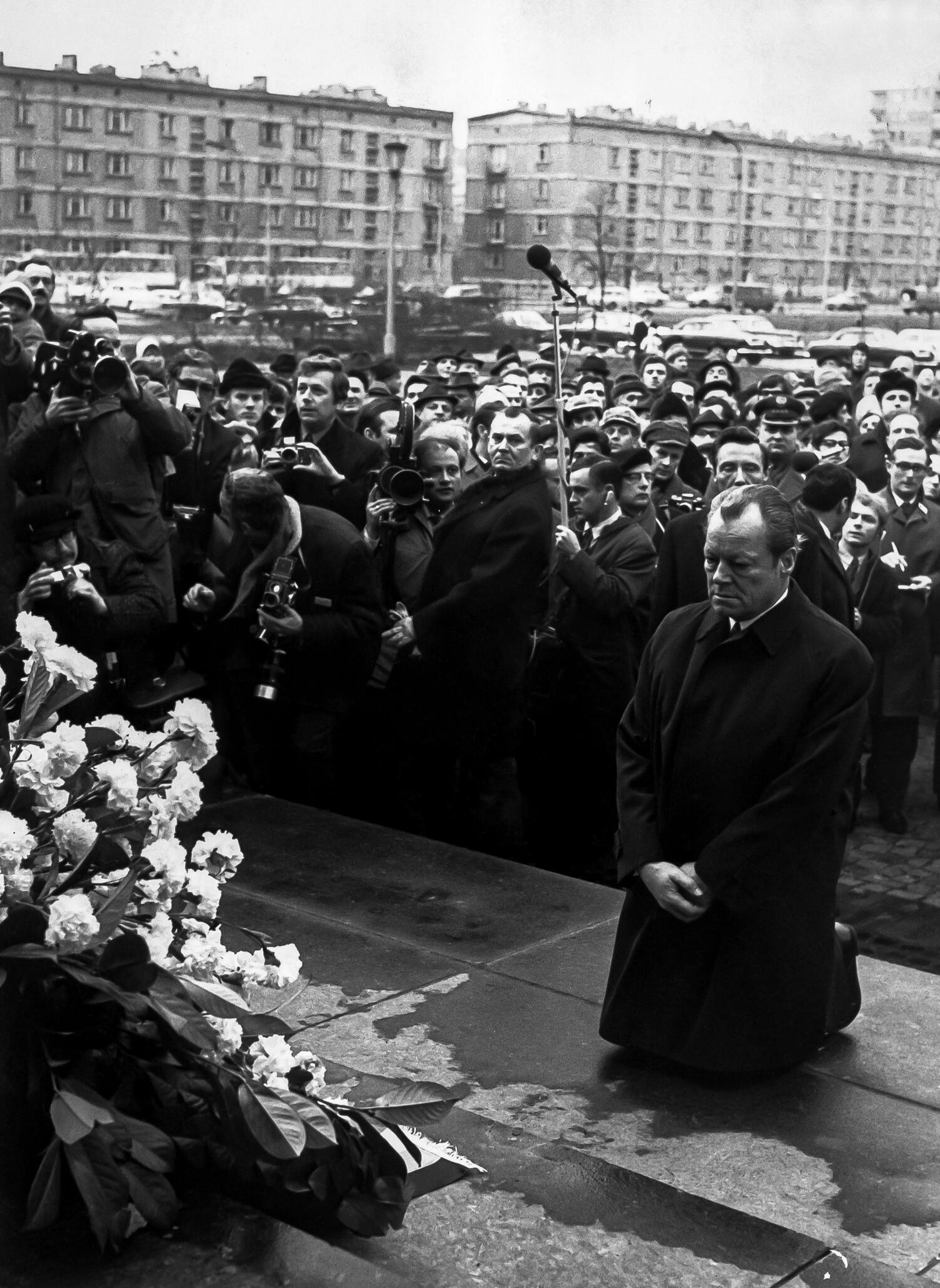

German Chancellor Willie Brandt went down on his knees (the Warschauer Kniefall, or Warsaw kneel) at the monument to the Warsaw Ghetto Uprising on a trip to Poland. He was there to sign the Treaty of Warsaw, a key element of his “Ostpolitik,” which aimed to improve Germany’s relations with Eastern Europe. His gesture of atonement for the genocide perpetrated by Germans against Jews did not go down well with everyone back home in Germany; interest in taking collective responsibility for Germany’s Nazi past was not yet as widespread as it became in ensuing decades.
We’re sorry. The Posen Library’s licensing agreements prevent this image from being printed or downloaded.
Credits
Bettmann / Getty Images.
Published in: The Posen Library of Jewish Culture and Civilization, vol. 9.
You may also like

Beauty
Moses Feigin painted both realist and abstract paintings, sometimes mixing both styles in one painting. In the late 1960s, he became fascinated by the world of the carnival, seemingly evoked by the…

Handball Players, Houston Street, NY
Leon Levinstein, widely admired for his street photography, held himself at a distance from the art world and never produced a book of his work. He kept his day job as a graphic designer and went out…

Portrait of a Man
Though he also worked in other media, Dmitry Borisovitch Lion preferred to work with ink on paper. His drawings have feathery, broken lines, and sometimes include text, illegible letters, and shapes…

Codex Artaud VII
Codex Artaud VII is one of a series of thirty-four scrolls that Nancy Spero based on the writings of Antonin Artaud, a writer and theater director famous for conceptualizing the “Theatre of Cruelty.”…

Red Horizon
Eric Bulatov created many paintings that paired nature scenes with Soviet slogans, suggesting that the control of the Soviet regime was everywhere, in every corner of its citizens’ lives. In Red…

Leah Goldberg, Dira le-Haskir, cover
Dira le-haskir (Apartment for Rent), by the Hebrew-language poet and writer Leah Goldberg, became a bestselling children’s book in Israel soon after its publication in 1959. It tells the story of an…
You may also like
Beauty
Moses Feigin painted both realist and abstract paintings, sometimes mixing both styles in one painting. In the late 1960s, he became fascinated by the world of the carnival, seemingly evoked by the…
Handball Players, Houston Street, NY
Leon Levinstein, widely admired for his street photography, held himself at a distance from the art world and never produced a book of his work. He kept his day job as a graphic designer and went out…
Portrait of a Man
Though he also worked in other media, Dmitry Borisovitch Lion preferred to work with ink on paper. His drawings have feathery, broken lines, and sometimes include text, illegible letters, and shapes…
Codex Artaud VII
Codex Artaud VII is one of a series of thirty-four scrolls that Nancy Spero based on the writings of Antonin Artaud, a writer and theater director famous for conceptualizing the “Theatre of Cruelty.”…
Red Horizon
Eric Bulatov created many paintings that paired nature scenes with Soviet slogans, suggesting that the control of the Soviet regime was everywhere, in every corner of its citizens’ lives. In Red…
Leah Goldberg, Dira le-Haskir, cover
Dira le-haskir (Apartment for Rent), by the Hebrew-language poet and writer Leah Goldberg, became a bestselling children’s book in Israel soon after its publication in 1959. It tells the story of an…