

Oppression and Exodus
About This Entry
The Exodus story occupies much of the second book of the Hebrew Bible. The power of the story rests in the many interpretive layers that Jews and non-Jews have added to the narrative through centuries of engaging with the foundational story of the march from enslavement to freedom, the birth of a national hero, and the guiding hand of divine providence. These selections from the book of Exodus highlight many of the key moments in the biblical narrative. In reading the source text, in conversation with hundreds of years of interpretive traditions, we can appreciate the endurance of these ideas, as well as the continuing need to refine and reshape key biblical elements.
Israel in Egypt
Chapter 1
1These are the names of the sons of Israel who came to Egypt with Jacob, each coming with his household: 2Reuben, Simeon, Levi, and Judah; 3Issachar, Zebulun, and Benjamin; 4Dan and Naphtali, Gad and Asher. 5The total number of persons that were of Jacob’s issue came to seventy, Joseph being already in Egypt. 6Joseph died, and all his brothers, and all that generation. 7But the Israelites were fertile and prolific; they multiplied and increased very greatly, so that the land was filled with them.
8A new king arose over Egypt who did not know Joseph. 9And he said to his people, “Look, the Israelite people are much too numerous for us. 10Let us deal shrewdly with them, so that they may not increase; otherwise in the event of war they may join our enemies in fighting against us and rise from the ground.” 11So they set taskmasters over them to oppress them with forced labor; and they built garrison cities for Pharaoh: Pithom and Raamses. 12But the more they were oppressed, the more they increased and spread out, so that the [Egyptians] came to dread the Israelites.
13The Egyptians ruthlessly imposed upon the Israelites 14the various labors that they made them perform. Ruthlessly they made life bitter for them with harsh labor at mortar and bricks and with all sorts of tasks in the field.
15The king of Egypt spoke to the Hebrew midwives, one of whom was named Shiphrah and the other Puah, 16saying, “When you deliver the Hebrew women, look at the birthstool:a if it is a boy, kill him; if it is a girl, let her live.” 17The midwives, fearing God, did not do as the king of Egypt had told them; they let the boys live. 18So the king of Egypt summoned the midwives and said to them, “Why have you done this thing, letting the boys live?” 19The midwives said to Pharaoh, “Because the Hebrew women are not like the Egyptian women: they are vigorous. Before the midwife can come to them, they have given birth.” 20And God dealt well with the midwives; and the people multiplied and increased greatly. 21And because the midwives feared God, He established households for them. 22Then Pharaoh charged all his people, saying, “Every boy that is born you shall throw into the Nile, but let every girl live.”
Moses’ Birth and Commissioning
Chapter 2
1A certain man of the house of Levi went and married a Levite woman. 2The woman conceived and bore a son; and when she saw how beautiful he was, she hid him for three months. 3When she could hide him no longer, she got a wicker basket for him and caulked it with bitumen and pitch. She put the child into it and placed it among the reeds by the bank of the Nile. 4And his sister stationed herself at a distance, to learn what would befall him.
5The daughter of Pharaoh came down to bathe in the Nile, while her maidens walked along the Nile. She spied the basket among the reeds and sent her slave girl to fetch it. 6When she opened it, she saw that it was a child, a boy crying. She took pity on it and said, “This must be a Hebrew child.” 7Then his sister said to Pharaoh’s daughter, “Shall I go and get you a Hebrew nurse to suckle the child for you?” 8And Pharaoh’s daughter answered, “Yes.” So the girl went and called the child’s mother. 9And Pharaoh’s daughter said to her, “Take this child and nurse it for me, and I will pay your wages.” So the woman took the child and nursed it. 10When the child grew up, she brought him to Pharaoh’s daughter, who made him her son. She named him Moses,b explaining, “I drew him out of the water.”
11Some time after that, when Moses had grown up, he went out to his kinsfolk and witnessed their labors. He saw an Egyptian beating a Hebrew, one of his kinsmen. 12He turned this way and that and, seeing no one about, he struck down the Egyptian and hid him in the sand. 13When he went out the next day, he found two Hebrews fighting; so he said to the offender, “Why do you strike your fellow?” 14He retorted, “Who made you chief and ruler over us? Do you mean to kill me as you killed the Egyptian?” Moses was frightened, and thought: Then the matter is known! 15When Pharaoh learned of the matter, he sought to kill Moses; but Moses fled from Pharaoh. He arrived in the land of Midian, and sat down beside a well.
16Now the priest of Midian had seven daughters. They came to draw water, and filled the troughs to water their father’s flock; 17but shepherds came and drove them off. Moses rose to their defense, and he watered their flock. 18When they returned to their father Reuel, he said, “How is it that you have come back so soon today?” 19They answered, “An Egyptian rescued us from the shepherds; he even drew water for us and watered the flock.” 20He said to his daughters, “Where is he then? Why did you leave the man? Ask him in to break bread.” 21Moses consented to stay with the man, and he gave Moses his daughter Zipporah as wife. 22She bore a son whom he named Gershom,c for he said, “I have been a stranger in a foreign land.”
23A long time after that, the king of Egypt died. The Israelites were groaning under the bondage and cried out; and their cry for help from the bondage rose up to God. 24God heard their moaning, and God remembered His covenant with Abraham and Isaac and Jacob. 25God looked upon the Israelites, and God took notice of them.
Chapter 3
1Now Moses, tending the flock of his father-in-law Jethro, the priest of Midian, drove the flock into the wilderness, and came to Horeb, the mountain of God. 2An angel of the Lord appeared to him in a blazing fire out of a bush. He gazed, and there was a bush all aflame, yet the bush was not consumed. 3Moses said, “I must turn aside to look at this marvelous sight; why doesn’t the bush burn up?” 4When the Lord saw that he had turned aside to look, God called to him out of the bush: “Moses! Moses!” He answered, “Here I am.” 5And He said, “Do not come closer. Remove your sandals from your feet, for the place on which you stand is holy ground. 6I am,” He said, “the God of your father, the God of Abraham, the God of Isaac, and the God of Jacob.” And Moses hid his face, for he was afraid to look at God.
7And the Lord continued, “I have marked well the plight of My people in Egypt and have heeded their outcry because of their taskmasters; yes, I am mindful of their sufferings. 8I have come down to rescue them from the Egyptians and to bring them out of that land to a good and spacious land, a land flowing with milk and honey, the region of the Canaanites, the Hittites, the Amorites, the Perizzites, the Hivites, and the Jebusites. 9Now the cry of the Israelites has reached Me; moreover, I have seen how the Egyptians oppress them. 10Come, therefore, I will send you to Pharaoh, and you shall free My people, the Israelites, from Egypt.”
11But Moses said to God, “Who am I that I should go to Pharaoh and free the Israelites from Egypt?” 12And He said, “I will be with you; that shall be your sign that it was I who sent you. And when you have freed the people from Egypt, you shall worship God at this mountain.”
13Moses said to God, “When I come to the Israelites and say to them, ‘The God of your fathers has sent me to you,’ and they ask me, ‘What is His name?’ what shall I say to them?” 14And God said to Moses, “Ehyeh-Asher-Ehyeh.” He continued, “Thus shall you say to the Israelites, ‘Ehyeh sent me to you.’” 15And God said further to Moses, “Thus shall you speak to the Israelites: The Lord,d the God of your fathers, the God of Abraham, the God of Isaac, and the God of Jacob, has sent me to you:
16“Go and assemble the elders of Israel and say to them: the Lord, the God of your fathers, the God of Abraham, Isaac, and Jacob, has appeared to me and said, ‘I have taken note of you and of what is being done to you in Egypt, 17and I have declared: I will take you out of the misery of Egypt to the land of the Canaanites, the Hittites, the Amorites, the Perizzites, the Hivites, and the Jebusites, to a land flowing with milk and honey.’ 18They will listen to you; then you shall go with the elders of Israel to the king of Egypt and you shall say to him, ‘The Lord, the God of the Hebrews, manifested Himself to us. Now therefore, let us go a distance of three days into the wilderness to sacrifice to the Lord our God.’ 19Yet I know that the king of Egypt will let you go only because of a greater might. 20So I will stretch out My hand and smite Egypt with various wonders which I will work upon them; after that he shall let you go. 21And I will dispose the Egyptians favorably toward this people, so that when you go, you will not go away empty-handed. 22Each woman shall borrow from her neighbor and the lodger in her house objects of silver and gold, and clothing, and you shall put these on your sons and daughters, thus stripping the Egyptians.” […]
The Encounter with Pharaoh and God’s Promise
Chapter 5
1Afterward Moses and Aaron went and said to Pharaoh, “Thus says the Lord, the God of Israel: Let My people go that they may celebrate a festival for Me in the wilderness.” 2But Pharaoh said, “Who is the Lord that I should heed Him and let Israel go? I do not know the Lord, nor will I let Israel go.” 3They answered, “The God of the Hebrews has manifested Himself to us. Let us go, we pray, a distance of three days into the wilderness to sacrifice to the Lord our God, lest He strike us with pestilence or sword.” 4But the king of Egypt said to them, “Moses and Aaron, why do you distract the people from their tasks? Get to your labors!” 5And Pharaoh continued, “The people of the land are already so numerous, and you would have them cease from their labors!”
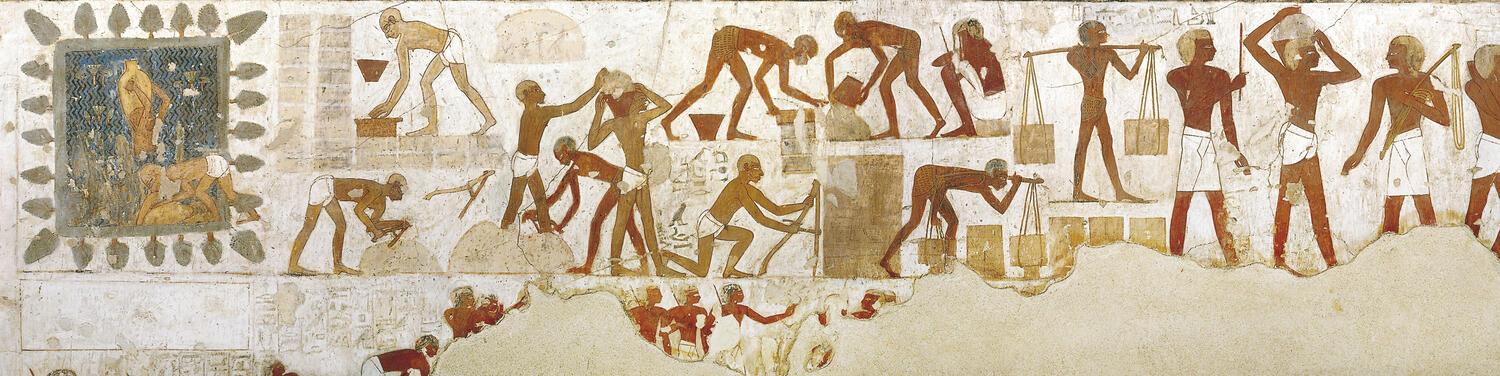
6That same day Pharaoh charged the taskmasters and foremen of the people, saying, 7“You shall no longer provide the people with straw for making bricks as heretofore; let them go and gather straw for themselves. 8But impose upon them the same quota of bricks as they have been making heretofore; do not reduce it, for they are shirkers; that is why they cry, ‘Let us go and sacrifice to our God!’ 9Let heavier work be laid upon the men; let them keep at it and not pay attention to deceitful promises.”
10So the taskmasters and foremen of the people went out and said to the people, “Thus says Pharaoh: I will not give you any straw. 11You must go and get the straw yourselves wherever you can find it; but there shall be no decrease whatever in your work.” 12Then the people scattered throughout the land of Egypt to gather stubble for straw. 13And the taskmasters pressed them, saying, “You must complete the same work assignment each day as when you had straw.” 14And the foremen of the Israelites, whom Pharaoh’s taskmasters had set over them, were beaten. “Why,” they were asked, “did you not complete the prescribed amount of bricks, either yesterday or today, as you did before?”
15Then the foremen of the Israelites came to Pharaoh and cried: “Why do you deal thus with your servants? 16No straw is issued to your servants, yet they demand of us: Make bricks! Thus your servants are being beaten, when the fault is with your own people.” 17He replied, “You are shirkers, shirkers! That is why you say, ‘Let us go and sacrifice to the Lord.’ 18Be off now to your work! No straw shall be issued to you, but you must produce your quota of bricks!”
19Now the foremen of the Israelites found themselves in trouble because of the order, “You must not reduce your daily quantity of bricks.” 20As they left Pharaoh’s presence, they came upon Moses and Aaron standing in their path, 21and they said to them, “May the Lord look upon you and punish you for making us loathsome to Pharaoh and his courtiers—putting a sword in their hands to slay us.” 22Then Moses returned to the Lord and said, “O Lord, why did You bring harm upon this people? Why did You send me? 23Ever since I came to Pharaoh to speak in Your name, he has dealt worse with this people; and still You have not delivered Your people.”

Chapter 6
1Then the Lord said to Moses, “You shall soon see what I will do to Pharaoh: he shall let them go because of a greater might; indeed, because of a greater might he shall drive them from his land.”
2God spoke to Moses and said to him, “I am the Lord. 3I appeared to Abraham, Isaac, and Jacob as El Shaddai, but I did not make Myself known to them by My name יהוה.e 4I also established My covenant with them, to give them the land of Canaan, the land in which they lived as sojourners. 5I have now heard the moaning of the Israelites because the Egyptians are holding them in bondage, and I have remembered My covenant. 6Say, therefore, to the Israelite people: I am the Lord. I will free you from the labors of the Egyptians and deliver you from their bondage. I will redeem you with an outstretched arm and through extraordinary chastisements. 7And I will take you to be My people, and I will be your God. And you shall know that I, the Lord, am your God who freed you from the labors of the Egyptians. 8I will bring you into the land which I swore to give to Abraham, Isaac, and Jacob, and I will give it to you for a possession, I the Lord.” 9But when Moses told this to the Israelites, they would not listen to Moses, their spirits crushed by cruel bondage. […]
The First Four Plagues
Chapter 7
[…] 8The Lord said to Moses and Aaron, 9“When Pharaoh speaks to you and says, ‘Produce your marvel,’ you shall say to Aaron, ‘Take your rod and cast it down before Pharaoh.’ It shall turn into a serpent.” 10So Moses and Aaron came before Pharaoh and did just as the Lord had commanded: Aaron cast down his rod in the presence of Pharaoh and his courtiers, and it turned into a serpent. 11Then Pharaoh, for his part, summoned the wise men and the sorcerers; and the Egyptian magicians, in turn, did the same with their spells; 12each cast down his rod, and they turned into serpents. But Aaron’s rod swallowed their rods. 13Yet Pharaoh’s heart stiffened and he did not heed them, as the Lord had said.
14And the Lord said to Moses, “Pharaoh is stubborn; he refuses to let the people go. 15Go to Pharaoh in the morning, as he is coming out to the water, and station yourself before him at the edge of the Nile, taking with you the rod that turned into a snake. 16And say to him, ‘The Lord, the God of the Hebrews, sent me to you to say, “Let My people go that they may worship Me in the wilderness.” But you have paid no heed until now. 17Thus says the Lord, “By this you shall know that I am the Lord.” See, I shall strike the water in the Nile with the rod that is in my hand, and it will be turned into blood; 18and the fish in the Nile will die. The Nile will stink so that the Egyptians will find it impossible to drink the water of the Nile.’”
19And the Lord said to Moses, “Say to Aaron: Take your rod and hold out your arm over the waters of Egypt—its rivers, its canals, its ponds, all its bodies of water—that they may turn to blood; there shall be blood throughout the land of Egypt, even in vessels of wood and stone.” 20Moses and Aaron did just as the Lord commanded: he lifted up the rod and struck the water in the Nile in the sight of Pharaoh and his courtiers, and all the water in the Nile was turned into blood 21and the fish in the Nile died. The Nile stank so that the Egyptians could not drink water from the Nile; and there was blood throughout the land of Egypt. 22But when the Egyptian magicians did the same with their spells, Pharaoh’s heart stiffened and he did not heed them—as the Lord had spoken. 23Pharaoh turned and went into his palace, paying no regard even to this. 24And all the Egyptians had to dig round about the Nile for drinking water, because they could not drink the water of the Nile.
25When seven days had passed after the Lord struck the Nile, 26the Lord said to Moses, “Go to Pharaoh and say to him, ‘Thus says the Lord: Let My people go that they may worship Me. 27If you refuse to let them go, then I will plague your whole country with frogs. 28The Nile shall swarm with frogs, and they shall come up and enter your palace, your bedchamber and your bed, the houses of your courtiers and your people, and your ovens and your kneading bowls. 29The frogs shall come up on you and on your people and on all your courtiers.’”
Chapter 8
1And the Lord said to Moses, “Say to Aaron: Hold out your arm with the rod over the rivers, the canals, and the ponds, and bring up the frogs on the land of Egypt.” 2Aaron held out his arm over the waters of Egypt, and the frogs came up and covered the land of Egypt. 3But the magicians did the same with their spells, and brought frogs upon the land of Egypt.
4Then Pharaoh summoned Moses and Aaron and said, “Plead with the Lord to remove the frogs from me and my people, and I will let the people go to sacrifice to the Lord.” 5And Moses said to Pharaoh, “You may have this triumph over me: for what time shall I plead in behalf of you and your courtiers and your people, that the frogs be cut off from you and your houses, to remain only in the Nile?” 6“For tomorrow,” he replied. And [Moses] said, “As you say—that you may know that there is none like the Lord our God; 7the frogs shall retreat from you and your courtiers and your people; they shall remain only in the Nile.” 8Then Moses and Aaron left Pharaoh’s presence, and Moses cried out to the Lord in the matter of the frogs which He had inflicted upon Pharaoh. 9And the Lord did as Moses asked; the frogs died out in the houses, the courtyards, and the fields. 10And they piled them up in heaps, till the land stank. 11But when Pharaoh saw that there was relief, he became stubborn and would not heed them, as the Lord had spoken.
12Then the Lord said to Moses, “Say to Aaron: Hold out your rod and strike the dust of the earth, and it shall turn to lice throughout the land of Egypt.” 13And they did so. Aaron held out his arm with the rod and struck the dust of the earth, and vermin came upon man and beast; all the dust of the earth turned to lice throughout the land of Egypt. 14The magicians did the like with their spells to produce lice, but they could not. The vermin remained upon man and beast; 15and the magicians said to Pharaoh, “This is the finger of God!” But Pharaoh’s heart stiffened and he would not heed them, as the Lord had spoken.
16And the Lord said to Moses, “Early in the morning present yourself to Pharaoh, as he is coming out to the water, and say to him, ‘Thus says the Lord: Let My people go that they may worship Me. 17For if you do not let My people go, I will let loose swarms of insects against you and your courtiers and your people and your houses; the houses of the Egyptians, and the very ground they stand on, shall be filled with swarms of insects. 18But on that day I will set apart the region of Goshen, where My people dwell, so that no swarms of insects shall be there, that you may know that I the Lord am in the midst of the land. 19And I will make a distinction between My people and your people. Tomorrow this sign shall come to pass.’” 20And the Lord did so. Heavy swarms of insects invaded Pharaoh’s palace and the houses of his courtiers; throughout the country of Egypt the land was ruined because of the swarms of insects.
21Then Pharaoh summoned Moses and Aaron and said, “Go and sacrifice to your God within the land.” 22But Moses replied, “It would not be right to do this, for what we sacrifice to the Lord our God is untouchable to the Egyptians. If we sacrifice that which is untouchable to the Egyptians before their very eyes, will they not stone us! 23So we must go a distance of three days into the wilderness and sacrifice to the Lord our God as He may command us.” 24Pharaoh said, “I will let you go to sacrifice to the Lord your God in the wilderness; but do not go very far. Plead, then, for me.” 25And Moses said, “When I leave your presence, I will plead with the Lord that the swarms of insects depart tomorrow from Pharaoh and his courtiers and his people; but let not Pharaoh again act deceitfully, not letting the people go to sacrifice to the Lord.”
26So Moses left Pharaoh’s presence and pleaded with the Lord. 27And the Lord did as Moses asked: He removed the swarms of insects from Pharaoh, from his courtiers, and from his people; not one remained. 28But Pharaoh became stubborn this time also, and would not let the people go. […]
The Tenth Plague and the Exodus
Chapter 11
1And the Lord said to Moses, “I will bring but one more plague upon Pharaoh and upon Egypt; after that he shall let you go from here; indeed, when he lets you go, he will drive you out of here one and all. 2Tell the people to borrow, each man from his neighbor and each woman from hers, objects of silver and gold.” 3The Lord disposed the Egyptians favorably toward the people. Moreover, Moses himself was much esteemed in the land of Egypt, among Pharaoh’s courtiers and among the people.
4Moses said, “Thus says the Lord: Toward midnight I will go forth among the Egyptians, 5and every firstborn in the land of Egypt shall die, from the first-born of Pharaoh who sits on his throne to the first-born of the slave girl who is behind the millstones; and all the firstborn of the cattle. 6And there shall be a loud cry in all the land of Egypt, such as has never been or will ever be again; 7but not a dog shall snarl at any of the Israelites, at man or beast—in order that you may know that the Lord makes a distinction between Egypt and Israel. 8Then all these courtiers of yours shall come down to me and bow low to me, saying, ‘Depart, you and all the people who follow you!’ After that I will depart.” And he left Pharaoh’s presence in hot anger.
9Now the Lord had said to Moses, “Pharaoh will not heed you, in order that My marvels may be multiplied in the land of Egypt.” 10Moses and Aaron had performed all these marvels before Pharaoh, but the Lord had stiffened the heart of Pharaoh so that he would not let the Israelites go from his land.
Chapter 12
1The Lord said to Moses and Aaron in the land of Egypt: 2This month shall mark for you the beginning of the months; it shall be the first of the months of the year for you. 3Speak to the whole community of Israel and say that on the tenth of this month each of them shall take a lamb to a family, a lamb to a household. 4But if the household is too small for a lamb, let him share one with a neighbor who dwells nearby, in proportion to the number of persons: you shall contribute for the lamb according to what each household will eat. 5Your lamb shall be without blemish, a yearling male; you may take it from the sheep or from the goats. 6You shall keep watch over it until the fourteenth day of this month; and all the assembled congregation of the Israelites shall slaughter it at twilight. 7They shall take some of the blood and put it on the two doorposts and the lintel of the houses in which they are to eat it. 8They shall eat the flesh that same night; they shall eat it roasted over the fire, with unleavened bread and with bitter herbs. 9Do not eat any of it raw, or cooked in any way with water, but roasted—head, legs, and entrails—over the fire. 10You shall not leave any of it over until morning; if any of it is left until morning, you shall burn it.
11This is how you shall eat it: your loins girded, your sandals on your feet, and your staff in your hand; and you shall eat it hurriedly: it is a passover offering to the Lord. 12For that night I will go through the land of Egypt and strike down every first-born in the land of Egypt, both man and beast; and I will mete out punishments to all the gods of Egypt, I the Lord. 13And the blood on the houses where you are staying shall be a sign for you: when I see the blood I will pass over you, so that no plague will destroy you when I strike the land of Egypt.
14This day shall be to you one of remembrance: you shall celebrate it as a festival to the Lord throughout the ages; you shall celebrate it as an institution for all time. 15Seven days you shall eat unleavened bread; on the very first day you shall remove leaven from your houses, for whoever eats leavened bread from the first day to the seventh day, that person shall be cut off from Israel.
16You shall celebrate a sacred occasion on the first day, and a sacred occasion on the seventh day; no work at all shall be done on them; only what every person is to eat, that alone may be prepared for you. 17You shall observe the [Feast of] Unleavened Bread, for on this very day I brought your ranks out of the land of Egypt; you shall observe this day throughout the ages as an institution for all time. 18In the first month, from the fourteenth day of the month at evening, you shall eat unleavened bread until the twenty-first day of the month at evening. 19No leaven shall be found in your houses for seven days. For whoever eats what is leavened, that person shall be cut off from the community of Israel, whether he is a stranger or a citizen of the country. 20You shall eat nothing leavened; in all your settlements you shall eat unleavened bread.
21Moses then summoned all the elders of Israel and said to them, “Go, pick out lambs for your families, and slaughter the passover offering. 22Take a bunch of hyssop, dip it in the blood that is in the basin, and apply some of the blood that is in the basin to the lintel and to the two doorposts. None of you shall go outside the door of his house until morning. 23For when the Lord goes through to smite the Egyptians, He will see the blood on the lintel and the two doorposts, and the Lord will pass overf the door and not let the Destroyer enter and smite your home.
24“You shall observe this as an institution for all time, for you and for your descendants. 25And when you enter the land that the Lord will give you, as He has promised, you shall observe this rite. 26And when your children ask you, ‘What do you mean by this rite?’ 27you shall say, ‘It is the passover sacrifice to the Lord, because He passed over the houses of the Israelites in Egypt when He smote the Egyptians, but saved our houses.’”
The people then bowed low in homage. 28And the Israelites went and did so; just as the Lord had commanded Moses and Aaron, so they did. 29In the middle of the night the Lord struck down all the first-born in the land of Egypt, from the first-born of Pharaoh who sat on the throne to the first-born of the captive who was in the dungeon, and all the first-born of the cattle. 30And Pharaoh arose in the night, with all his courtiers and all the Egyptians—because there was a loud cry in Egypt; for there was no house where there was not someone dead. 31He summoned Moses and Aaron in the night and said, “Up, depart from among my people, you and the Israelites with you! Go, worship the Lord as you said! 32Take also your flocks and your herds, as you said, and begone! And may you bring a blessing upon me also!”
33The Egyptians urged the people on, impatient to have them leave the country, for they said, “We shall all be dead.” 34So the people took their dough before it was leavened, their kneading bowls wrapped in their cloaks upon their shoulders. 35The Israelites had done Moses’ bidding and borrowed from the Egyptians objects of silver and gold, and clothing. 36And the Lord had disposed the Egyptians favorably toward the people, and they let them have their request; thus they stripped the Egyptians.
37The Israelites journeyed from Raamses to Succoth, about six hundred thousand men on foot, aside from children. 38Moreover, a mixed multitude went up with them, and very much livestock, both flocks and herds. 39And they baked unleavened cakes of the dough that they had taken out of Egypt, for it was not leavened, since they had been driven out of Egypt and could not delay; nor had they prepared any provisions for themselves.
40The length of time that the Israelites lived in Egypt was four hundred and thirty years; 41at the end of the four hundred and thirtieth year, to the very day, all the ranks of the Lord departed from the land of Egypt. […]
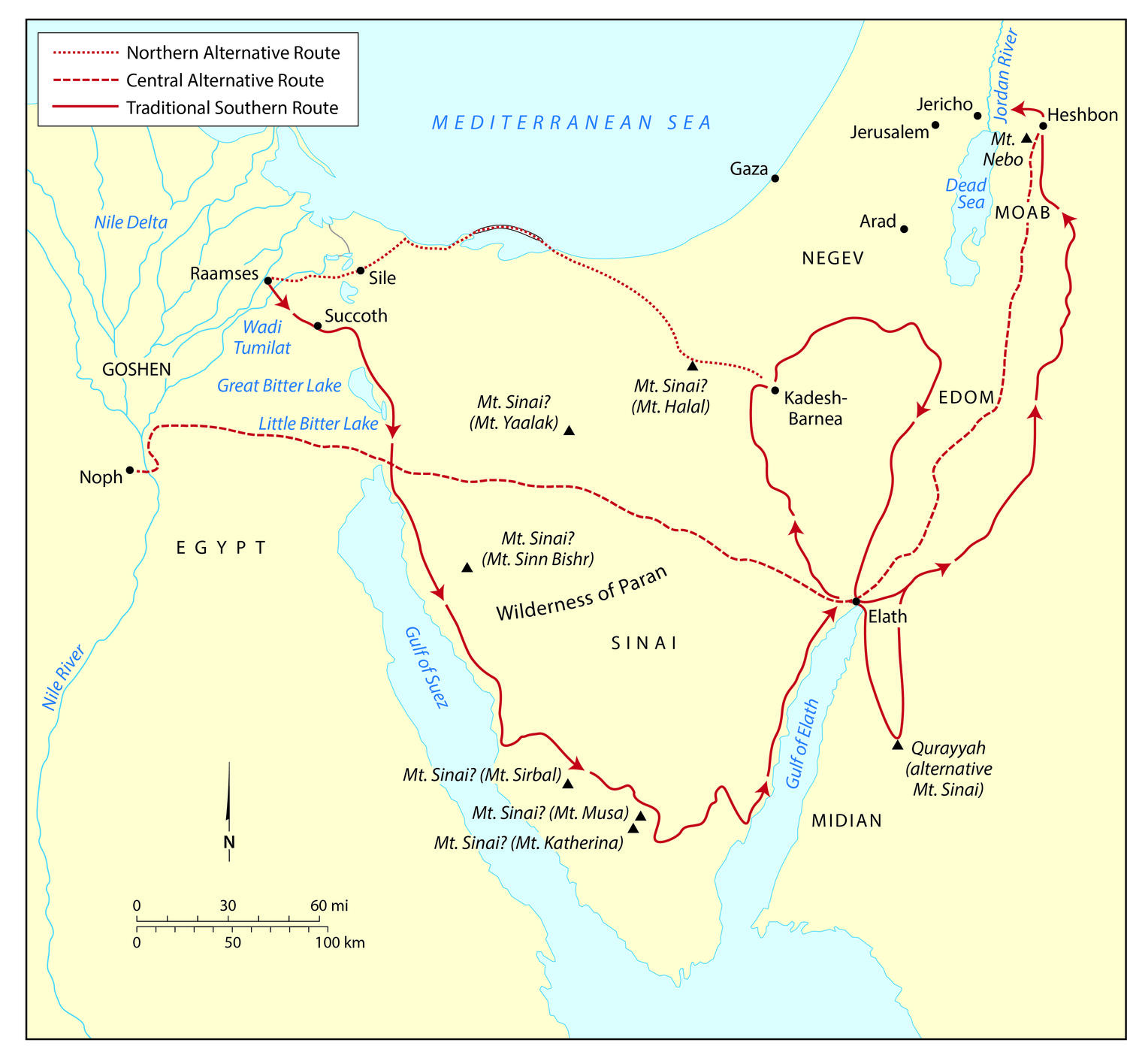
Based on three current scholarly theories, this map presents possible routes by which the Israelites may have left Egypt and traveled through the Sinai desert to arrive at Mount Sinai and then on to the banks of the Jordan before crossing into the Promised Land.
The Crossing of the Sea
Chapter 14
[…] 5When the king of Egypt was told that the people had fled, Pharaoh and his courtiers had a change of heart about the people and said, “What is this we have done, releasing Israel from our service?” 6He orderedg his chariot and took his men with him; 7he took six hundred of his picked chariots, and the rest of the chariots of Egypt, with officersh in all of them. 8The Lord stiffened the heart of Pharaoh king of Egypt, and he gave chase to the Israelites. As the Israelites were departing defiantly,i 9the Egyptians gave chase to them, and all the chariot horses of Pharaoh, his horsemen, and his warriors overtook them encamped by the sea, near Pihahiroth, before Baal-zephon.
10As Pharaoh drew near, the Israelites caught sight of the Egyptians advancing upon them. Greatly frightened, the Israelites cried out to the Lord. 11And they said to Moses, “Was it for want of graves in Egypt that you brought us to die in the wilderness? What have you done to us, taking us out of Egypt? 12Is this not the very thing we told you in Egypt, saying, ‘Let us be, and we will serve the Egyptians, for it is better for us to serve the Egyptians than to die in the wilderness’?” 13But Moses said to the people, “Have no fear! Stand by, and witness the deliverance which the Lord will work for you today; for the Egyptians whom you see today you will never see again. 14The Lord will battle for you; you hold your peace!”
15Then the Lord said to Moses, “Why do you cry out to Me? Tell the Israelites to go forward. 16And you lift up your rod and hold out your arm over the sea and split it, so that the Israelites may march into the sea on dry ground. 17And I will stiffen the hearts of the Egyptians so that they go in after them; and I will gain glory through Pharaoh and all his warriors, his chariots and his horsemen. 18Let the Egyptians know that I am the Lord, when I gain glory through Pharaoh, his chariots, and his horsemen.”
19The angel of God, who had been going ahead of the Israelite army, now moved and followed behind them; and the pillar of cloud shifted from in front of them and took up a place behind them, 20and it came between the army of the Egyptians and the army of Israel. Thus there was the cloud with the darkness, and it cast a spell upon the night, so that the one could not come near the other all through the night.
21Then Moses held out his arm over the sea and the Lord drove back the sea with a strong east wind all that night, and turned the sea into dry ground. The waters were split, 22and the Israelites went into the sea on dry ground, the waters forming a wall for them on their right and on their left. 23The Egyptians came in pursuit after them into the sea, all of Pharaoh’s horses, chariots, and horsemen. 24At the morning watch, the Lord looked down upon the Egyptian army from a pillar of fire and cloud, and threw the Egyptian army into panic. 25He locked the wheels of their chariots so that they moved forward with difficulty. And the Egyptians said, “Let us flee from the Israelites, for the Lord is fighting for them against Egypt.”
26Then the Lord said to Moses, “Hold out your arm over the sea, that the waters may come back upon the Egyptians and upon their chariots and upon their horsemen.” 27Moses held out his arm over the sea, and at daybreak the sea returned to its normal state, and the Egyptians fled at its approach. But the Lord hurled the Egyptians into the sea. 28The waters turned back and covered the chariots and the horsemen—Pharaoh’s entire army that followed them into the sea; not one of them remained. 29But the Israelites had marched through the sea on dry ground, the waters forming a wall for them on their right and on their left.
30Thus the Lord delivered Israel that day from the Egyptians. Israel saw the Egyptians dead on the shore of the sea. 31And when Israel saw the wondrous power which the Lord had wielded against the Egyptians, the people feared the Lord; they had faith in the Lord and His servant Moses. […]
Jethro’s Visit and Advice
Chapter 18
[…] 5Jethro, Moses’ father-in-law, brought Moses’ sons and wife to him in the wilderness, where he was encamped at the mountain of God. […]
13Next day, Moses sat as magistrate among the people, while the people stood about Moses from morning until evening. 14But when Moses’ father-in-law saw how much he had to do for the people, he said, “What is this thing that you are doing to the people? Why do you act alone, while all the people stand about you from morning until evening?” 15Moses replied to his father-in-law, “It is because the people come to me to inquire of God. 16When they have a dispute, it comes before me, and I decide between one person and another, and I make known the laws and teachings of God.”
17But Moses’ father-in-law said to him, “The thing you are doing is not right; 18you will surely wear yourself out, and these people as well. For the task is too heavy for you; you cannot do it alone. 19Now listen to me. I will give you counsel, and God be with you! You represent the people before God: you bring the disputes before God, 20and enjoin upon them the laws and the teachings, and make known to them the way they are to go and the practices they are to follow. 21You shall also seek out from among all the people capable men who fear God, trustworthy men who spurn ill-gotten gain. Set these over them as chiefs of thousands, hundreds, fifties, and tens, and 22let them judge the people at all times. Have them bring every major dispute to you, but let them decide every minor dispute themselves. Make it easier for yourself by letting them share the burden with you. 23If you do this—and God so commands you—you will be able to bear up; and all these people too will go home unwearied.”
24Moses heeded his father-in-law and did just as he had said. 25Moses chose capable men out of all Israel, and appointed them heads over the people—chiefs of thousands, hundreds, fifties, and tens; 26and they judged the people at all times: the difficult matters they would bring to Moses, and all the minor matters they would decide themselves. 27Then Moses bade his father-in-law farewell, and he went his way to his own land.
Notes
More exactly, the brick or stone supports used by Egyptian women during childbirth.
Heb. Mosheh from Egyptian for “born of”; here associated with mashah, “draw out.”
Associated with ger sham, “a stranger there.”
The name YHWH (traditionally read Adonai “the Lord”) is here associated with the root hayah “to be.”
This divine name is traditionally not pronounced; instead, Adonai, “(the) Lord,” is regularly substituted for it.
Or “protect.”
See on Gen. 46:29.
Heb. shalish; originally “third man on royal chariot”; hence “adjutant,” “officer.”
Lit. “with upraised hand.”
Credits
Reprinted from Tanakh: The Holy Scriptures by permission of the University of Nebraska Press. Copyright 1985 by the Jewish Publication Society, Philadelphia.
Discussion Questions
Is there anything in this excerpt that you didn’t realize was part of the story? Why might it have been marginalized?
Is there anything you expected to see in this excerpt based on what you have learned about the Exodus story that does not appear in the biblical version?
What theme(s) in this narrative best explain its outsized influence on Western religion, culture, and politics?
Published in: The Posen Library of Jewish Culture and Civilization, vol. 1.
You may also like
Passover across Jewish Time and Space
Passover is the most celebrated holiday for American Jews. Yet, few appreciate the historical evolution and diversity of its key themes and messages.

Brickmaking by Prisoners

A Map of the Israelites' Exodus and Journey through the Wilderness of Sinai
A map of the routes the Israelites may have traveled upon leaving Egypt to go to Mount Sinai and on to the Promised Land.

At Sinai
Exodus 19–34 (selections)
This account of the divine revelation at Mount Sinai and the making of the golden calf is the highlight of the Torah’s wilderness narratives.
In the Wilderness
Chapter 16Setting out from Elim, the whole Israelite community came to the wilderness of Sin, which is between Elim and Sinai, on the fifteenth day of the second month after their…
Moses’ Farewell
Moses delivers his final instructions and exhortations to the Israelites before his death.
You may also like
Passover across Jewish Time and Space
Passover is the most celebrated holiday for American Jews. Yet, few appreciate the historical evolution and diversity of its key themes and messages.
Brickmaking by Prisoners
A Map of the Israelites' Exodus and Journey through the Wilderness of Sinai
A map of the routes the Israelites may have traveled upon leaving Egypt to go to Mount Sinai and on to the Promised Land.
At Sinai
Exodus 19–34 (selections)
This account of the divine revelation at Mount Sinai and the making of the golden calf is the highlight of the Torah’s wilderness narratives.
In the Wilderness
Chapter 16Setting out from Elim, the whole Israelite community came to the wilderness of Sin, which is between Elim and Sinai, on the fifteenth day of the second month after their…
Moses’ Farewell
Moses delivers his final instructions and exhortations to the Israelites before his death.