

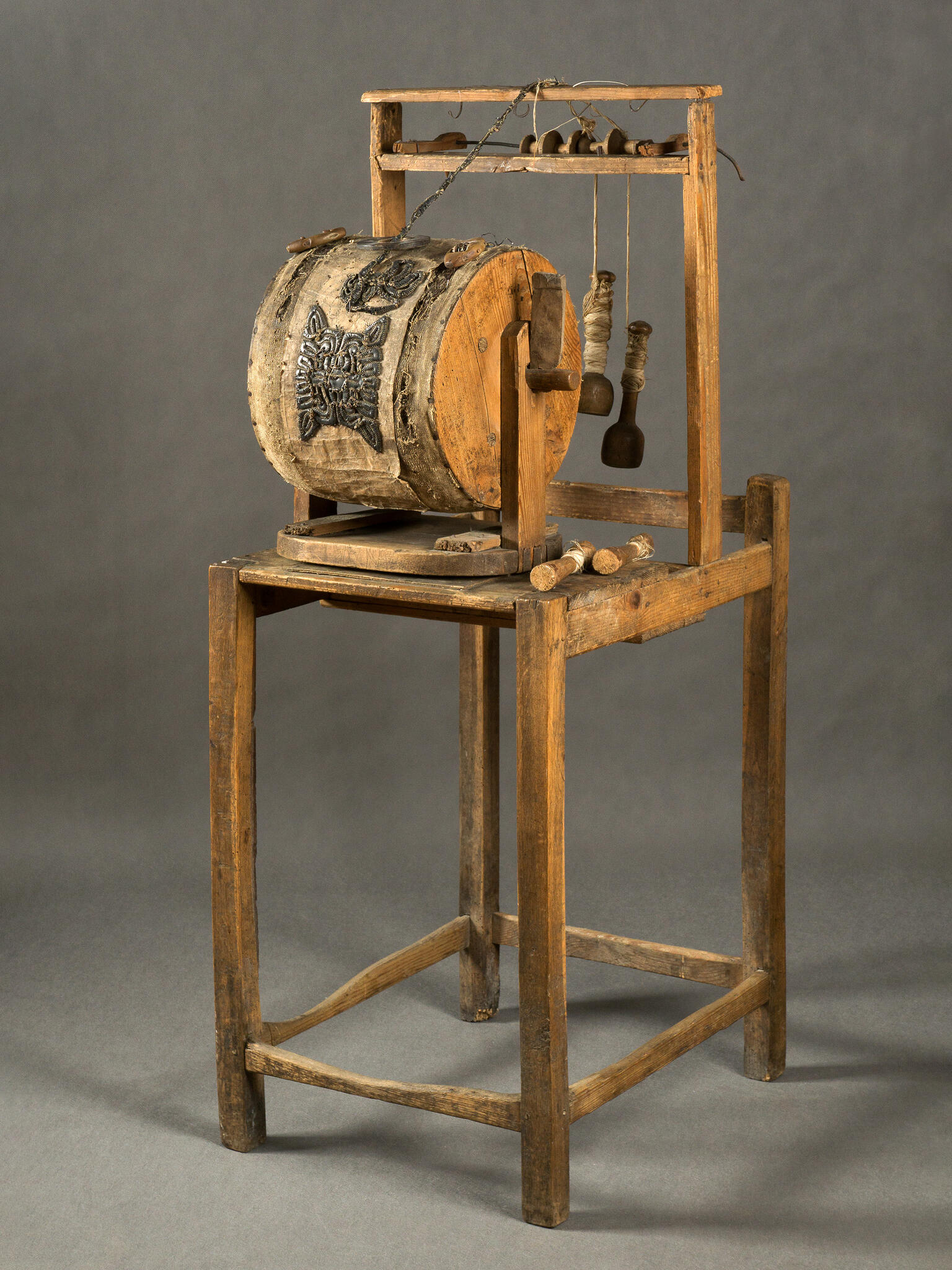
Shpanyer-arbet Tallis Machine
Image
Please login or register for free access to Posen Library
Already have an account?
You may also like


Paper Cuts for Shavuot
Paper cuts were a distinctive Jewish folk art in Eastern Europe, where rural Poles and Ukrainians also practiced the craft. These Shavuot decorations were made for display in windowpanes.

Torah Pointers (Ukraine)
These two Torah pointers (yadayim) are from Galicia, one made of ivory and brass and the other of wood. Yadayim (hands) are used during public reading of the Torah, so that the reader may avoid…

Mizraḥ Tablet Lithograph
This mizraḥ (an ornamental wall plaque used to indicate the direction of Jerusalem) includes a map of the land of Israel surrounded by sacred sites and vistas. These elaborate mizraḥ sheets were often…

Moses Group Portrait
This lithograph portrays great figures from Jewish history whose first names are Moses. Clockwise from the center: the biblical Moses (evoking Michelangelo’s famous sculpture), Moses Mendelssohn, Baro…

Birth Amulet (Ukraine)
This impressive cut-paper birth amulet is in the form of the double eagle, the symbol of the Habsburg Monarchy (and pre-partition Poland) and thus a popular motif in Galician Jewish folk art. It is…

Birth Amulet (Tunis)
This is a printed amulet from Tunis, containing texts and symbols commonly used on such talismans printed in North Africa. However, this example is somewhat unusual, as it combines two traditional…