

Critical Notes on the Mishneh Torah: On Graven Images
About This Entry
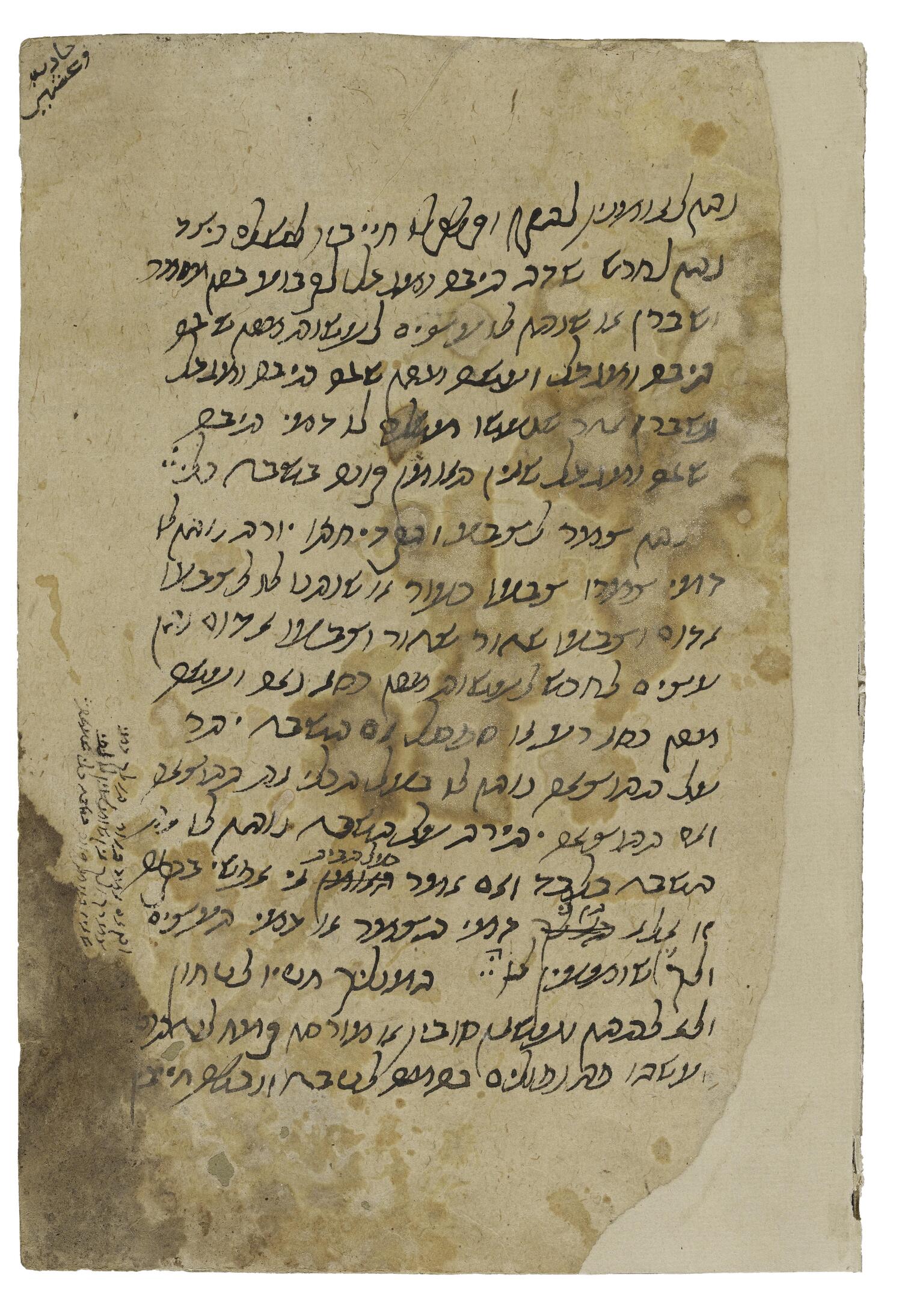
Abraham ben David’s critical notes (hasagot) on Maimonides’ Mishneh Torah were composed toward the end of his life, after that work had arrived in Provence. Printed alongside the Mishneh Torah for hundreds of years, Abraham’s comments reflect a deep study and appreciation of Maimonides’ contributions. They often record alternative interpretations, praise for Maimonides, and, famously, disagreements with him. In this excerpt, the issue at hand is the prohibition of graven images, which classically applies only to images that protrude from a wall but are here discussed in the context of a seal. According to Maimonides, protruding images of humans are generally prohibited, but in some cases seals with human images on them can be used. Maimonides also distinguishes between images of humans and those of heavenly objects, which elicits a series of objections by Abraham ben David.
Regarding a ring with a seal that bears a human image, if the image protrudes, it is prohibited to wear it, but it is permitted to use it as a seal. If the image is sunken, it is permitted to wear it, but it is prohibited to use it as a seal, because the seal will create a protruding image. Likewise, it is prohibited to fashion an image of the sun, moon, stars, constellations, or angels, as it is stated: Do not make with Me [gods of silver, etc.] (Exodus 20:19), meaning, do not make images of My attendants, those who attend upon Me on high. This applies even to tablets. It is permitted to fashion images of animals and other living creatures—with the exception of men—and images of trees and plants and the like. This is the case even if the image protrudes. [Maimonides, Mishneh Torah, Laws of Idolatry and the Ruling of the Nations 3:11]
Abraham ben David (Rabad)
It seems that Maimonides differentiates between images of humans and images of His attendants on high. Images of His attendants are prohibited even if they are level; that is, they neither protrude nor are sunken, whereas if the human image does not protrude, it is permitted. I do not know why this should be the case, and from where he derived this ruling. It might be suggested that it is based on the [talmudic] teaching: If its seal protrudes, it is prohibited to wear it [b. Avodah Zarah 43b], which implies that if it is level it is permitted, but it can be inferred from an examination of the continuation of that statement—“if its seal is sunken, it is permitted to wear it”—that if it is level, it is prohibited. The bottom line is that if it is made by a Jew, it is prohibited in all cases, whereas in a case where non-Jews made it for one, then if it protrudes, one may not wear it, but it is permitted for the non-Jew to seal with it on one’s behalf, and, if it was sunken, one may wear it, but it is prohibited for the non-Jew to seal with it on one’s behalf. The same law applies to images of humans and images of His attendants on high. This is the correct explanation.

Published in: The Posen Library of Jewish Culture and Civilization, vol. 3: Encountering Christianity and Islam.
You may also like

Responsum: On Burial in a Crypt
Critical Notes on the Mishneh Torah: On Rabbinic Authority
Critical Notes on Maimonides, Mishneh Torah, Introduction
Book of the Luminary: Introduction
Sefer ha-ma’or, Introduction (selections)
Book of the Luminary: On the Hours of the Day
Sefer ha-ma’or, b. Rosh Hashanah 20b
Tosafot: On the Babylonian Talmud, Tractate Avodah Zarah
Corrections of the Scribes
‘Itur soferim, Introduction (selections)
You may also like
Responsum: On Burial in a Crypt
Critical Notes on the Mishneh Torah: On Rabbinic Authority
Critical Notes on Maimonides, Mishneh Torah, Introduction
Book of the Luminary: Introduction
Sefer ha-ma’or, Introduction (selections)
Book of the Luminary: On the Hours of the Day
Sefer ha-ma’or, b. Rosh Hashanah 20b
Tosafot: On the Babylonian Talmud, Tractate Avodah Zarah
Corrections of the Scribes
‘Itur soferim, Introduction (selections)