

Façades for the International Commission
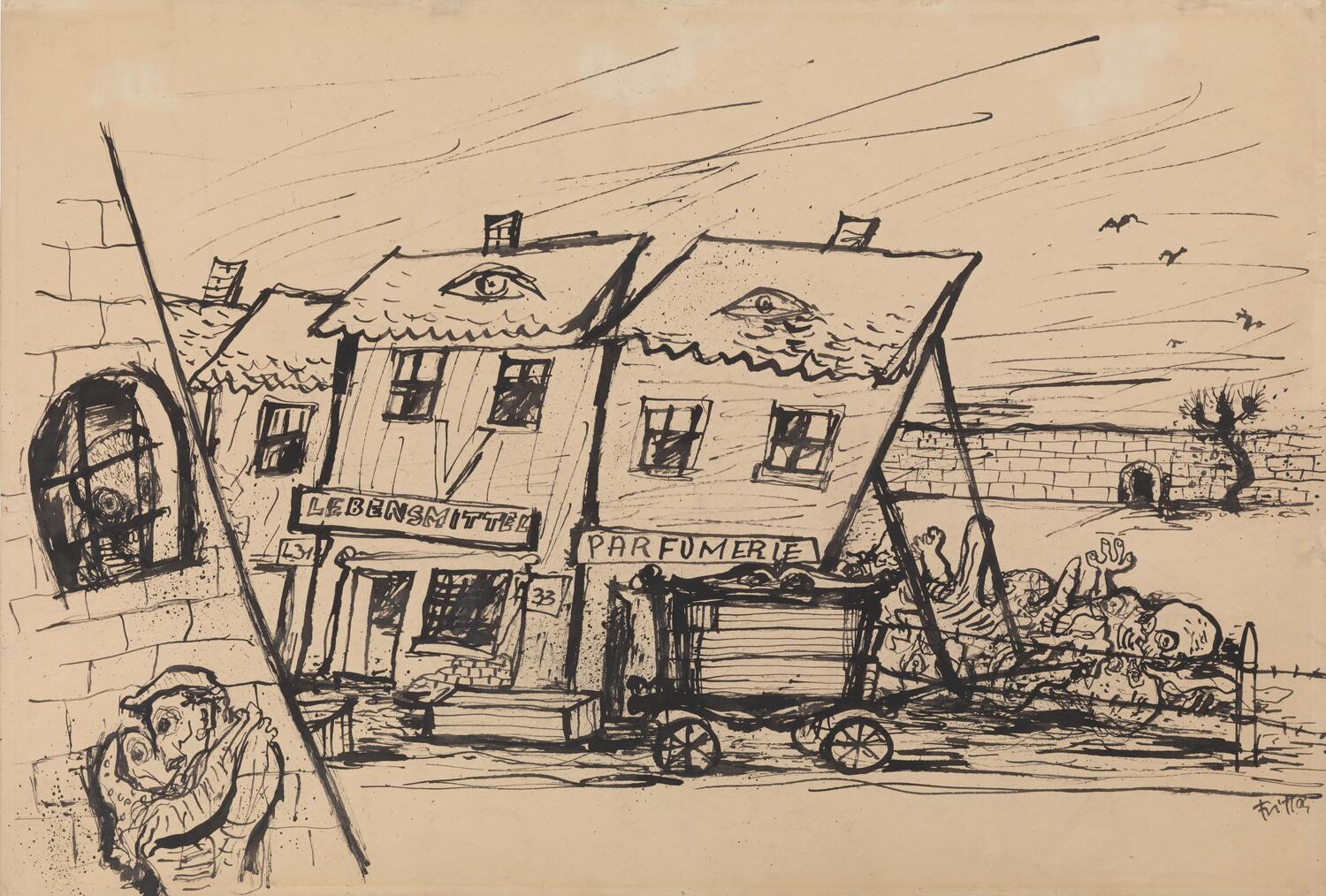

In the Terezin concentration camp, before a visit by the International Red Cross and the Danish Red Cross in 1944, the Nazis created an elaborate ruse, designed to convince the delegation that the camp was actually a “self-governing town,” and not a prison camp where tens of thousands had died and which served as a transit point for deportation to Auschwitz. To this end, they constructed a fake park, theater, school, sports area, playground, and café, and forced ghetto inhabitants to put on a show and pretend to be happy. Even a fake documentary film was produced. Here, Bedřich Fritta satirizes the deception. Behind the false façades are dead bodies and, at left, a gaunt prisoner looks out from the window of a prison. After the departure of the international delegation, almost everyone who had been forced to act in the farce was deported to Auschwitz, including Bedřich Fritta.
We’re sorry. The Posen Library’s licensing agreements prevent this image from being printed or downloaded.
Credits
© Thomas Fritta-Haas, long-term loan to the Jewish Museum Berlin, photo: Jens Ziehe.
Published in: The Posen Library of Jewish Culture and Civilization, vol. 9.
You may also like

Women’s Auxiliary Air Force Recruitment Poster
This surprising 1942 Hebrew-language poster from Palestine calls for women to serve in an all-female unit within Britain’s Royal Air Force. This recruitment office was not open on Saturdays!

Evening in the City of London
Evening in the City of London was one of several charcoal drawings that David Bomberg made during World War II when he was a firewatcher in London. The city was regularly bombed by the Germans and…

Untitled—Three Men and a Horse in the Shtetl
Though he was born and lived all his life in North America, Norman Leibovitch’s oeuvre included not only depictions of the Montreal neighborhood where he grew up and Canadian landscapes, but many…

D Day Rescue, Omaha Beach, France. June 6, 1944
Though this photograph of Second Lieutenant Walter Sidlowski with the body of a soldier killed during the Allied assault on Omaha Beach has gone down in history as a photograph of D-Day, it was…

La Ghriba Djerba, Tunisia
Jules Lellouche painted the interior of this synagogue in Djerba during World War II, when Tunisia was ruled by Vichy France. Though Tunisia’s Jewish community escaped mass deportations and murder in…

Untitled, Execution: Babi Yar series. Nizhny Tagil or Leningrad
Felix Lembersky’s three Babi Yar paintings were among the first artistic representations of the Nazi massacre in Kyiv, when, over the course of two days in September 1941, over 33,000 Jews were…
You may also like
Women’s Auxiliary Air Force Recruitment Poster
This surprising 1942 Hebrew-language poster from Palestine calls for women to serve in an all-female unit within Britain’s Royal Air Force. This recruitment office was not open on Saturdays!
Evening in the City of London
Evening in the City of London was one of several charcoal drawings that David Bomberg made during World War II when he was a firewatcher in London. The city was regularly bombed by the Germans and…
Untitled—Three Men and a Horse in the Shtetl
Though he was born and lived all his life in North America, Norman Leibovitch’s oeuvre included not only depictions of the Montreal neighborhood where he grew up and Canadian landscapes, but many…
D Day Rescue, Omaha Beach, France. June 6, 1944
Though this photograph of Second Lieutenant Walter Sidlowski with the body of a soldier killed during the Allied assault on Omaha Beach has gone down in history as a photograph of D-Day, it was…
La Ghriba Djerba, Tunisia
Jules Lellouche painted the interior of this synagogue in Djerba during World War II, when Tunisia was ruled by Vichy France. Though Tunisia’s Jewish community escaped mass deportations and murder in…
Untitled, Execution: Babi Yar series. Nizhny Tagil or Leningrad
Felix Lembersky’s three Babi Yar paintings were among the first artistic representations of the Nazi massacre in Kyiv, when, over the course of two days in September 1941, over 33,000 Jews were…