
Harvesting and Threshing in Egyptian Painting, from the Tomb of Pa-heri (New Kingdom)
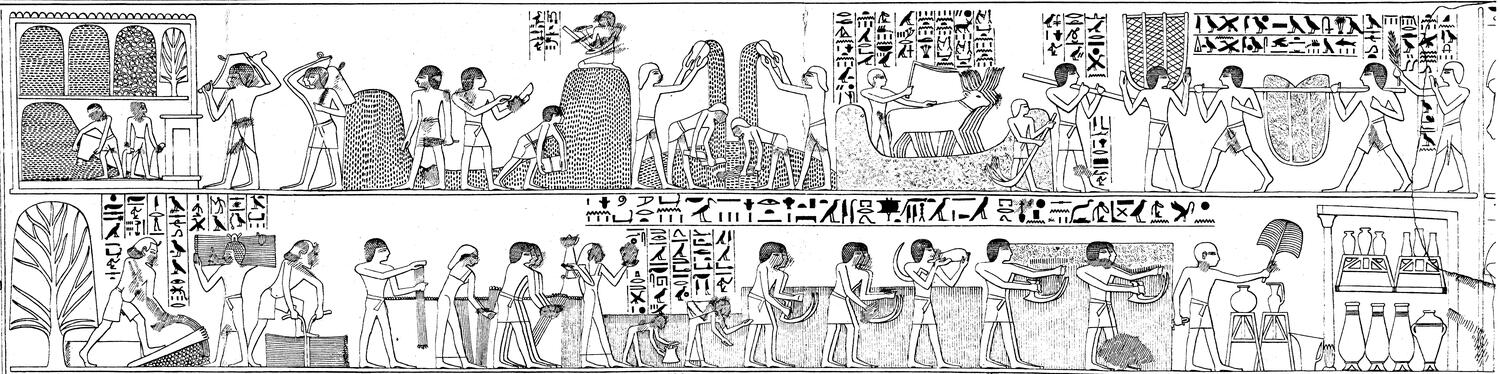
New Kingdom (Egypt), 14th Century BCE
Credits
Joseph John Tylor and Francis Llewellyn Griffith, from The Tomb of Paheri at El Kab (London: Egypt Exploration Fund, 1894), Plate III.
Published in: The Posen Library of Jewish Culture and Civilization, vol. 1.
You may also like
Ruth
Ruth 1–4
In the days when the chieftains ruled, there was a famine in the land; and a man of Bethlehem in Judah, with his wife and two sons, went to reside in the country of Moab. The man’s name…
Esther
Esther 1–8
It happened in the days of Ahasuerus—that Ahasuerus who reigned over a hundred and twenty-seven provinces from India to Ethiopia. In those days, when King Ahasuerus occupied the royal…
Behistun Trilingual Inscription and Aramaic Papyrus
Behistun Trilingual Inscription, Persia. This inscription of Darius I (reigned 522–486 BCE) illustrates the polyglot character of the Persian Empire. Versions in the Old Persian, Elamite, and Akkadian…
Lot (puru), Assyria
Lot (puru), Assyria, 8th century BCE. The inscription identifies this as a lot (puru—the Akkadian form of Hebrew pur, the word used in Esther 3:7) that belonged to an Assyrian official named Yahalu…
Impaled Corpses at Lachish
Impaled corpses at Lachish, detail from Assyrian relief in the Nineveh palace of Sennacherib (reigned 705–681 BCE), depicting the conquest of Lachish in 701 BCE. For the full relief see Conquest of…
Daniel 1–6
Daniel 1, 5–6
In the third year of the reign of King Jehoiakim of Judah, King Nebuchadnezzar of Babylon came to Jerusalem and laid siege to it. The Lord delivered King Jehoiakim of Judah into his power…
Engage with this Source
Restricted
Related Guide
Biblical Narrative Style
Biblical Period
Biblical narrative presents a long and often continuous account of Israel’s story that differs significantly from modern narrative style.
You may also like
Ruth
Ruth 1–4
In the days when the chieftains ruled, there was a famine in the land; and a man of Bethlehem in Judah, with his wife and two sons, went to reside in the country of Moab. The man’s name…
Esther
Esther 1–8
It happened in the days of Ahasuerus—that Ahasuerus who reigned over a hundred and twenty-seven provinces from India to Ethiopia. In those days, when King Ahasuerus occupied the royal…
Behistun Trilingual Inscription and Aramaic Papyrus
Behistun Trilingual Inscription, Persia. This inscription of Darius I (reigned 522–486 BCE) illustrates the polyglot character of the Persian Empire. Versions in the Old Persian, Elamite, and Akkadian…
Lot (puru), Assyria
Lot (puru), Assyria, 8th century BCE. The inscription identifies this as a lot (puru—the Akkadian form of Hebrew pur, the word used in Esther 3:7) that belonged to an Assyrian official named Yahalu…
Impaled Corpses at Lachish
Impaled corpses at Lachish, detail from Assyrian relief in the Nineveh palace of Sennacherib (reigned 705–681 BCE), depicting the conquest of Lachish in 701 BCE. For the full relief see Conquest of…
Daniel 1–6
Daniel 1, 5–6
In the third year of the reign of King Jehoiakim of Judah, King Nebuchadnezzar of Babylon came to Jerusalem and laid siege to it. The Lord delivered King Jehoiakim of Judah into his power…
