

Letter on the Capture of Jerusalem
About This Entry
In 1099, after a months-long siege, the Crusaders took Jerusalem, and then met and defeated a Fātimid army outside the walled coastal city of Ascalon. In the aftermath of the fighting, six Karaite leaders left for Egypt as refugees. Once in Alexandria, they sent this lengthy Judeo-Arabic letter to the Jews of Fustāt (Old Cairo), pleading for financial support to help redeem Jews who had been taken prisoner by the Crusaders. It is possible that this letter was intended to be read aloud as part of a fundraising appeal. The destruction of the Palestinian Karaite community by the Crusaders contributed to their diminished influence in later generations.
And news does not cease arriving that some of those who were redeemed from the Franks and have stayed in Ascalon are starving, naked, and destitute. Others remain as prisoners, while others were killed in front of the rest with all kinds of torture, in their lust for extermination. And we cannot hear of anyone of Israel in such a plight that we do not make every exertion or strive with all our might for their deliverance.
God—may He be exalted—has granted a few of the refugees ease and favor—thanks to the mercy of Heaven—of which the first and greatest fact is that Abū ’l-Faḍl Sahl ibn Yusha‘ ibn Shay‘a—may God preserve him—is in Ascalon, and he has connections with the sultan—may God bless his victory—and his influence is great in the port city [Alexandria], where his word carries weight. He maneuvered within this calamity wisely, but it will take time to explain how he did it.
He could not ransom some and leave others, but eventually he was able to ransom everyone he could buy, and only a few remained, including a boy of about eight or ten years of age, known as Abū Sa‘d, the son of al-Tustarī’s wife. It was said that the Franks proposed he convert to the Christian faith of his own free will, promising to treat him well, but he said to them, “How can a kohen [priest] become a Christian?!,” and they left him alone. And we have already spent a large sum of money on him, but he is still there along with the rest of them, apart from those few who were taken to Antioch and those who renounced their religion, because they lost patience when it was not possible to ransom them and because they despaired of being permitted to go free. But we are not aware, thanks be to God—may He be exalted—that those aforementioned accursed Germans raped or violated any woman.
Also, some of those who preserved their lives escaped on the second and third days after the battle, together with the governor, who was granted safe conduct; and some others, who had been taken by the Franks and remained with them for a while, were able to escape, but these are only few. The majority are those who were ransomed.
And to our distress, some of them died under cruel punishment and persecution, while others, because of the force of the attack that overtook them, had to leave for this land without taking provisions with them nor protection against the effects of the cold, and they died on the journey. Others who went by sea died in the same way, and others, after having arrived here safely, experienced the change of climate and arrived at the peak of the plague, and a number of them died. But some people had already arrived here, one by one.
And when the aforementioned distinguished sheikh arrived, he took a group of them—most of those who had been in Ascalon—and he spent the Sabbath and celebrated the festival of Passover with them on the way, insofar as the circumstances allowed. He also took out a loan in his own name for the cost of the camel drivers, their provisions, and the guards, and for all the other expenses, and this in addition to what he had already paid out and not charged to the community. And added to this is what was borrowed and spent in order to buy back 230 codices of the Bible, one hundred unbound books, and eight Torah scrolls. All these belong to the community’s pious foundation and are now in Ascalon. And about two hundred dinars remain as a debt on the community, even after what they have already paid out in various payments: the expense only of the ransom of human lives and maintaining some of them, and the cost of the aforementioned communal property—totaling five hundred dinars.
And all this is in addition to what has been spent on preserving the lives of those who have arrived from the beginning until now—on medicines, medical treatment, provisions, and, insofar as possible, clothing. If it could be calculated how much this has cost over the whole period, the total would be great. Were the situation widely known to the public, that the usual custom is that the ransom of three Jewish prisoners costs one hundred dinars, then this whole sum would have been spent only on the ransoming of a very few!
Source: CUL T-S 20.113.
Translated by Amir Ashur and Benjamin M. Outhwaite.
Credits
Yeshaya ben Matsliaḥ, David ben Solomon, and Ḥanina Ibn ‘Ubayd, Letter on the Capture of Jerusalem, CUL T-S 20.113.
Published in: The Posen Library of Jewish Culture and Civilization, vol. 3: Encountering Christianity and Islam.
You may also like

Migration and Mobility in the Early Medieval Period
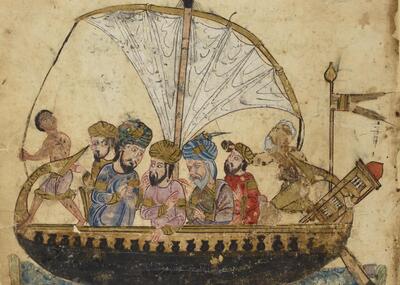
Medieval societies can sometimes be seen as static and isolated. Yet medieval people of all sorts moved from one place to another, for a variety of reasons: for economic opportunity and trade, driven by wars and forced displacement, and more. Western Europe and the Mediterranean, the Middle East, and even the Far East were connected by the migration of people, merchandise, and ideas.

Controversy between the Karaites and the Rabbanites
Ḥilluk ha-Kara’im ve-ha-Rabbanim

The Scroll of Ovadiah
Megilat ‘Ovadyah
Ovadiah recounts his travels before finally reached Egypt, meeting Karaites, and encountering Crusaders.
Dialogue Against the Jews: His Conversion to Christianity
Dialogi contra Iudaeos

I uttered a vow to God
Report of Messianic Troubles from Baghdad
You may also like
Migration and Mobility in the Early Medieval Period
Medieval societies can sometimes be seen as static and isolated. Yet medieval people of all sorts moved from one place to another, for a variety of reasons: for economic opportunity and trade, driven by wars and forced displacement, and more. Western Europe and the Mediterranean, the Middle East, and even the Far East were connected by the migration of people, merchandise, and ideas.
Controversy between the Karaites and the Rabbanites
Ḥilluk ha-Kara’im ve-ha-Rabbanim
The Scroll of Ovadiah
Megilat ‘Ovadyah
Ovadiah recounts his travels before finally reached Egypt, meeting Karaites, and encountering Crusaders.
Dialogue Against the Jews: His Conversion to Christianity
Dialogi contra Iudaeos