
Marriage Documents of Shelamzion and Salome Komaïse
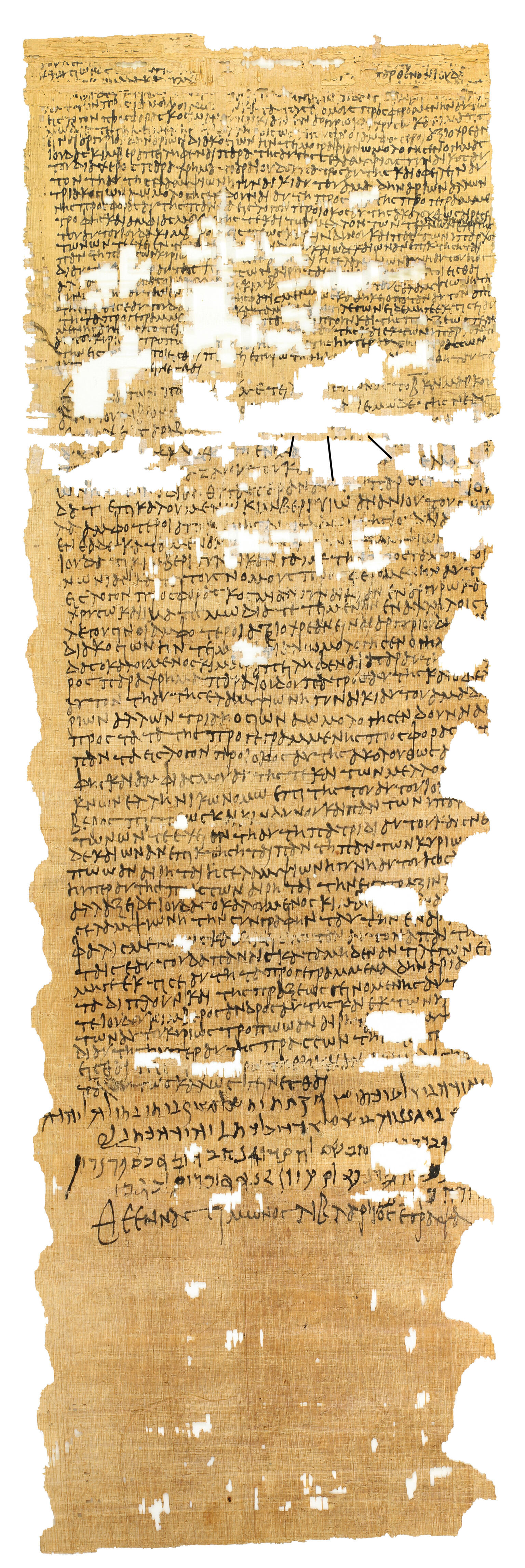
P. Yadin 18

In the consulship of Publius Metilius Nepos for the 2nd time and Marcus Annius Libo on the nones of April, and by the compute of the new province of Arabia year twenty-third on the fifteenth month of Xandikos, in Maoza, Zoara district, Judah son of Eleazar also known as Khthusion, gave over Shelamzion, his very own daughter, a virgin, to Judah surnamed Cimber son of Ananias son of Somalas, both of the village of En-gedi in Judaea residing here, for Shelamzion to be a wedded wife to Judah Cimber for the partnership of marriage according to the laws, she bringing to him on account of bridal gift feminine adornment in silver and gold and clothing appraised by mutual agreement, as they both say, to be worth two hundred denarii of silver, which appraised value the bridegroom Judah called Cimber acknowledged that he has received from her by hand forthwith from Judah her father and that he owes to the said Shelamzion his wife together with another three hundred denarii which he promised to give her in addition to the sum of her aforesaid bridal gift, all accounted toward her dowry, pursuant to his undertaking of feeding and clothing both her and the children to come in accordance with Greek custom upon the said Judah Cimber’s good faith and peril and [the security of] all his possessions, both those which he now possesses in his said home village and here and all those which he may in addition validly acquire everywhere, in whatever manner his wife Shelamzion may choose, or whoever acts through her or for her may choose, to carry out the execution. Judah called Cimber shall redeem this contract for his wife Shelamzion, whenever she may demand it of him, in silver secured in due form, at his own expense interposing no objection. If not, he shall pay to her all the aforesaid denarii twofold, she having the right of execution, both from Judah Cimber her husband and upon the possessions validly his, in whatever manner Shelamzion or whoever acts through her or for her may choose to carry out the execution. In good faith the formal question was asked and it was acknowledged in reply that this is thus rightly done.

[2nd hand, Aramaic] Yehudah son of Elazar Khthousian: I have given my daughter Shelamzion, a virgin, in marriage to Yehudah Cimber son of Ḥananiah son of Somala, according to what is written above. Yehudah wrote it.

[3rd hand, Aramaic] Yehudah Cimber son of Ḥananiah son of Somala: I acknowledge the debt of silver denarii five hundred, the dowry of Shelamzion my wife, according to what they wrote above. Yehudah wrote it.

[1st hand] I, Theënas son of Simon, librarius, wrote [this].

On the back, individual signatures

Yehudah son of Elazar wrote it.

Yehudah son of Ḥananiah [wrote it.]

Of ________ son of _________, the hand?

Shim‘on son of __________, witness

Eliezer son of Ḥilqiah, witness

Yohsef son of Ḥananiah, witness

Wanah son of _______, for himself.

P. Yadin 37

In the consulship of Sergius Octavius Laenas Pontianus and Marcus Antonius Rufinus seven days before the ides of August, and by the compute of the new province of Arabia year twenty-sixth on the nineteenth of month Löos, in Maoza of the Zoarene [district] of the administrative region of Petra, metropolis of Arabia, Jesus son of Menahem, domiciled in the village of Soffathe . . . in the district of the city of Livias of the administrative region of P[] acknowledged of his own free will(?) that he has taken Salome also called Komaïse . . . a Maozene woman, for them to . . . and for Jesus to live with her as also before this time . . . to the said Komaïse as her dowry ninety-six denarii of silver, and the bridegroom, the said Jesus, acknowledged that he has received from her on the present day feminine adornment in silver and gold and clothing and other feminine articles equivalent in appraised value to the [stated sum of] money, with his undertaking of feeding and clothing both her and the children to come in accordance with Greek custom and Greek manners upon the said Jesus’ good faith and peril of all his possessions, both those which he possesses in his home village of Soffathe . . . and those which he may in addition acquire, she having the right of execution both from the said Jesus and upon all(?) his validly held possessions everywhere, in whatever manner the said Komaïse or whoever acts through her or for her may choose to carry out the execution, regarding this being thus rightly done the formal question having in good faith been asked and acknowledged in reply. I, _______ son of Menahem, guardian of the said Komaïse have agreed(?) . . .

Translated by Naphtali Lewis.

Notes

Words in brackets appear in the original translation.

Credits

P. Yadin 18, 37, from The Documents from the Bar-Kokhba Period in the Cave of Letters: Greek Papyri, ed. and trans. Naphtali Lewis, Judean Desert Studies, vol. 2 (Jerusalem: Israel Exploration Society, 1989): pp. 80–81, 131–32. Used with permission of the publisher.

Published in: The Posen Library of Jewish Culture and Civilization, vol. 2: Emerging Judaism.

Engage with this Source

You may also like
