

Meiron House


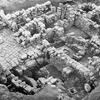
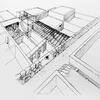
This large, late Roman house in the village of Meiron, in upper Galilee, had two stories with several rooms each. The upper story served as living space and was accessed by a built staircase. The lower level had eight rooms, probably used as workshops, like a cooperage (for making wooden crates and caskets) and a carpenter’s shop. The adjacent flagstone terrace was partially roofed on one end, with a portico supporting the ceiling. The courtyard kept the floor from getting muddy and would have been easier to keep clean, especially if animals were around. Household activities also took place in the courtyard; there was little distinction between private and public space. This kind of overlap also appears in tannaitic passages that describe the production of olives inside the home (m. Teharot 9:6). The family living within such a house thus functioned as a unit, with men, women, children, and sometimes servants and enslaved people all living and working together. The reconstruction drawing shows the street separating this home from adjacent buildings and community infrastructure.
Credits
-
Courtesy of the Meiron Excavation Project, Duke University, Eric & Carol Meyers.
-
Courtesy of the Meiron Excavation Project, Duke University, Eric & Carol Meyers.
Published in: The Posen Library of Jewish Culture and Civilization, vol. 2: Emerging Judaism.
You may also like


Capernaum House

Ḥorvat ‘Ethri House

Katzrin House

Ḥorvat Kanaf House

Khirbet Shema House

Related Guide
Architecture of Ancient Jewish Houses and Palaces
You may also like
Capernaum House
Ḥorvat ‘Ethri House
Katzrin House
Ḥorvat Kanaf House