

Phoenician Ship
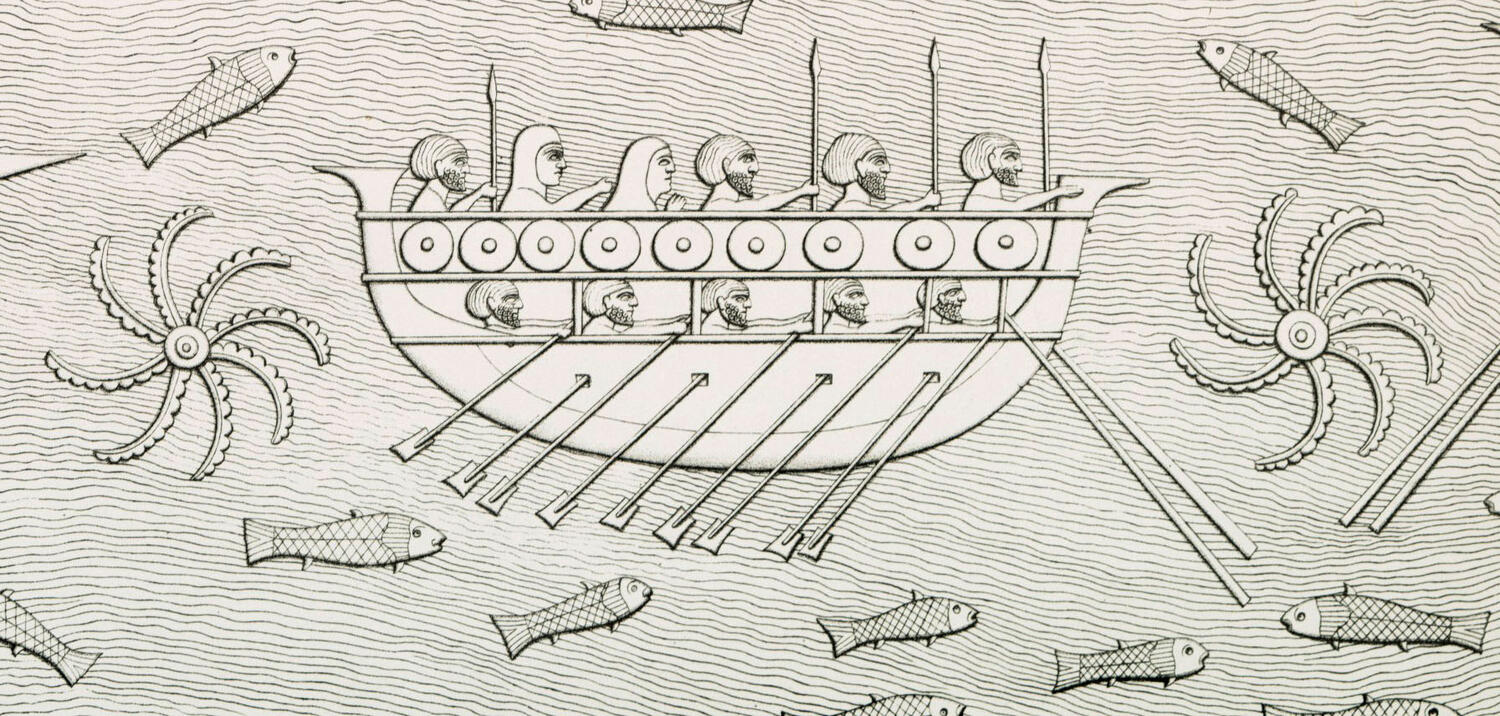

Phoenician ship in Assyrian relief from palace of Sennacherib (reigned 705–681 BCE), Nineveh. Transport galleys flee Tyre in the face of Sennacherib’s attack in 701 BCE. Soldiers and passengers stand on the upper deck while oarsmen row from the lower decks. See also Destruction of City and Capture of Inhabitants in Assyrian Relief. References to Phoenician ships and shipping include the expert sailors Hiram sent to join King Solomon’s fleet in 1 Kings 9:27, references to Phoenician ships in the Latter Prophets, and Jonah’s attempted flight on a ship, to evade his divine mission of exhorting Nineveh to repent.
Credits
A. H. Layard, from The Monuments of Nineveh, (London: J. Murray, 1849), pl. 71. General Research Division, The New York Public Library. "Enemies of the Assyrians Taking Refuge in Ships." New York Public Library Digital Collections. http://digitalcollections.nypl.org/items/510d47dc-4773-a3d9-e040-e00a18064a99.
Published in: The Posen Library of Jewish Culture and Civilization, vol. 1.
You may also like

Harvesting and Threshing in Egyptian Painting, from the Tomb of Pa-heri (New Kingdom)
Harvesting and threshing in Egyptian painting, from the tomb of Pa-heri (New Kingdom, 18th dynasty, 15th century BCE). In the lower register, on the right, reapers are followed by a woman and child…

Behistun Trilingual Inscription and Aramaic Papyrus
Behistun Trilingual Inscription, Persia. This inscription of Darius I (reigned 522–486 BCE) illustrates the polyglot character of the Persian Empire. Versions in the Old Persian, Elamite, and Akkadian…

Lot (puru), Assyria
Lot (puru), Assyria, 8th century BCE. The inscription identifies this as a lot (puru—the Akkadian form of Hebrew pur, the word used in Esther 3:7) that belonged to an Assyrian official named Yahalu…

Impaled Corpses at Lachish
Impaled corpses at Lachish, detail from Assyrian relief in the Nineveh palace of Sennacherib (reigned 705–681 BCE), depicting the conquest of Lachish in 701 BCE. For the full relief see Conquest of…
You may also like
Harvesting and Threshing in Egyptian Painting, from the Tomb of Pa-heri (New Kingdom)
Harvesting and threshing in Egyptian painting, from the tomb of Pa-heri (New Kingdom, 18th dynasty, 15th century BCE). In the lower register, on the right, reapers are followed by a woman and child…
Behistun Trilingual Inscription and Aramaic Papyrus
Behistun Trilingual Inscription, Persia. This inscription of Darius I (reigned 522–486 BCE) illustrates the polyglot character of the Persian Empire. Versions in the Old Persian, Elamite, and Akkadian…
Lot (puru), Assyria
Lot (puru), Assyria, 8th century BCE. The inscription identifies this as a lot (puru—the Akkadian form of Hebrew pur, the word used in Esther 3:7) that belonged to an Assyrian official named Yahalu…
Impaled Corpses at Lachish
Impaled corpses at Lachish, detail from Assyrian relief in the Nineveh palace of Sennacherib (reigned 705–681 BCE), depicting the conquest of Lachish in 701 BCE. For the full relief see Conquest of…