

Fox Fables
About This Entry
Most of the stories in Berekhiah ben Natronay ha- Nakdan’s Fox Fables (Mishle shu‘alim), his best-known work, come from a French work titled Ysopet, by Marie de France, and from medieval Latin versions of Aesop’s fables. Berekhiah also used sources from India and the Islamic world that circulated in northern Europe. Many of the stories feature animals. At the end of each one, Berekhiah helpfully offers the lessons to be gleaned from the parables.
Author’s Proem
[ . . . ] Lo, I draw parables of beasts and birds to strengthen hands that are weak, and of creeping things that crawl upon the ground; these are for a similitude for them that walk on earth. I shall begin with the lion who rules over them all, great and small, for they changed his honor for shame. So when a rich man grows poor, his comrades make themselves strangers to him.
The Ape, His Two Sons, a Leopard
Though a Man Differentiate between Two Sons, in the End the Diverse Will Be Mingled
Upon a rock near a bush were an ape and his two sons, of whom he loved the younger and hated the elder. When a watchful leopard descended from his lair the ape trembled for himself and the son he loved, for he saw that he was come from the mountains of the leopards. In great fury the leopard came on to destroy and lay waste; he roared over his prey and made a way for his anger. Said the ape: “Of him that I hate I shall know how to be bereft; I shall hide my face from him and he shall be for devouring.” And he took him and cast him over his back, intending to present him to the leopard first. But the younger, upon whom he took pity, he carried between his legs as he ran. When he saw that the leopard was approaching nearer he wished to hurl the ape upon his back to the ground, but that one perceived his willfulness and in his desire to deliver his soul grasped hold of the fringes of his hair. When the ape saw that he could not throw him down and the leopard was drawing very nigh, he forsook the one he loved and himself escaped with the one that held sway over his back. When the ape saw that his scheme was frustrated, his reins and heart clove to the one he hated, and his hatred was turned into love; he took pity upon him as a man takes pity upon the son that serves him.
The parable: A man should love his sons in equal measure, for him that he loves best and in whom he reposes his hope the wheel will suddenly ravish away; shut thine eye upon him and he is gone. But him that he hated and kept afar will restore his soul and sustain his old age.
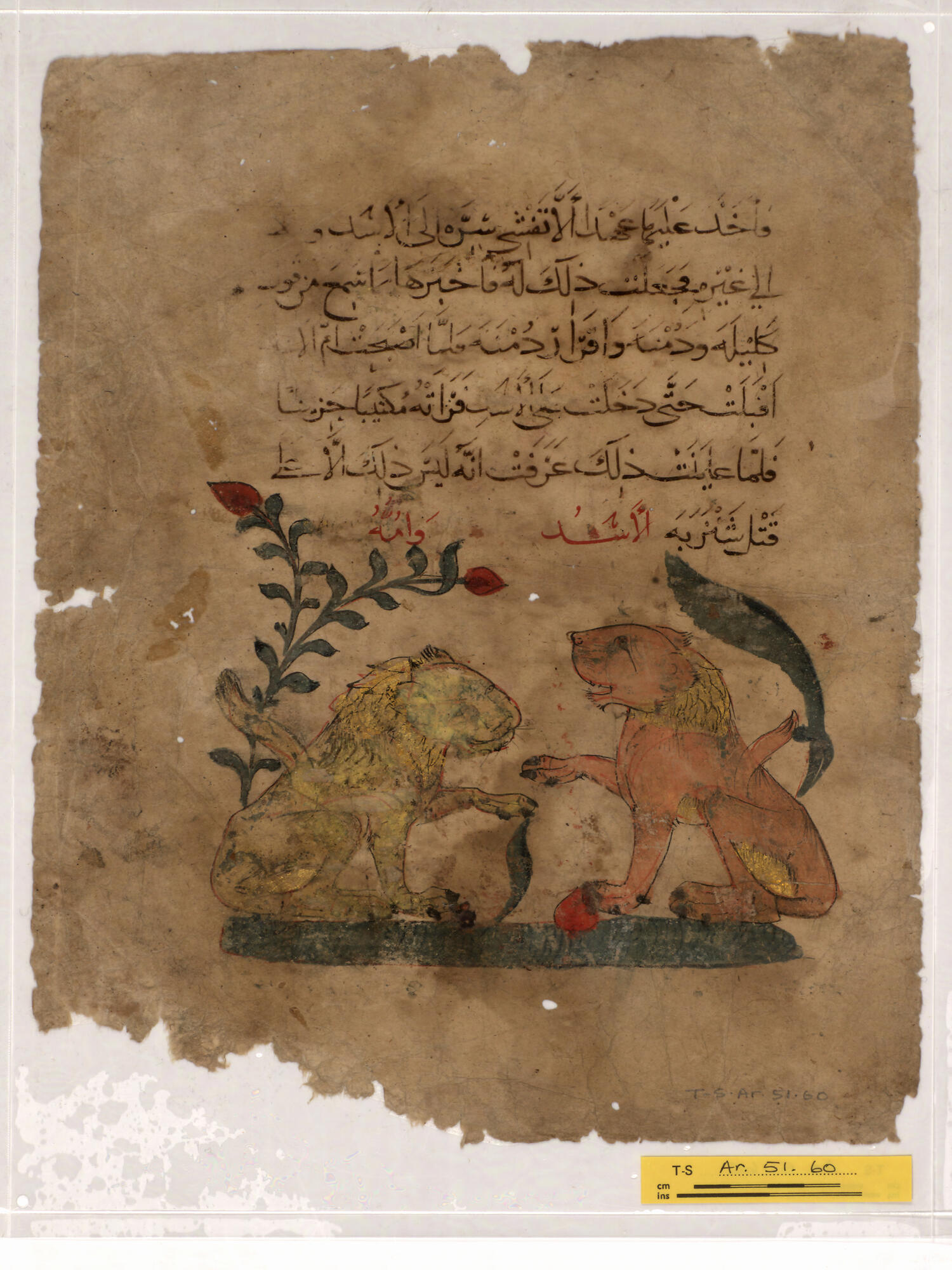

Lion & Toad
Thou Shalt Surely Say to Men of Might That the Great Must Beware of the Small
The lion, whose strength surpassed all, was sleeping in the shade of a rock in the wilderness, and behind him in a cleft of the rock there stood a toad. Said the toad: “Who is this before my hole?” He knelt and crouched like a lion, and was moved with choler, and dashed up to him in the fury of his spirit; he bit the lion upon the forehead like an adder, and the lion awoke from his sleep. His eyes were like coals, and like flames they roved abroad to see who and where he was whose heart emboldened him to do such a thing. The toad had already returned by the way he had come; he looked at the lion, and behold, he was raging and furious, as if he would lop his biter down with terror. The toad called to him: “Art thou seeking him who hurt thee? It is I, the toad who stands before thee, that bit thee in my furious anger. I am greatly vexed that I did not kill thee. Alas for thee that thou hast sinned; thy sins will find thee out. Suddenly they shall rise up that shall bite thee, and they that shall vex thee shall awake. Wilt thou be my persecutor in thy strength and stature because I am accounted puny and contemptible in thy sight? Thou hast neared my rock to stop the entry to my house, and in my anger I have come forth to be thy persecutor.”
The parable is to admonish the great with respect to the small, lest by reason of their strength and might and power and pride they sin against those smaller than they. For the pursued are tenacious of life, and though they be small, the might of their heart is great. Within themselves they set their ambush to take vengeance in spite. The vain should be wise, for a giant is sometimes strangled by a fly, and there are times when towering giants stumble into pitfalls, and lions fear sheep.
Credits
Berekhiah ha-Nakdan, Fox Fables, from Fables of a Jewish Aesop, trans. Moses Hadas (New York: Columbia University Press, 1967), 1, 4–5, 106–7, 190–91. Reprinted by David R. Godine, 2001. Courtesy Estate of Moses Hadas.
Published in: The Posen Library of Jewish Culture and Civilization, vol. 3: Encountering Christianity and Islam.
You may also like

The Tale of the Wicked Neighbor
The Speech of Tuviah ben Zedekiah

Book of Delight
Sefer sha'ashu'im, I.1-2, IV:2, V:2.
The Tale of the Drakon
The Tale of the Sorcerer

Sayings of the Arabs
Ten pieces of advice from a mother to her daughter about how to please her husband, from a 12th-century Hebrew story collection, translated from Arabic.
You may also like
The Tale of the Wicked Neighbor
The Speech of Tuviah ben Zedekiah
Book of Delight
Sefer sha'ashu'im, I.1-2, IV:2, V:2.
The Tale of the Drakon
The Tale of the Sorcerer
Sayings of the Arabs
Ten pieces of advice from a mother to her daughter about how to please her husband, from a 12th-century Hebrew story collection, translated from Arabic.