

Letter to Her Son, Dosa
About This Entry
In this Judeo-Arabic letter from the Cairo Geniza, a woman writes to her son, Dosa ben Joshua al-Lādhiqī, asking him to write more often, and to send her garments and other items from Fustāt (Old Cairo). The mother likely employed a scribe or male relative to write this letter. We learn that the woman’s husband and other son have also been away from the family’s residence in al-Raqqa, a city in what is now Syria that had a thriving Jewish community. Several members of the al-Lādhiqī family have been tentatively identified; the son not named in this letter may have been Eli ben Joshua he-ḥaver (fellow; an honorific), a ḥazan (a cantor and synagogue functionary) in the al-Raqqa community.
In Your name, O Merciful One.
My letter [I write to you], my son, dearest to me and of all people by me, may God perpetuate your honor and strength and happiness and your health, and confer His favor upon you, from the place of residence in al-Raqqa, Thursday, the 21st of Av.
[I am] in good health—may God always grant you the same in His mercy. And I have already become weary of writing to you, my son, without receiving a reply from you, and I don’t understand why you cut off family ties. Letters arrived from your brother, may God preserve him, and I did not receive from among them a letter from you. Is it not the case that you are together in one place? And don’t you realize that a letter from you, whenever it reaches me, is for me in place of [seeing] your face, and don’t you realize that my heart depends on news about you [pl.]? Surely nothing less than a letter written by you will calm my heart. Don’t kill me before my time! And your brother, may God preserve his well-being, mentioned that he is coming down to worship [during] the month of the festival in Jerusalem [i.e., Tishri] and intends to come to us. I would like you to pressure him to do so. And don’t relent until he brings his boys, because I start to ask [myself], really, [if] you [pl.] granted the enemy what he sought, and you are scattered among the cities. And I ask God, my son, not to count these three years of my life, and surely no man so neglects his family and his own people.
Is it not the case that all I want from you is that you write a letter every once in a while, so that I know that you are in good health? I looked forward to the summer, when your letters might arrive, but the summer passed, and I did not read a single letter of yours. I wanted you to inform me how long you will stay in Fustāt, to calm my heart before I die. I would be happy if you were closer to us, in Jerusalem or in this country. I entreat God to be good to you. I fast and pray for you night and day. I want from you, my son, twenty dirhems of pure antimony1 and five dirhems of Indian zinc and lead.2 By God, if you had sent me your worn and dirty shirts, I would have revived my spirits through them. Don’t withhold your letters. And by God, beware that no ruse befalls you, and beware drunkenness. And [be careful] when you come and go; even when you were by my side, I was insecure about you[r safety]. I swear to God, I have had no sustenance and no life since your departure. And I beg God to reunite us soon. You will see, my son, that we will be together, you and I, before I die, and I will be pleased to see you before I see Him and am extinguished. Praise be the Lord who dispersed you [pl.]. Your father is in one city, your brother in another, and you in another. And you [pl.] abandoned me with your sister, for this is how you [sing.] wanted it. How long can a person stay in other people’s homes? By God, you must convince your brother as much as is within your power, so that he will listen to my words.
And in every letter that comes from him, he complains, saying, “I have nothing,” and [he says that] his father did not leave him a business. For two years, he has been saying, “I have bought gifts for you.” How kind he is to us! And we have seen nothing. And I ask God to be good to him. And Barhūn’s wife is asking you about Ṣāliḥ, if he has married al-Mazrūr’s [former] wife. They said about him that he lost his way; give us news about him.
And if you like, buy me a dark blue wimple with white embroidery. . . . I send you the warmest regards. By God, do not discontinue your letters to us.
Ḥātim [son-in-law] and the members of the house [family] and your sister and Sahl [nephew] and Abū ’l-Riḍā’, I rejoice when I see any of them. They send you best regards. And Sulaymān, your pupil, sends you regards. Letters to you had already been written by us and to Abū ’l-‘Alā, may God grant him well-being. [Written] on the 9th of Av.
[P.S.] I wrote to you about the wimple only because I am tired of writing to your father for two years, and he hasn’t done anything.
Address, in Arabic Script
To my lord and patron Abū Manṣūr Dosa ben Joshua, the ḥaver [fellow; an honorific], al-Lādhiqī, may God prolong his life and perpetuate his honor and support him.
From Sahl ibn Ḥātim [in] Fustāt
Qaṣr al-Shāma‘, Makīn Alley, may it arrive with the help of God.
To the partner of the [Arabic unclear], Eli the Ḥalabī [the Aleppan]
Letter Carriers
Al-Ḥasan Ibrāhīm and his son
To Asad ibn Muḥammad ibn Abī ‘Iyād
May his reply be gotten quickly, God willing.
Source: CUL T-S 13J23.5.
Translated by Renée Levine Melammed.
Notes
[Used for black eye makeup.—Trans.]
[This is an impure protoxide of zinc used as collyrium, eyeshadow, or a medicated eyewash. Might she have been selling these items?—Trans.]
Published in: The Posen Library of Jewish Culture and Civilization, vol. 3: Encountering Christianity and Islam.
You may also like
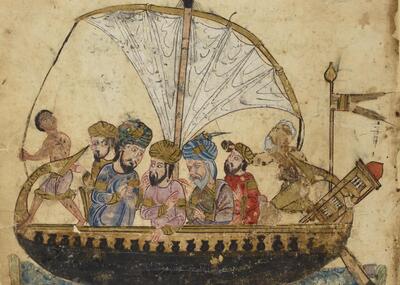

Migration and Mobility in the Early Medieval Period
Medieval societies can sometimes be seen as static and isolated. Yet medieval people of all sorts moved from one place to another, for a variety of reasons: for economic opportunity and trade, driven by wars and forced displacement, and more. Western Europe and the Mediterranean, the Middle East, and even the Far East were connected by the migration of people, merchandise, and ideas.

Letter to His Nephew, Yūsha‘ ibn Nathan

Letter to Nahray ben Nissim

Letter to the Jewish Community of Fustāt (I)
In this short 11th-century Hebrew declaration, intended be publicly displayed, the Jewish community of Damascus seeks to locate a husband who has abandoned his family.
Letter to the Jewish Community of Fustāt (II)
Letter to Nahray ben Nissim (I)
You may also like
Migration and Mobility in the Early Medieval Period
Medieval societies can sometimes be seen as static and isolated. Yet medieval people of all sorts moved from one place to another, for a variety of reasons: for economic opportunity and trade, driven by wars and forced displacement, and more. Western Europe and the Mediterranean, the Middle East, and even the Far East were connected by the migration of people, merchandise, and ideas.
Letter to His Nephew, Yūsha‘ ibn Nathan
Letter to Nahray ben Nissim
Letter to the Jewish Community of Fustāt (I)
In this short 11th-century Hebrew declaration, intended be publicly displayed, the Jewish community of Damascus seeks to locate a husband who has abandoned his family.