

Temple Emanuel Sanctuary Wall (Grand Rapids, Michigan)
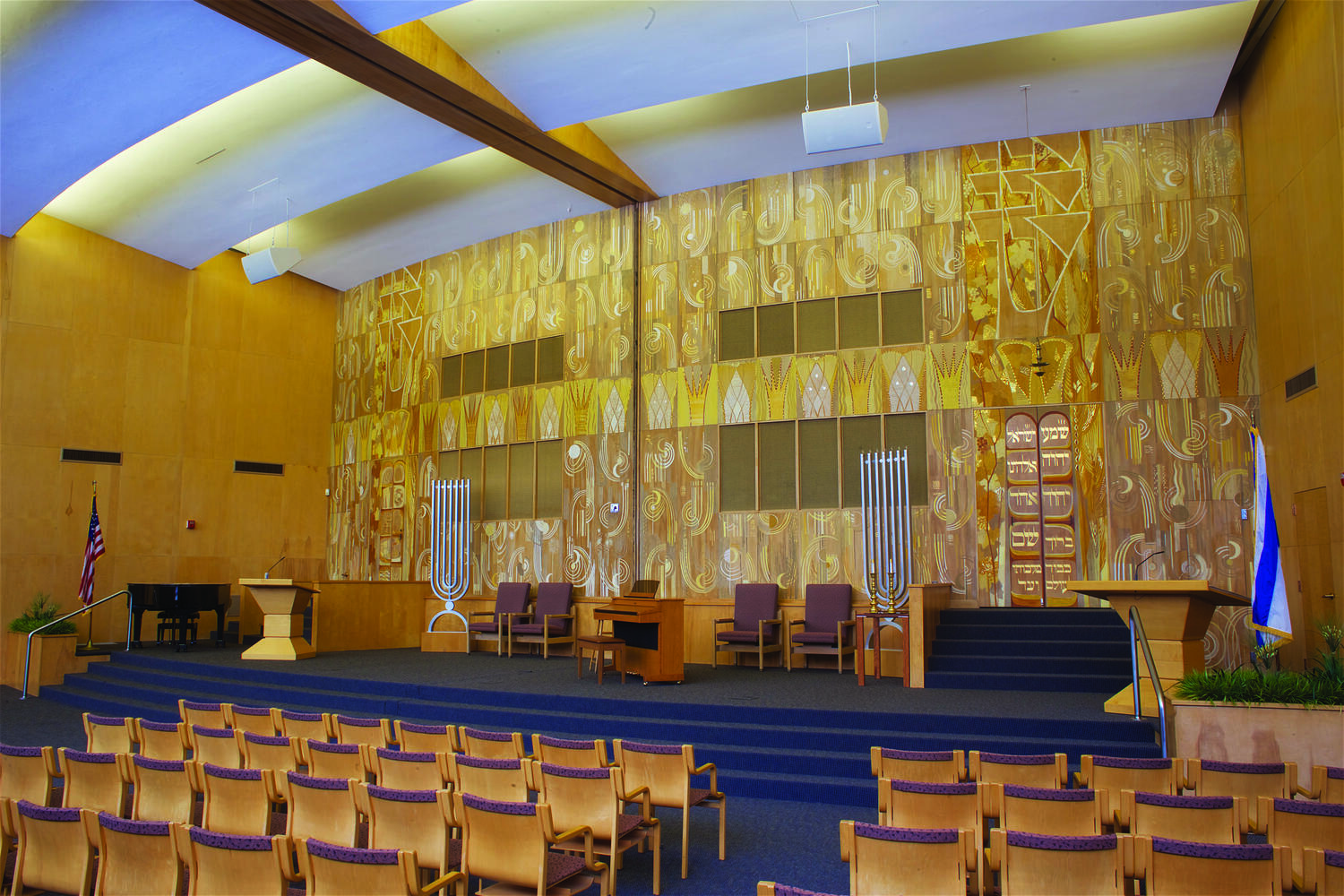

Lucienne Bloch’s thousand-square-foot mural covers the entire rear wall of Temple Emanuel, the building of which was designed by Erich Mendelssohn. Painted on lightweight wood panels in a palette favoring golden yellow, orange, and brown, the mural includes both abstract and representational motifs that include traditional biblical imagery such as wheat, grape vines, and crowns. Some of the panels with abstract designs represent the artist’s interpretation of the opening words of Genesis: the creation of light, heaven, and earth.
We’re sorry. The Posen Library’s licensing agreements prevent this image from being printed or downloaded.
Credits
Courtesy Temple Emanuel, Grand Rapids, MI. Photo: Dave Kagan, Sensitography.
Published in: The Posen Library of Jewish Culture and Civilization, vol. 9.
You may also like

The Binding of Isaac
The Binding of Isaac was painted at a time when Aharon Kahana was developing a new style that favored abstract forms divided by thick lines. His paintings were both an embrace of modern European art…

Symphonie Vitale
Like most of Henry Valensi’s other “Symphony” paintings, Symphonie Vitale does not refer to a specific piece of music, but instead reflects the principles of Musicalism, the art movement founded by…

L’Unité d’habitation à Nantes-Rezé
The Unité d'habitation of Nantes-Rezé is an apartment building located in Rezé, a suburb of Nantes, France designed by Le Corbusier. Lucien Hervé photographed the building, as he did many buildings…

Superduperman, Mad #4
Over its more than fifty-two years of publication, Mad Magazine skewered everyone from politicians to movie stars, with a particular dedication to rooting out hypocrisy. Here it spoofs its own genre…

In the Ma‘abarah
Ruth Schloss’s artworks were infused with her commitment to social justice and egalitarianism. This painting of a ma‘abarah (refugee absorption camp), made at a time when the new State of Israel was…

Ritual Figure
Though he later turned to a more abstract style, Elbert Weinberg was still making figurative sculptures in the early 1950s, when a trend toward pure abstraction was already dominant. But Ritual Figure…
You may also like
The Binding of Isaac
The Binding of Isaac was painted at a time when Aharon Kahana was developing a new style that favored abstract forms divided by thick lines. His paintings were both an embrace of modern European art…
Symphonie Vitale
Like most of Henry Valensi’s other “Symphony” paintings, Symphonie Vitale does not refer to a specific piece of music, but instead reflects the principles of Musicalism, the art movement founded by…
L’Unité d’habitation à Nantes-Rezé
The Unité d'habitation of Nantes-Rezé is an apartment building located in Rezé, a suburb of Nantes, France designed by Le Corbusier. Lucien Hervé photographed the building, as he did many buildings…
Superduperman, Mad #4
Over its more than fifty-two years of publication, Mad Magazine skewered everyone from politicians to movie stars, with a particular dedication to rooting out hypocrisy. Here it spoofs its own genre…
In the Ma‘abarah
Ruth Schloss’s artworks were infused with her commitment to social justice and egalitarianism. This painting of a ma‘abarah (refugee absorption camp), made at a time when the new State of Israel was…
Ritual Figure
Though he later turned to a more abstract style, Elbert Weinberg was still making figurative sculptures in the early 1950s, when a trend toward pure abstraction was already dominant. But Ritual Figure…