

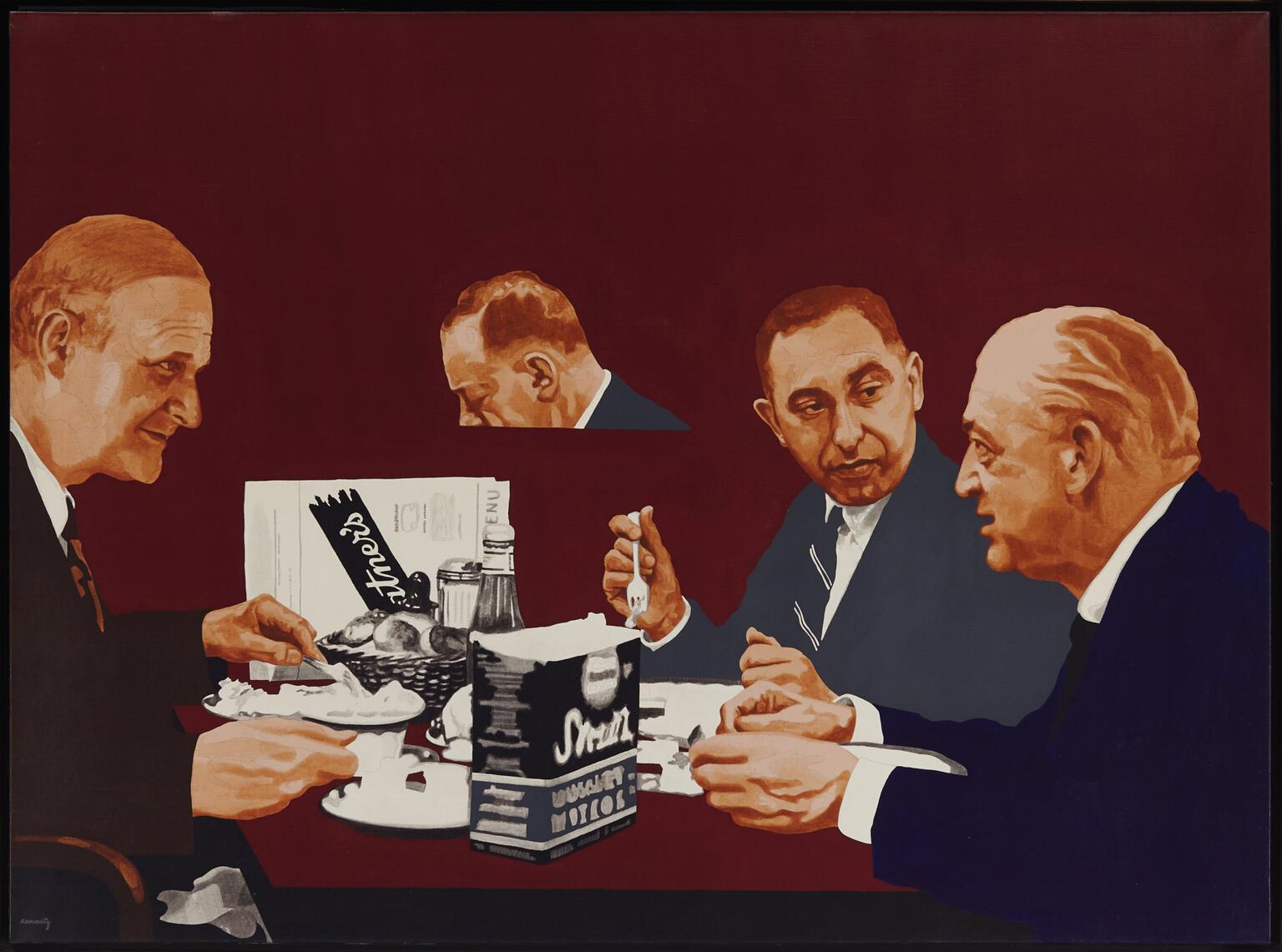
Lunch at Ratner’s
Image
Please login or register for free access to Posen Library
Already have an account?
You may also like


Chickensouperman from L’il Abner
L’il Abner, set in the fictional town of Dogpatch in Kentucky, presented a stereotyped view of the U.S. South. But its trenchant satire targeted political and social issues, and popular culture. Here…

Primary Structures, cover
Elaine Lustig Cohen designed this catalog cover for the Jewish Museum in New York’s exhibition, Primary Structures: Younger American and British Sculptors, at a time when she was developing a bold new…

Survivors Are Not Heroes
Survivors Are Not Heroes stands five meters tall on the St. George Campus of the University of Toronto. Etrog intended the bronze sculpture to serve as a critique of traditional war memorials, which…

Paratroopers at the Western Wall, June 7, 1967
Perhaps the most iconic photograph of the Six Day War is this one, of three Israeli paratroopers at the Western Wall shortly after its capture by the Israeli army on the third day of the war. A few…

“Le people juif . . . sur de lui-même et dominateur . . .” (“The Jews, a People Sure of Itself and Domineering, . . .” Charles de Gaulle)
Louis Mitelberg drew this cartoon in ironic response to a 1967 comment made by French president Charles De Gaulle in the wake of the Six Day War, in which he described the Jewish people (now that they…

Red Stripe Kitchen
Red Stripe Kitchen is from Martha Rosler’s Bringing the War Home: House Beautiful, a series created to protest the Vietnam War and the ways in which Americans distance themselves from violence…