

Mishneh Torah, The Book of Knowledge: Principles of the Torah
About This Entry
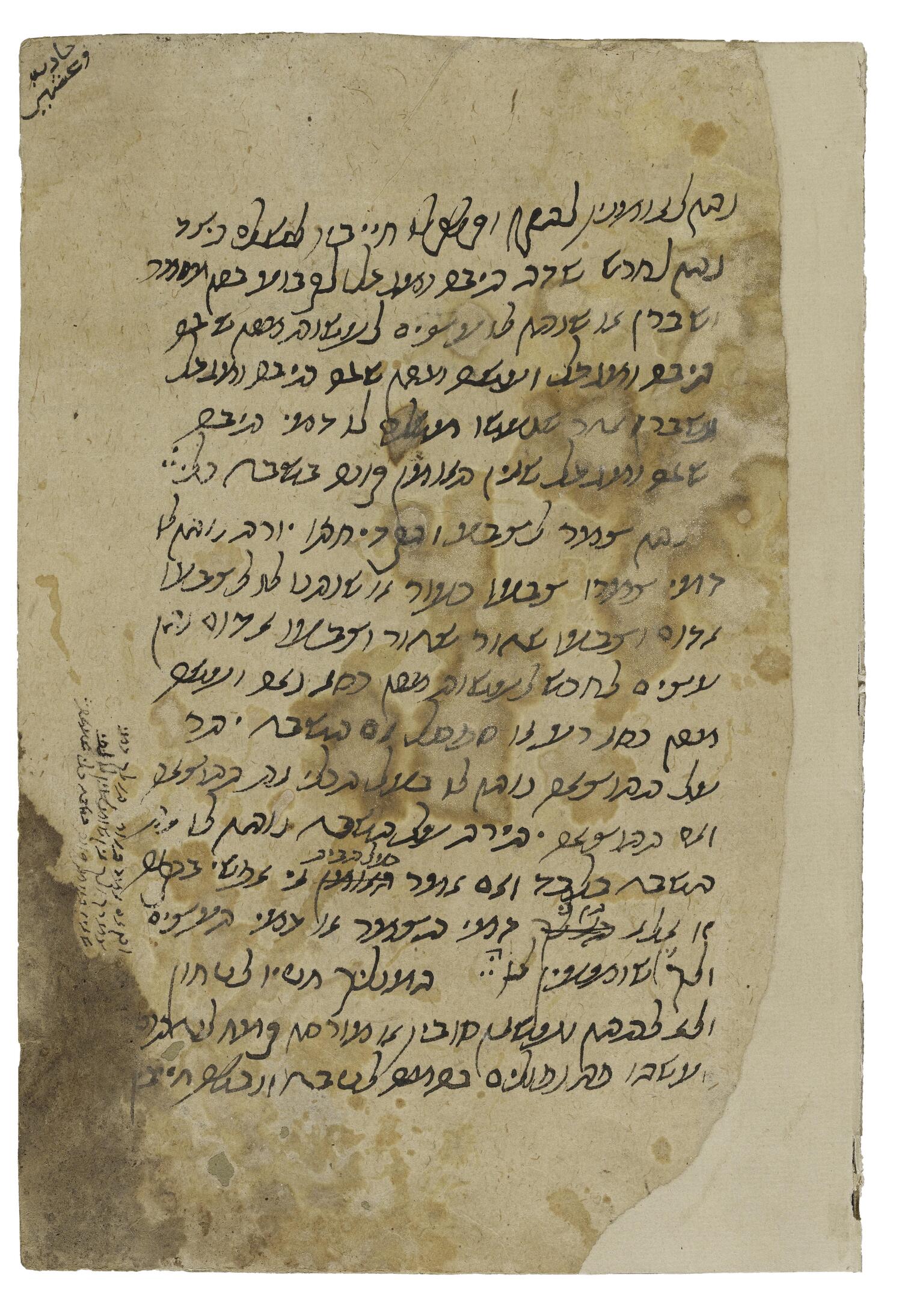
The Mishneh Torah (Repetition of the Law) is a monumental code summarizing the entirety of Jewish law. Written by Maimonides in elegant, concise Hebrew, it was organized according to topical categories, as opposed to the order of the appearance of the laws in the Talmud. These excerpts from the first book, The Book of Knowledge (Sefer ha-mada‘), typify the philosophical and ethical themes that are integrated into this complex work. The positions that Maimonides presents integrate both rabbinic and Aristotelian perspectives and reflect his efforts to integrate law and speculative reasoning. The first passages, drawn from the section titled “Laws Concerning the Basic Principles of the Torah,” summarize much of contemporary Arabic philosophical tradition, address biblical anthropomorphisms, and reflect Maimonides’ suggestions for love of the divine. The second passages, drawn from “Laws Relating to Moral Dispositions and to Ethical Conduct,” offer guidance for the cultivation of ethical conduct and medically appropriate behaviors.
Laws Concerning the Basic Principles of the Torah
Chapter 1
The basic principle of all basic principles and the pillar of all sciences is to realize that there is a First Being who brought every existing thing into being. All existing things, whether celestial, terrestrial, or belonging to an intermediate class, exist only through His true existence. If it could be supposed that He did not exist, it would follow that nothing else could possibly exist. If, however, it were supposed that all other beings were nonexistent, He alone would still exist. Their nonexistence would not involve His nonexistence. For all beings are in need of Him; but He, blessed be He, is not in need of them nor of any of them. Hence, His real essence is unlike that of any of them. [ . . . ]
And He it is, who controls the sphere [of the universe] with a power that is without end or limit; with a power that is never intermitted. For the sphere is always revolving; and it is impossible for it to revolve without someone making it revolve. God, blessed be He, it is, who, without hand or body, causes it to revolve. To acknowledge this truth is an affirmative precept, as it is said: I am the Lord, your God (Exodus 20:2; Deuteronomy 5:6). [ . . . ]
This God is One. He is not two nor more than two, but One; so that none of the things existing in the universe to which the term one is applied is like unto His unity; neither such a unit as a species which comprises many units [e.g., sub-species], nor such a unit as a physical body which consists of parts and dimensions. His unity is such that there is no other unity like it in the world. [ . . . ]
Since this is so, what is the meaning of the following expressions found in the Torah: beneath his feet (Exodus 24:10); written with the finger of God (Exodus 31:18); the hand of God (Exodus 9:3); the eyes of God (Genesis 38:7); the ears of God (Numbers 11:1); and similar phrases? All these expressions are adapted to the mental capacity of the majority of mankind who have a clear perception of physical bodies only. The Torah speaks in the language of men. All these phrases are metaphorical [ . . . ].
What was it that Moses sought to comprehend, when he said: Show me, I beseech thee, Your glory (Exodus 33:18)? He sought to have so clear an apprehension of the truth of God’s existence that the knowledge might be like that which one possesses of a human being, whose face one has seen and whose image is imprinted on the mind and whom, therefore, the mind distinguishes from other men. In the same way, Moses, our teacher, asked that the truth of God’s existence might be distinguished in his mind from other beings, and that he might thus know the truth of God’s existence, as it really is. God replied that it is beyond the mental capacity of a human creature, composed of body and soul, to obtain in this regard clear knowledge of the truth. The Almighty, however, imparted to Moses what has been vouchsafed to no man before or since. Moses attained so much knowledge of the truth of the divine existence, that God was, in his mind, distinct from other beings, in the same way as an individual, whose back is seen, whose physical form and apparel are perceived, is distinguished in the observer’s mind from the physical form of other individuals. [ . . . ]
Chapter 2
This God, honored and revered, it is our duty to love and fear; as it is said: You shall love the Lord, your God (Deuteronomy 6:5), and it is further said: You shall fear the Lord, your God (Deuteronomy 6:13).
And what is the way that will lead to the love of Him and the fear of Him? When a person contemplates His great and wondrous works and creatures and from them obtains a glimpse of His wisdom which is incomparable and infinite, he will straightway love Him, praise Him, glorify Him, and long with an exceeding longing to know His great Name. [ . . . ]

Laws Relating to Moral Dispositions and to Ethical Conduct
Chapter 1
Every human being is characterized by numerous moral dispositions which differ from each other and are exceedingly divergent. One man is choleric, always irascible; another sedate, never angry; or, if he should become angry, is only slightly and very rarely so. One man is haughty to excess; another humble in the extreme. One is a sensualist whose lusts are never sufficiently gratified; another is so pure in soul that he does not even long for the few things that our physical nature needs. [ . . . ]
To cultivate either extreme in any class of dispositions is not the right course nor is it proper for any person to follow or learn it. If a man finds that his nature tends or is disposed to one of these extremes, or if one has acquired and become habituated to it, he should turn back and improve, so as to walk in the way of good people, which is the right way.
The right way is the mean in each group of dispositions common to humanity, namely, that disposition which is equally distant from the two extremes in its class, not being nearer to the one than to the other. Hence, our ancient sages exhorted us that a person should always evaluate his dispositions and so adjust them that they shall be at the mean between the extremes, and this will secure his physical health. Thus a man should not be choleric, easily moved to anger, nor be like the dead without feeling; but should aim at the happy medium; be angry only for a grave cause that rightly calls for indignation, so that the like shall not be done again. [ . . . ]
Chapter 2
To those who are sick in body, the bitter tastes as if it were sweet, and the sweet as if it were bitter. Among sick folk, some long and yearn for things unfit for food, such as earth and charcoal, and have an aversion to wholesome foods, like bread and meat—the perversity depending on the severity of the illness. Similarly, human beings whose souls are sick love evil dispositions and hate the way that is good and are too indolent to walk therein, and find it exceedingly irksome because of their sickness. [ . . . ]
There are some dispositions in regard to which it is forbidden merely to keep to the middle path. They must be shunned to the extreme. Such a disposition is pride. The right way in this regard is not to be merely meek, but to be humble-minded and lowly of spirit to the utmost. [ . . . ] Anger too, is an exceedingly bad passion, and one should avoid it to the last extreme. One should train oneself not to be angry even for something that would justify anger. If one wishes to arouse fear in his children and household, or in the members of a community of which he is the head, and desires to exhibit anger, so that they may amend their ways, he should make a show of anger before them, so as to correct them, but in reality, his mind should be composed like that of a man who simulates anger and does not really feel it. [ . . . ]
Chapter 3
[ . . . ] He who regulates his life in accordance with the laws of hygiene, with the sole motive of maintaining a sound and vigorous physique and begetting children to do his work and labor for his benefit, is not following the right course. A man should aim to maintain physical health and vigor, in order that his soul may be upright, in a condition to know God. For it is impossible for one to understand sciences and meditate upon them, when he is hungry or sick, or when any of his limbs is aching. [ . . . ]
Chapter 4
Since, by keeping the body in health and vigor, one walks in the ways of God—it being impossible during sickness to have any understanding or knowledge of the Creator—it is a man’s duty to avoid whatever is injurious to the body and cultivate habits conducive to health and vigor. These are as follows: One should not take food except when one is hungry, nor drink unless one is thirsty. One should not neglect the calls of nature for a single moment but respond to them immediately.
Food should not be taken to repletion; during a meal, about one-third less should be eaten than the quantity that would give a feeling of satiety, and only a little water should be drunk—and that mixed with wine. After the process of digestion has commenced, water may be taken as needed. But even after food has been digested, it should not be drunk copiously. Before eating, careful attention should be paid to the functions of excretion. No meal should be taken without previously walking till the body begins to get warm, or engaging in manual labor, or tiring oneself with other activities. In short, strenuous exercise should be taken every day in the morning, till the body is in a glow. Then, there should be an interval of rest till one has recovered composure. The meal may then be taken. If the exercise is followed by a bath of warm water, so much the better. In this case too, there should be an interval for repose before the meal.
During a meal, one should sit or recline on the left side; but not walk, ride, take violent exercise, sway the body, or engage in sport, till the food is digested. Anyone who engages in sport or violent exercise immediately after a meal subjects himself to grave disorders.
The day and night consist of twenty-four hours. It is sufficient to sleep for a third of that period, namely eight hours. And these hours should be in the latter part of the night; that is to say, the period from retirement to dawn should be eight hours so that one will rise from his bed before dawn.
One should not sleep face downwards, nor on one’s back, but lying on the side; at the beginning, on the left side, and at the close of one’s rest, on the right side. One should not go to sleep immediately after a meal, but only when three or four hours have elapsed. One should not sleep during the day. [ . . . ]
Semen constitutes the strength of the body, its life and the light of the eyes. Its emission to excess causes physical decay, debility and diminished vitality. Thus, Solomon, in his wisdom, said: Give not your strength to women (Proverbs 31:3). Whosoever indulges in sexual dissipation becomes prematurely aged; his strength fails; his eyes become dim; a foul odor proceeds from his mouth and armpits; the hair of his head, eyebrows, and eyelashes drops out; the hair of his beard, armpits, and legs grows abnormally; his teeth fall out; and besides these, he becomes subject to numerous other diseases.
Notes
Words in brackets appear in the original translation.
Published in: The Posen Library of Jewish Culture and Civilization, vol. 3: Encountering Christianity and Islam.
You may also like

Medical Treatise
Commentary: On the Babylonian Talmud, Berakhot 10
Epistle on Hemorrhoids
Risāla fī ’l-bawāsīr, Introduction, Chapters 2, 6 (selections)


Book on Coitus
Kitāb fī l-jimā‘

The Cure of Souls: Curriculum of Study
Ṭibb al-nufūs
You may also like
Medical Treatise
Commentary: On the Babylonian Talmud, Berakhot 10
Epistle on Hemorrhoids
Risāla fī ’l-bawāsīr, Introduction, Chapters 2, 6 (selections)
Book on Coitus
Kitāb fī l-jimā‘
The Cure of Souls: Curriculum of Study
Ṭibb al-nufūs