

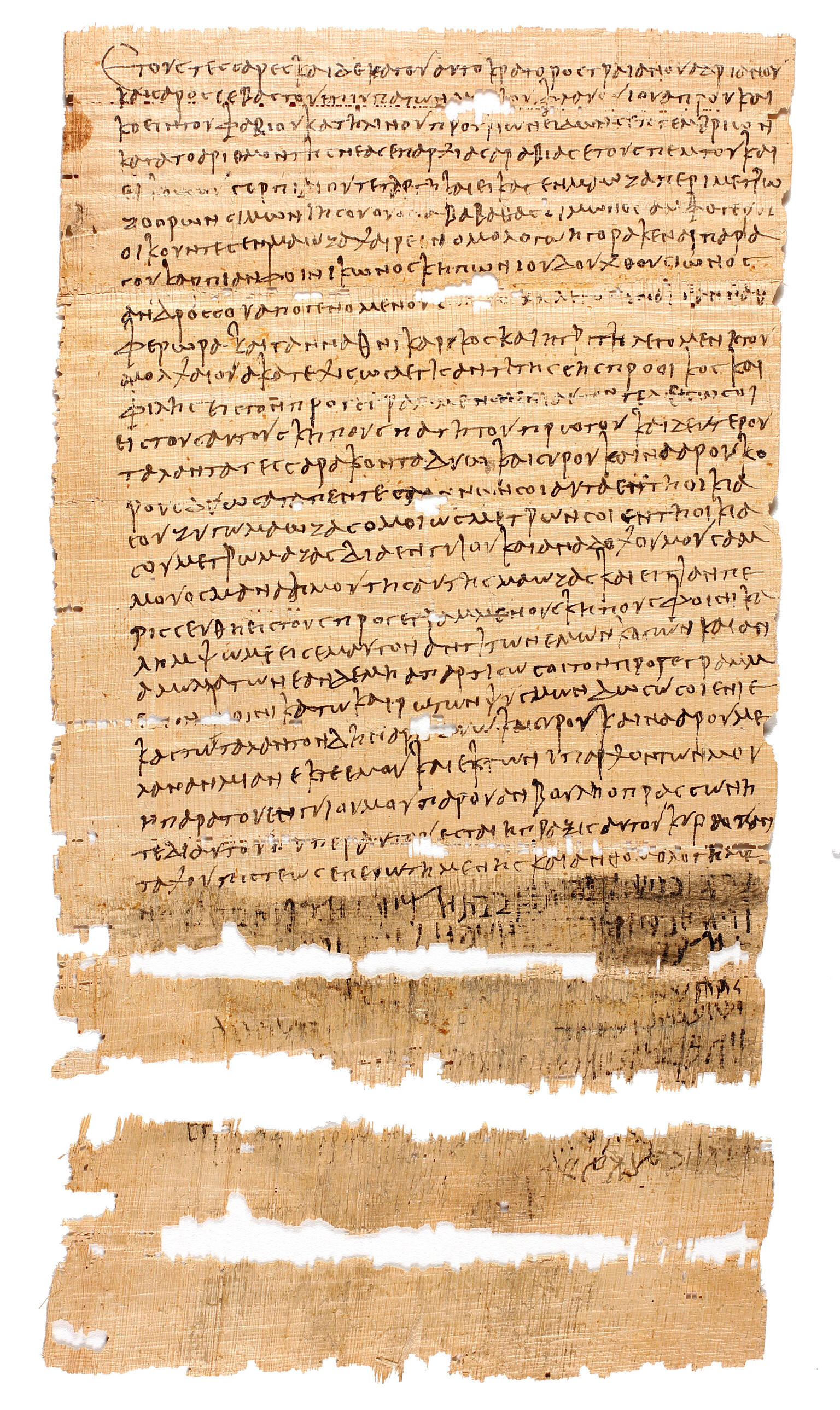
Date Orchard Contract
Image
Please login or register for free access to Posen Library
Already have an account?
Engage with this Source
This contract from the Babatha archive concerns crops from the three date-palm orchards of Babatha’s late husband, over which she assumed control after his death. It is written on papyrus in Greek and is signed in Aramaic.
Read more


Related Guide
Agriculture in the Economy of Ancient Judea
2nd Century BCE–7th Century CE

Related Guide
The Babatha Archive
94–132
The Babatha archive contains thirty-five papyri belonging to a wealthy Judean woman from the second century CE. Found in the Cave of Letters, these documents illustrate a woman's legal and economic autonomy in second-century Judea.
You may also like

Deed of Gift to Salome Komaïse
In the second consulship of Publius Iuventius Celsus and Lucius Neratius Marcellus, the ninth [ . . . ] year twenty-four, on the twentieth (twenty-third?) of Dios in…
Basalt Olive Press, Capernaum
This press consists of a basin and a large wheel that was rolled over the olives. Olive oil was used as food, as fuel for lamps, and in soapmaking, as well as in religious ceremonies. This type of…

Olive Screwpress, Katzrin
This type of press, which was first used in the first century CE, consists of a vertical screw in a wooden frame, a crushing stone, and a basin. The screw was turned with a short handle, which pushed…

Sickle Blade
This sickle blade was found in the Judean desert. Sickles were used for harvesting grain or for cutting forage, which was mainly used as feed for livestock, either freshly cut or dried.

Wine Floor Mosaic, Beth Shean
This floor mosaic from a synagogue in Beth Shean depicts men pressing grapes to make wine. Wine was drunk regularly, as it was safer than water. It was also used as a disinfectant for wounds, a dyeing…

Winepress Installation
This is one of several winepresses found at Shivta, in the Negev, indicating that grapes were one of the main crops in the area.