

Critical Notes
About This Entry
In this Hebrew work, Isaac al-Fāsī responds to a ruling by Isaac ben Baruch Ibn Albalia (al-Bālīya; d. 1094), an Andalusi talmudist, astronomer, astrologer, poet, and writer, who lived at various times in Córdoba, Lucena, Seville, and Granada. He is known for two books, both now lost: one on the calendar, and one, never finished, called The Spice-Peddler’s Basket (Kupat ha-rokhelim), which discussed difficult passages in the Talmud. Al-Fāsī arrived in Lucena in 1088, six years before Ibn Albalia’s death, and quickly began criticizing the halakhic basis of certain practices in his new home. These excerpted passages address the prohibition against setting sail within three days of the Sabbath, an almost unending area of disagreement among medieval halakhists. Ibn Albalia’s arguments do not survive, but he apparently limited this prohibition to ships that were of a fairly large size.
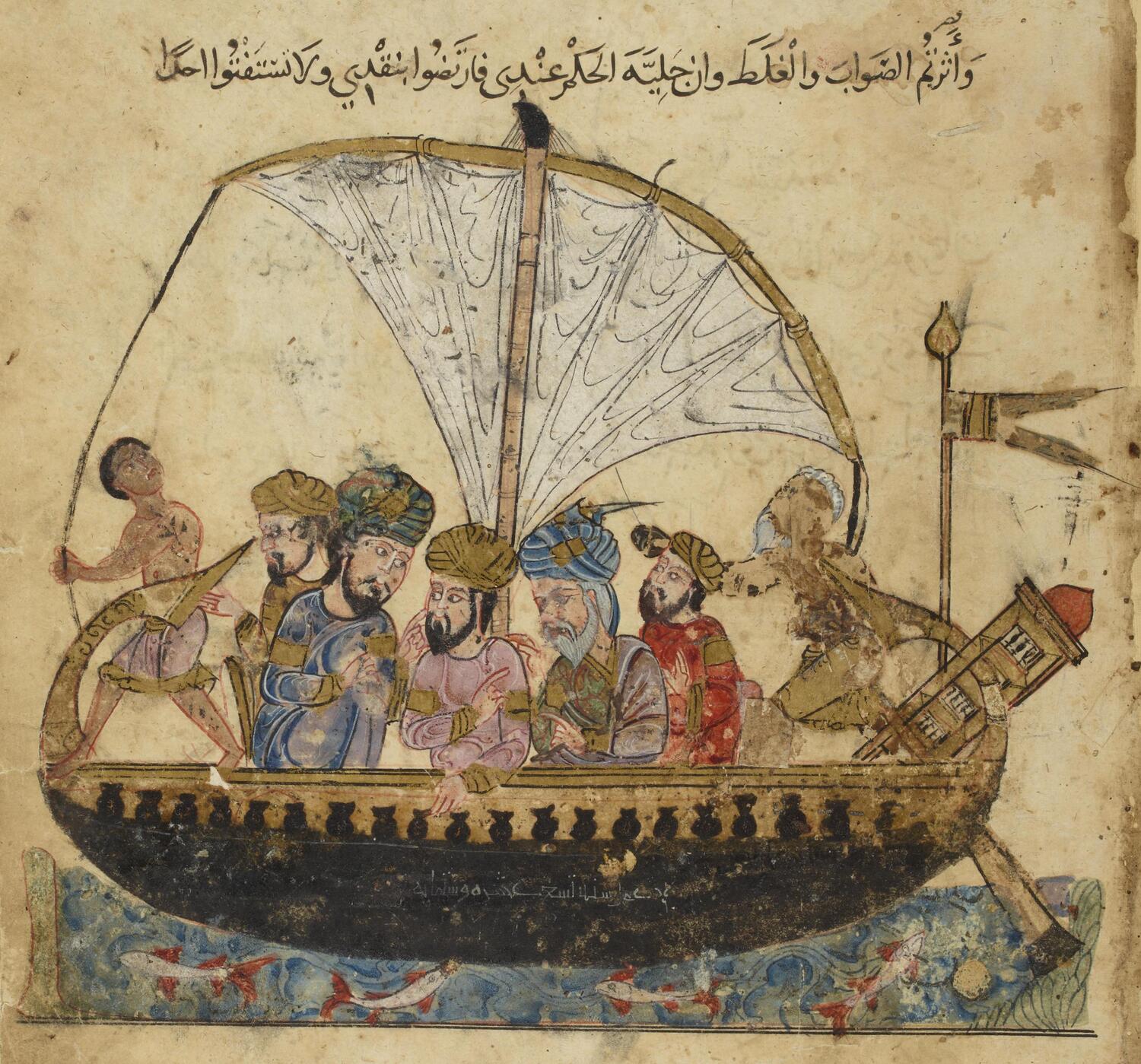

It states: One may not set sail on a ship less than three days before the Sabbath. [b. Shabbat 19a]
I saw one who said that this matter is specifically about a ship which draws more than ten [hand-breaths deep], and it is because of a decree against [violating] the boundaries [of the Sabbath]. In my opinion, this statement is unsound. If this were so, then they would have established it for [those] specific circumstances, but they did not refer to it except in general terms. Moreover, there are further reasons to reject this, but we do not need to recall them.
In my opinion, this matter is about the distress caused by spending the Sabbath in it [the boat] and seasickness preventing him from enjoying the Sabbath. Most people suffer seasickness for three days and after three days are accustomed to it and no longer feel it. This is also the reason for the statement:
One may not lay siege to cities of non-Jews less than three days before the Sabbath. [b. Shabbat 19a]
This is because the fear of death breaks after three days, while the Sabbath is a day of calm and joy. The sufferer questions if he is [really] suffering. [ . . . ]
After we have explained the stupidity, bragging, and need for harshness, I will return and show you the validity of our reasoning for the statements “One may not set sail on a ship less than three days before the Sabbath” and “One may not lay siege to cities of non-Jews less than three days before the Sabbath” [b. Shabbat 19a]. We establish that the reason for this is the abrogation of the commandment to “enjoy the Sabbath.” Proof of this is the statement [there]: In what case is this said? [If he is traveling in the ship] in a voluntary matter. However, for a matter of a commandment, it is permitted [b. Shabbat 19a]. Since “one who is engaged in a commandment is exempt from [performing] another commandment” [b. Sukkah 25a], he is therefore exempt from a commandment and is not required to “enjoy the Sabbath.”
Now if their decree [against getting on the ship] was not for this reason [i.e., making sure one would be able to enjoy the Sabbath], they would not have overturned it [in the case where the trip was for a commandment] because of “a commandment.” [ . . . ] This is confirmed by the statement:
A person should not walk on the eve of the Sabbath more than a distance of three parasangs. They say: We said [this] only [when he is returning] to his house [and needs to prepare his own food]. However, to an inn, he relies on [the food] he took. [b. Sukkah 44b]
Thus, they forbade walking on the Sabbath eve more than three parasangs, lest he should be delayed that day and not enjoy [what he prepared to eat] for the Sabbath. Perhaps this fool also laughs at this [reason], just as he laughed at that [reason].
Source: CUL T-S Ar.47.207 + T-S Ar.18(1).161.
Credits
Published in: The Posen Library of Jewish Culture and Civilization, vol. 3: Encountering Christianity and Islam.
You may also like

Book of the Laws: On the Babylonian Talmud, Tractate Berakhot
Sefer ha-halakhot, b. Berakhot 30b

Responsum: On a Book Thief

The Book of Contracts
Sefer ha-shetarot, 26
Commentary: On the Babylonian Talmud, Tractate Beẓah
Commentary on b. Beẓah 24b–25a

Commentary: On the Babylonian Talmud, Tractate Rosh Hashanah
Commentary on b. Rosh Hashanah 20b
Responsum on the Testimony of Forced Converts
You may also like
Book of the Laws: On the Babylonian Talmud, Tractate Berakhot
Sefer ha-halakhot, b. Berakhot 30b
Responsum: On a Book Thief
The Book of Contracts
Sefer ha-shetarot, 26
Commentary: On the Babylonian Talmud, Tractate Beẓah
Commentary on b. Beẓah 24b–25a
Commentary: On the Babylonian Talmud, Tractate Rosh Hashanah
Commentary on b. Rosh Hashanah 20b