

Letter to His Sister, Balluta
About This Entry
Simon of Toledo, now in Jerusalem, sent this letter to his sister Balluta, who was living somewhere in al-Andalus. This correspondence was accompanied by a lost second letter to an unnamed brother in Uclés, in the province of Cuenca. Simon relates his efforts on behalf of a poor couple who had been Rabbanites but converted to Karaism, and it turned out their marriage contravened Karaite laws regarding forbidden (consanguineous) marriages. Simon also writes of his concerns about a famine in Iberia, updating Balluta with the goings-on of other Iberian émigrés in Jerusalem. It is unclear how this document ended up in the Cairo Geniza, but it is possible that it never reached its intended recipient. The ellipsis indicates a lacuna in the manuscript.
In the name of the High and Exalted
I write to you, my beloved sister—may God prolong your life and give me cause to be thankful for you and reunite us in this holy [city] of Jerusalem through his mercy.
I wrote several letters to you previously, but I do not know if they arrived, for I realize that the West is in turbulence and am aware of what has been happening there. Your precious letter did arrive. It did me great honor, and I appreciated it very much. I was delighted to learn that God, the exalted, gave you and your sons and daughters well-being and health—may God always protect them—and may He accept my prayers at this noble place.
I have received about four letters from you since the time I left you. They are with me, folded up. I derive blessing from them. From our brother, however, I have not seen more than one letter since the day of his departure. And were it not for your telling in your letter that he is in Uclés [in al-Andalus], supervising a store, I would have remained worried about him. May God not let me hear anything unfavorable about any of you! I wrote a message to him in an enclosure within this letter to you. You may read it, God willing, and then you will know some of the ailments and adversities that I have endured. I also recounted the reason for my marriage, and that I, thank God, am pleased with my new relatives.
Our father, however, is in a state that we wish only upon our enemies. He is paralyzed, blind, demented, and in great torment. The deliverers of this letter will inform you about his condition and what I do for him. He lacks nothing and is treated with respect and looked after. I do not rely upon anyone else to take care of him. My bed adjoins his. I get up several times at night to cover him and turn him over, as he is incapable of doing anything by himself—may God, the exalted, increase his reward for his suffering.
I was very distressed to hear your report about the famine and plague taking place in Toledo. Alas, we have no recourse but submission to God. I was happy to hear that you are preparing the dowry for the [marriage of the] young girl Dona. May God, the exalted, assist you and increase your reward. You should be resigned to every tribulation that befalls you and thus be amply rewarded.
I was delighted to hear about the well-being of my master and friend Sulaymān, our sister’s son, about the children God has provided him, and about Khalaf and his livelihood and prosperity.
I have, as it were, forgotten your voices, and whenever I remember one of you, I sob profusely. I only wish that we could be united in this special place.
You wrote concerning the turban—may God increase your reward—you need not concern yourself with sending it, for it is hard for me to accept that what has remained behind should be sent away from the house.
[Our father] devoted himself to praying on the Mount of Olives and the Temple of the Lord as long as he was able—may God reward him for this. From my letter to our brother, you will learn details about his condition and my situation and status.
Our Andalusi friends are all fine. Mūsā al-Majrīṭī and his sister Pagana died, and there is no longer a vestige of the al-Majrīṭī family here. Abū Zikrī ben Hani and Joseph ben Ḥayim died. Bonil, the young son of Ben Dabuqa, went on a journey about four years ago, and there has been no word about whether he is dead or alive. Ibrahīm ibn Fadānj and Ibrahīm ibn al-Harūnī arrived in Jerusalem from Byzantine territory after tribulations that befell them, as you already know.
When ibn Fadānj arrived in Ramla with his wife and their children, poor and destitute, before they arrived in Jerusalem, the Toledan women decided to spread rumors about them among the Karaites, saying that his wife was legally prohibited to him, and I found out about it.
I went to [the women], and they made quite an uproar, and so I pronounced a ban on anyone who circulated gossip about them, knowing that he intended to go live with the Karaites. When they arrived in Jerusalem, they went to the Samartaka quarter [i.e., the Karaite quarter of Jerusalem] and stayed with [the Karaites]. [He and his wife] joined them and lived among them. [The Karaites] settled them in a house and treated them well. But after remaining with them for about two years, people informed on him to the Karaite elders. They claimed that he was living with his wife although she was forbidden to him according to their rite. They intended to have them separated. But when I discovered this, I argued with [the elders], and a dispute erupted between us on account of them. My answer to Jacob was that your wife is really forbidden to you according to your religion and rite, as two brothers married to two sisters, and this is forbidden to the Karaites. When he heard me say this, he left her and separated himself from her.
[Verso:] Then I presented myself to our lord, the head of the court, on account of this poor, destitute woman, and he sent word to the Karaites to announce that he may not divorce her save according to the rite by which he married her, and her marriage contract had been drawn up by the Rabbanites. If so, he should pay her dowry and only then divorce her. I continued to deal gently with her case until the Rabbanites accepted him. He went to settle among them with his wife and children, Abū Zikrī, Joseph, Mūsā, and Ḥalwa. They settled him among the Rabbanites and treated him well. He lacked nothing when he was with them, although they were reluctant to receive [the couple], as they had formerly been Rabbanites and thereafter went over to Karaism. They abided with them for two years.
When I saw what they wished to do to the poor woman—to separate her from her husband, with the result that the children would become orphans while [their parents were] alive—and considering that it was a time of adversity and famine, I acted on their behalf, may God reward me for it.
And now the aforementioned Ibrahīm is going out with his son to a village in Palestine near Jerusalem, where they have a store that will provide them a livelihood. They are well and protected, and no one will suspect, for they have directives forbidding [marriage to] two sisters after the death [of one of them]. And no one of the jurisprudents today can find a reason for this aside from [the Karaites’] claim that this is laid down as custom by ‘Anan their leader and the first of the Karaites, and they invent misleading things that are completely unfounded.
When they saw that ibn Fadānj left them and returned to the Rabbanites, like the one who said: I will go and return to my first husband, for then was it better with me than now (Hosea 2:9), they acquiesced and smoothed over the matter concerning Jacob, apprehending that he may not stay among them and remain with his wife. But they made him take an oath that he would abstain from her, which I did not command, nor did it dawn on me (Jeremiah 7:31).
I tell you all this, my sister, so that you inform her brother, my master Mūsā ben al-Falmiqī, about [the contents of] my letter. If I were not writing in a hurry, I would have written to him directly about this.
I send you, my sister, many greetings; convey [greetings] also to the entire family—your sons, daughters, sons-in-law; our maternal aunts, their sons and daughters; and the rest of the family, and Jacob and . . . Joseph ben Palkhon, the daughter of our paternal uncle and Salāma Yael.
[Margin:] And the sons of our maternal uncle and their sons and those I have mentioned and those I have not. I wrote this letter during the month of Marheshvan of the year [4]818. Peace and abundant salvation. Simeon ben R. Saul, may his end be prosperous.
Address
To be delivered to al-Andalus, to the town of Toledo, to Balluta daughter of Saul, son of Israel, from her father Saul and her brother Simeon, who live in the City of Peace [Jerusalem], may God rebuild it in our days.
Source: CUL T-S 13J9.4.
Translated by Renée Levine Melammed.
Published in: The Posen Library of Jewish Culture and Civilization, vol. 3: Encountering Christianity and Islam.
You may also like
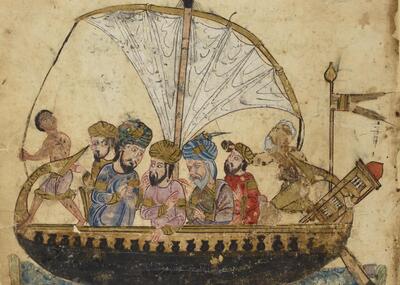

Migration and Mobility in the Early Medieval Period
Medieval societies can sometimes be seen as static and isolated. Yet medieval people of all sorts moved from one place to another, for a variety of reasons: for economic opportunity and trade, driven by wars and forced displacement, and more. Western Europe and the Mediterranean, the Middle East, and even the Far East were connected by the migration of people, merchandise, and ideas.

Letter to Nahray ben Nissim (II)
Letter to Nahray ben Nissim

Letter to Judah ben Moses ben Sughmar
Letter to Nahray ben Nissim (I)
Letter to a Relative
You may also like
Migration and Mobility in the Early Medieval Period
Medieval societies can sometimes be seen as static and isolated. Yet medieval people of all sorts moved from one place to another, for a variety of reasons: for economic opportunity and trade, driven by wars and forced displacement, and more. Western Europe and the Mediterranean, the Middle East, and even the Far East were connected by the migration of people, merchandise, and ideas.
Letter to Nahray ben Nissim (II)
Letter to Nahray ben Nissim