

Jonah
About This Entry
The book of Jonah is found among the Twelve Prophets, but unlike the other classical prophetic books, which are largely prophetic speeches, it contains only a few words spoken by the prophet. It is, rather, a story about a prophet named Jonah, son of Amittai (also mentioned in 2 Kings 14:25), who reluctantly accepts a mission to go to Nineveh to warn about the city’s impending destruction. The Ninevites (unlike the Israelites and the Judahites elsewhere in the Bible) heed the warning and repent, and are thereby spared destruction, much to the consternation of the prophet.
The fictional nature of the book is evident. Jonah is not set in any historical context; he is not connected with any king of Israel or Judah. Prophets do not regularly go on foreign missions. The foreigners are Ninevites and are never called Assyrians; they do not resemble the historical Assyrians. Most incredible is that Jonah spends three days inside a large fish. The message of the book has been debated, and perhaps all the possibilities are right. The book instructs us about the role of the prophet (not to predict the future, but to bring about repentance), the power of repentance, and God’s concern for foreign nations, not only for Israel.
See also Jonah’s Prayer from Within the Fish.
Chapter 1
1The word of the Lord came to Jonah son of Amittai: 2Go at once to Nineveh, that great city, and proclaim judgment upon it; for their wickedness has come before Me.
3Jonah, however, started out to flee to Tarshish from the Lord’s service. He went down to Joppa and found a ship going to Tarshish. He paid the fare and went aboard to sail with the others to Tarshish, away from the service of the Lord.
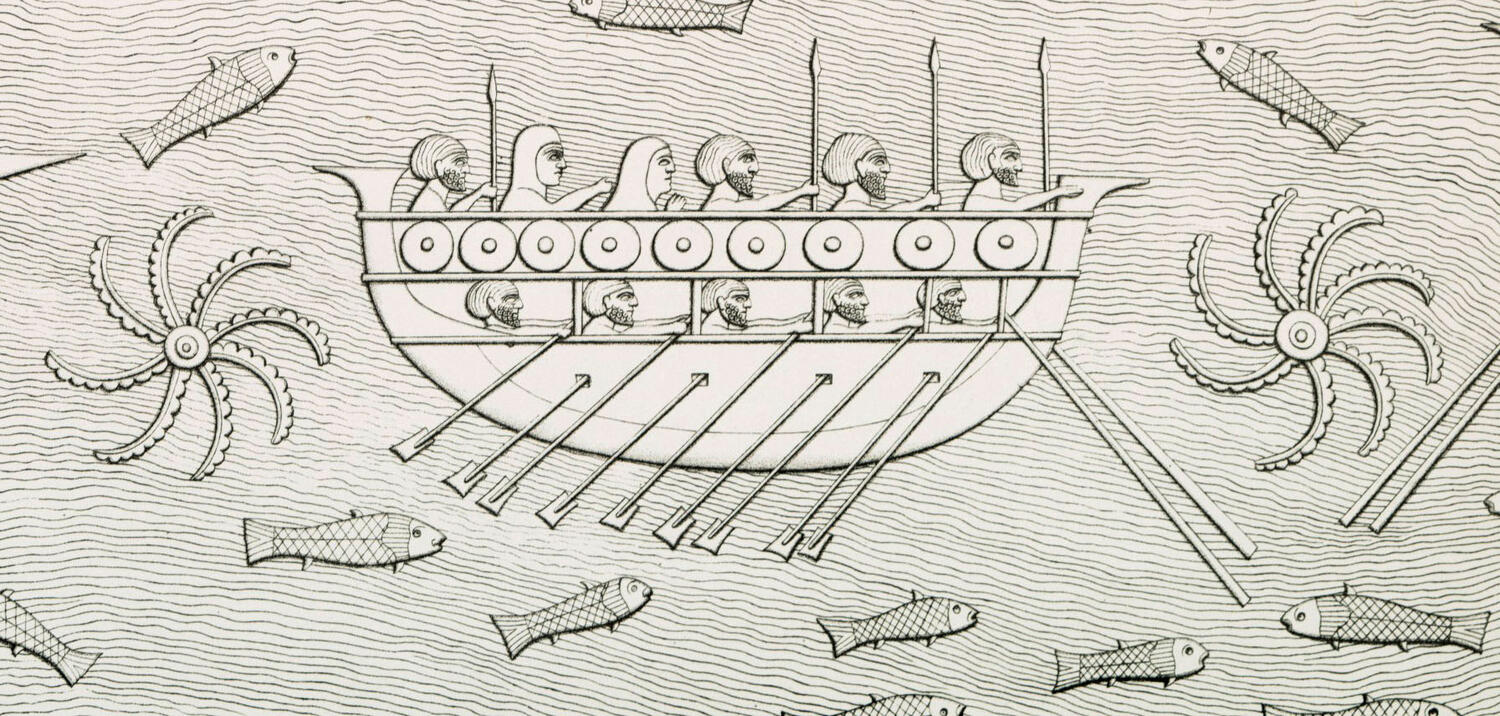
4But the Lord cast a mighty wind upon the sea, and such a great tempest came upon the sea that the ship was in danger of breaking up. 5In their fright, the sailors cried out, each to his own god; and they flung the ship’s cargo overboard to make it lighter for them. Jonah, meanwhile, had gone down into the hold of the vessel where he lay down and fell asleep. 6The captain went over to him and cried out, “How can you be sleeping so soundly! Up, call upon your god! Perhaps the god will be kind to us and we will not perish.”
7The men said to one another, “Let us cast lots and find out on whose account this misfortune has come upon us.” They cast lots and the lot fell on Jonah. 8They said to him, “Tell us, you who have brought this misfortune upon us, what is your business? Where have you come from? What is your country, and of what people are you?” 9“I am a Hebrew,” he replied. “I worship the Lord, the God of Heaven, who made both sea and land.” 10The men were greatly terrified, and they asked him, “What have you done?” And when the men learned that he was fleeing from the service of the Lord—for so he told them—11they said to him, “What must we do to you to make the sea calm around us?” For the sea was growing more and more stormy. 12He answered, “Heave me overboard, and the sea will calm down for you; for I know that this terrible storm came upon you on my account.” 13Nevertheless, the men rowed hard to regain the shore, but they could not, for the sea was growing more and more stormy about them. 14Then they cried out to the Lord: “Oh, please, Lord, do not let us perish on account of this man’s life. Do not hold us guilty of killing an innocent person! For You, O Lord, by Your will, have brought this about.” 15And they heaved Jonah overboard, and the sea stopped raging.
16The men feared the Lord greatly; they offered a sacrifice to the Lord and they made vows.
Chapter 2
1The Lord provided a huge fish to swallow Jonah; and Jonah remained in the fish’s belly three days and three nights. 2Jonah prayed to the Lord his God from the belly of the fish. [ . . . ]
11The Lord commanded the fish, and it spewed Jonah out upon dry land.
Chapter 3
1The word of the Lord came to Jonah a second time: 2“Go at once to Nineveh, that great city, and proclaim to it what I tell you.” 3Jonah went at once to Nineveh in accordance with the Lord’s command.
Nineveh was an enormously large city a three days’ walk across. 4Jonah started out and made his way into the city the distance of one day’s walk, and proclaimed: “Forty days more, and Nineveh shall be overthrown!”
5The people of Nineveh believed God. They proclaimed a fast, and great and small alike put on sackcloth. 6When the news reached the king of Nineveh, he rose from his throne, took off his robe, put on sackcloth, and sat in ashes. 7And he had the word cried through Nineveh: “By decree of the king and his nobles: No man or beast—of flock or herd—shall taste anything! They shall not graze, and they shall not drink water! 8They shall be covered with sackcloth—man and beast—and shall cry mightily to God. Let everyone turn back from his evil ways and from the injustice of which he is guilty. 9Who knows but that God may turn and relent? He may turn back from His wrath, so that we do not perish.”
10God saw what they did, how they were turning back from their evil ways. And God renounced the punishment He had planned to bring upon them, and did not carry it out.
Chapter 4
1This displeased Jonah greatly, and he was grieved. 2He prayed to the Lord, saying, “O Lord! Isn’t this just what I said when I was still in my own country? That is why I fled beforehand to Tarshish. For I know that You are a compassionate and gracious God, slow to anger, abounding in kindness, renouncing punishment. 3Please, Lord, take my life, for I would rather die than live.” 4The Lord replied, “Are you that deeply grieved?”
5Now Jonah had left the city and found a place east of the city. He made a booth there and sat under it in the shade, until he should see what happened to the city. 6The Lord God provided a ricinus plant, which grew up over Jonah, to provide shade for his head and save him from discomfort. Jonah was very happy about the plant. 7But the next day at dawn God provided a worm, which attacked the plant so that it withered. 8And when the sun rose, God provided a sultry east wind; the sun beat down on Jonah’s head, and he became faint. He begged for death, saying, “I would rather die than live.” 9Then God said to Jonah, “Are you so deeply grieved about the plant?” “Yes,” he replied, “so deeply that I want to die.”
10Then the Lord said: “You cared about the plant, which you did not work for and which you did not grow, which appeared overnight and perished over-night. 11And should not I care about Nineveh, that great city, in which there are more than a hundred and twenty thousand persons who do not yet know their right hand from their left, and many beasts as well!”
Credits
Reprinted from Tanakh: The Holy Scriptures by permission of the University of Nebraska Press. Copyright 1985 by the Jewish Publication Society, Philadelphia.
Published in: The Posen Library of Jewish Culture and Civilization, vol. 1.
You may also like


Phoenician Ship

Harvesting and Threshing in Egyptian Painting, from the Tomb of Pa-heri (New Kingdom)

Behistun Trilingual Inscription and Aramaic Papyrus

Lot (puru), Assyria
You may also like
Phoenician Ship
Harvesting and Threshing in Egyptian Painting, from the Tomb of Pa-heri (New Kingdom)
Behistun Trilingual Inscription and Aramaic Papyrus