

Letter to Nissim of Cairo
About This Entry
Menaḥem ben Elijah sent this Hebrew letter from the Greek port city of Salonika to a certain Nissim, likely living in Cairo, at the beginning of the First Crusade. As the Crusaders arrived in his Byzantine community, Menaḥem wrote, a feeling that the end times had come was supported by stories of miracles in nearby Jewish communities. The letter testifies to important aspects of the complicated relationship between medieval Jews and Christians. Even at the height of communal tension and anti-Jewish violence, many religious principles and sensibilities were shared among members of both communities.
May God [return] to Zion, as spoken by the Lord: There are many who say: let her be defiled, and let our eye gaze upon Zion. But they know not the thoughts of the Lord, etc. (Micah 4:11–12). The threshing floor is not yet full, but know, our brethren, you blessed ones of the Lord, that in this year the word of our God was fulfilled. For a countless multitude of Ashkenazim [Germans] came, thousands upon thousands, with their wives and children and all their wealth. Our God gathered them together to the threshing floor. Both non-Jews and Jews inquired of them, saying: “Why did you leave your houses and your places and venture abroad?” The important and great ones among them answered as follows: “The black mountains are close to us, but now they have been revealed in a great light. We saw a nation and innumerable tents, whose language we do not understand. One man emerged from among them and declared to us: go along your way, and thus we have come . . . and for this we are being pursued, while we claim: God has undoubtedly fulfilled His word and has said to those who are in darkness: Show yourselves [see Isaiah 49:9]—these are the other tribes. When the Germans all go to the land of Israel and the threshing floor is full, then our God will proclaim: Arise and thresh, O daughter of Zion, etc. (Micah 4:13).”
All of the communities were shocked and returned to God through fasting and charity, including from the land of the Khazars. And they went, when seventeen communities said, “We shall go to the wilderness of the peoples [see Ezekiel 20:35].” But we do not know whether or not they encountered the tribes. Also, from the land of France they sent an emissary with letters to Constantinople, but what was written in them about you has not yet been clarified. Furthermore, in Constantinople, in the city of Abidun [Abydos], near Constantinople, small communities have arisen, in accordance with the words of Daniel, the greatly beloved man [see e.g., Daniel 10:11]: the children of the violent among your people will be confounded. Here Elijah was revealed to us, as it is written: And the children of the violent among your people shall lift [themselves up to establish the vision, but they shall stumble] (Daniel 11:14). We did not accept them, neither us nor the community of Constantinople, but instead we ostracized them and banned them.
However, we will relate before your honors what occurred in the holy congregation of Salonika. For Jewish and uncircumcised [i.e., Christian] foreigners, as well as officials, came and told us that the prophet Elijah revealed himself openly, not in a dream, to men of distinguished lineage. They also saw many signs and wonders there, which were recounted by both the uncircumcised and the Jews. And he revealed himself to R. Eliezer ben R. Judah ben R. Eliezer ha-gadol, and when the foreigners suggested it, a bed was given to him. In any case, the wonders that happened in Salonika were made clear through the innocent testimony of the uncircumcised, and the Jews paused from all their work. Furthermore, R. Tobiah sent one student with an open letter to Constantinople, informing them of these tidings. A Jew was there from our region who had the air of Torah around him, and he saw the letter that was sent by R. Tobiah, in which it was written: “Signs and wonders occurred in our place, and Elijah also revealed himself to us.” This was attested by that Jew . . . whose name was Michael the German, that he himself saw in R. Tobiah’s letter regarding a certain Michael, son of R. Aaron, a colleague in Salonika, that he was blind in both eyes, and he regained his sight and saw with his own eyes, and R. Nissim is also acquainted with him. But this Michael made the mistake of not making a copy of the letter, for had he done so we would have sent it to you, so that you would believe the matter. In addition, it was clearly established to us that the head of the academy, R. Evyatar ha-Kohen, sent an explicit letter from Tripoli to the community of Constantinople, and four men there saw the letter in the possession of the uncircumcised Lugas. Yet it did not occur to them to send us a copy either, for they are ignoramuses.
At this stage we are hoping to receive letters from R. Tobiah and from the holy congregations, for we are astonished by the great miracle that unfolded in Salonika. For the uncircumcised [there] hate the Jews to an unfathomable degree, as R. Nissim knows regarding them. Had there not been a miracle and a great wonder, whose reports reached the king himself, none of those beloved by God [i.e., the Jews] would have escaped or remained [see Jeremiah 44:14], yet now they are dwelling in great security, without a poll tax or any penalty. They are sitting in their prayer shawls and not working. We do not know what they hope will happen, but we are scared that this might be publicized among the nations and that they will kill us. For the moment, however, the rulers themselves and the head official are all saying, “O Jews, why do you remain in Salonika? Sell your homes and your property. The Caesar is offering you assistance, and no man may touch you, and yet you still are not leaving. For we have clearly learned that your Messiah has emerged.” Praised be the Lord, we are not afraid, and also, praised be the Lord, we have returned to God in repentance, through fasting and charity. Many fast every day, while others do so on Mondays and Thursdays. They also receive lashes and confess their sins. Before we heard the tidings from Salonika, both the Jews and the uncircumcised saw things in dreams, but since we knew nothing about Salonika we did not believe what they said, and instead we rebuked them. At one point a certain Jew, a priest, saw in his dream (before we had heard about this) that all the communities of Romania will gather together in Salonika, and from there they will venture forth. But we rebuked him, saying that they [i.e., the communities of Romania] hate God, so how could this happen? Finally, Tobiah of Thebes came with a letter relaying the signs and wonders in Salonika, and showing that other communities were gathering there. Behold, Tobiah will go there and relate to you everything that he heard and saw, and that the dream seen by the Jew, the priest, has come to pass.
Now, our brethren, if God will be good to you, if you have heard reports and new tidings (for we know what our master, the head of the academy, has heard and knows, and you, too, have heard and know it), and if you wish to perform a kindness with us, write to us that which you know and have heard. Do not be frightened at all, for even the king has heard it, and we are not afraid. If a letter arrives from your honors, all our communities will be encouraged to repent. May God repay you with a good reward, and may you merit to behold the graciousness of the Lord and to visit His sanctuary (Psalms 27:4). I, Menaḥem, wanted to go there this year, but I saw that many German soldiers were passing through, and I do not know where they will raid next. May the Lord protect you and us. Amen.
This letter came from the possession of the principal master, our teacher, R. Nissim.
(This is the letter sent by our master R. Menaḥem ben Elijah.)
Source: Oxford Bodleian Library MS Heb.3 94a–b.
Published in: The Posen Library of Jewish Culture and Civilization, vol. 3: Encountering Christianity and Islam.
You may also like
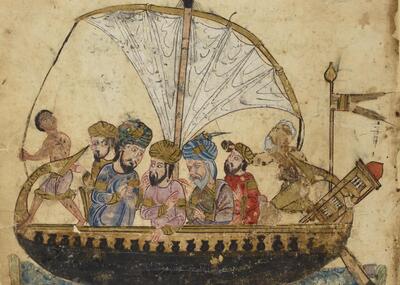

Migration and Mobility in the Early Medieval Period
Medieval societies can sometimes be seen as static and isolated. Yet medieval people of all sorts moved from one place to another, for a variety of reasons: for economic opportunity and trade, driven by wars and forced displacement, and more. Western Europe and the Mediterranean, the Middle East, and even the Far East were connected by the migration of people, merchandise, and ideas.

Letter to Aaron ha-Ḥazan ben Ephraim
Petition on Behalf of a Widowed Proselyte
Letter of Recommendation to Eli ben Ḥayim ha-Kohen (II)

Letter to Her Brother

Letter to a Student’s Father (I)
You may also like
Migration and Mobility in the Early Medieval Period
Medieval societies can sometimes be seen as static and isolated. Yet medieval people of all sorts moved from one place to another, for a variety of reasons: for economic opportunity and trade, driven by wars and forced displacement, and more. Western Europe and the Mediterranean, the Middle East, and even the Far East were connected by the migration of people, merchandise, and ideas.
Letter to Aaron ha-Ḥazan ben Ephraim
Petition on Behalf of a Widowed Proselyte
Letter of Recommendation to Eli ben Ḥayim ha-Kohen (II)
Letter to Her Brother