

Petition to Saladin with a Reply
About This Entry
This text comprises two parts, a petition and the answer on the verso of the page. ‘Abd al-Bāqī ibn Yaḥyā petitions Saladin, the Ayyūbid ruler, to remove him from service as a tax collector. Nasih al-Din Ishaq might have been an administrator, to whom the petition was sent directly. However, the response relates that due to ‘Abd’s previous experience in this manner of work, he was required to perform this duty. This page was later reused for a text on the subject of the Jewish calendar, with some notes appearing in Ladino in the margins.
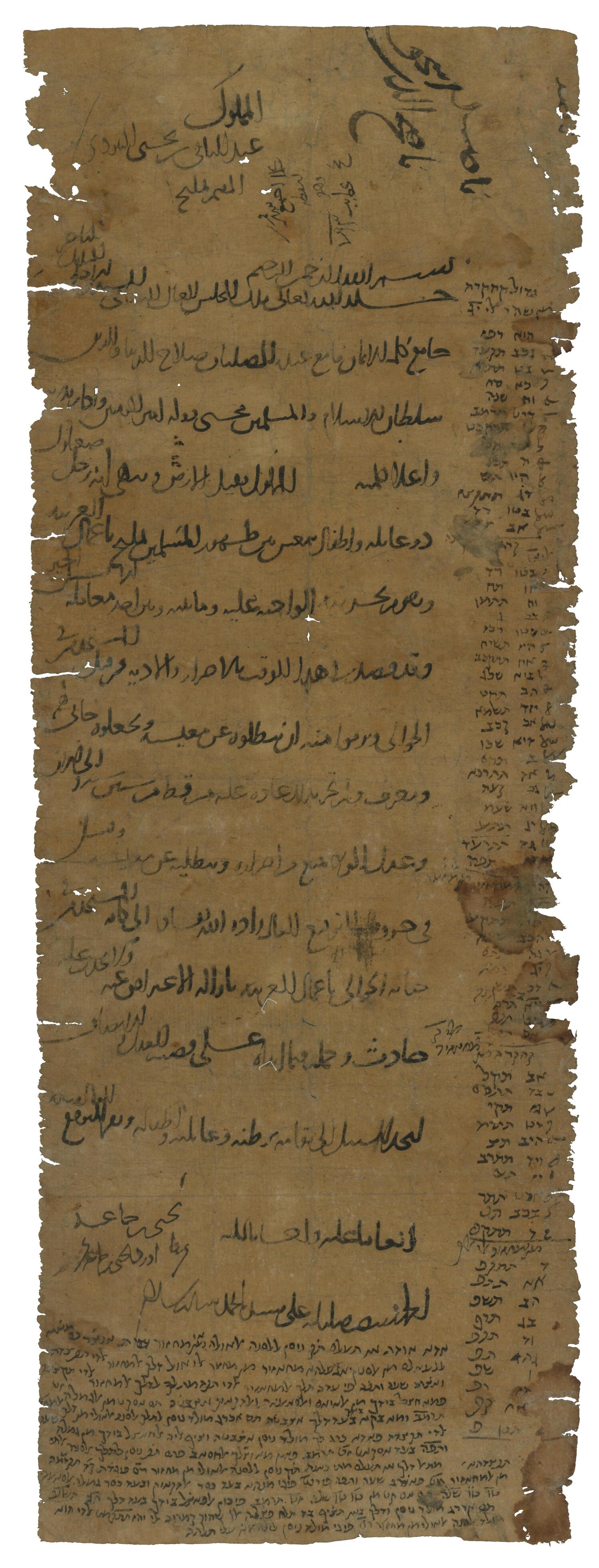

Nasih al-Din Ishaq. The slave ‘Abd al-Bāqī ibn Yaḥyā, the Jew, who resides in Malīj. In the name of God, the merciful and compassionate. May God, the exalted, make eternal the rule of the exalted and lofty seat, the mighty lord, al-Malik al-Nasir, the uniter of the word of the faith, the conqueror of the slaves of the cross, Salah al-Dunya wa-l-Din, sultan of Islam and the Muslims, reviver of the dynasty of the commander of the faithful, cause his power to endure and exalt his word. The slave kisses the ground and reports that he is a poor man with a family and children, who makes his living among Muslims in Malīj in the province of al-Garbiyya.
He pays the poll tax for which he is liable and there is no one with whom he has bad relations. Recently he has been hurt and made to suffer by the poll-tax officials. They have summarily made him give up his employment and forced him to work as a tax collector and an informant. There has been no precedent for this for 60 years. The justice of the master should prevent his being caused damage and his being made to give up his livelihood. He asks for the issuing of an exalted rescript,1 may God increase its efficacy, to all the officials concerned with the collection of the poll tax in the province of al-Garbiyya to release him so that nothing will befall him and to treat his case with justice and impartiality, that he may be able to live in his native town with his family and children. Let the exalted rescript be deposited in his hand, as a kindness and benefaction to him. Praise be to God alone and his blessings be upon our lord Muhammad, his prophet, and save him.
Answer [in Arabic characters]
If there has been a precedent for you to work as a tax collector, you have no excuse with regard to the service of the aforementioned people.
Notes
[An edict.—Ed.]
Credits
‘Abd al-Bāqī ibn Yaḥyā, “Petition to Saladin” and “Saladin’s Reply,” trans. Geoffrey Khan, from Benjamin M. Outhwaite, Melonie Schmierer-Lee, and Cayley M. Burgess, Discarded History: The Genizah of Medieval Cairo (Cambridge: Cambridge University Library, 2017), 9. Translation originally published in Arabic Legal and Administrative Documents in the Cambridge Genizah Collections, ed. and trans. Geoffrey Khan, Cambridge University Library Genizah Series (Cambridge: University of Cambridge Press, 1993), 362–63. Used with permission of the translator. Photo: CUL T-S K2.96, fol. 1v. Reproduced by kind permission of the Syndics of Cambridge University Library.
Published in: The Posen Library of Jewish Culture and Civilization, vol. 3: Encountering Christianity and Islam.
You may also like

Betrothal Contract (Fustāt, Egypt)
Legal Document Circumventing Interest
Will (Fustāt, Egypt)
Betrothal Contract (Fustāt, Egypt)
Land Grant (Lincolnshire, England)

Quitclaim for Rent (Lincolnshire, England)
You may also like
Betrothal Contract (Fustāt, Egypt)
Legal Document Circumventing Interest
Will (Fustāt, Egypt)
Betrothal Contract (Fustāt, Egypt)
Land Grant (Lincolnshire, England)